
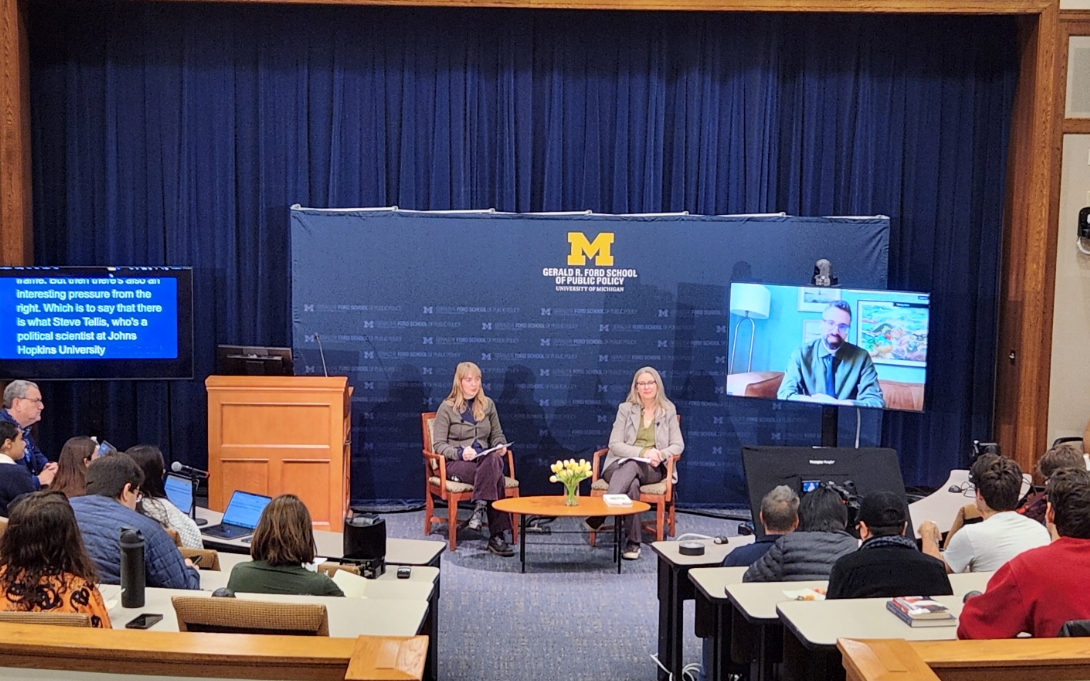
The Ford School launched its first-ever school-wide read with Abundance last summer. Through our public events series, policy experts have helped our community grapple with the ideas put forward in the book. Last week, the Ford School welcomed one of the book’s authors, Ezra Klein, to join political scientist Jenna Bednar for a conversation on the Abundance Movement.
To Klein, abundance is a frame of mind that informs how we make policies. He began by observing that policymakers and citizens on every part of the political spectrum are wanting, and needing, more. More housing, more energy, more infrastructure. More deregulation. More possibilities.

“The fundamental question of the book, the fundamental question of abundance, is not just how do you make more. … The question is what you are creating, what kind of world you want to live in. Once you have answered that—an abundance of what?—then you can begin working backwards to the policies and bottlenecks and politics that will get you there,” said Klein. He noted that these ideas are especially taking hold in liberal circles, as the Democratic Party is struggling to find an identity to rally around. Meanwhile, under Donald Trump, the Republican Party has shown the power of a simple and clear vision.
Klein continued to say that party politics are splitting into two directions: “the character of the Republican Party is now autocratic, and the character of the Democratic Party is now bureaucratic, Republicans are too anti-institutional and Democrats are too institutional.” As a result of this split, process has become a barrier to progress.
He described how layers of regulation and bureaucracy, which civic technologist Jen Pahlka calls “sediments,” have slowed the government’s ability to act. He argued that process is now an end rather than a means for policymaking. Using examples like the Inflation Reduction Act and infrastructure projects, he demonstrated how even lavishly funded policies get caught in procedural sludge. He hopes the ideas of his book will convince policymakers to reform government systems so they can build “fast and fair.”
Klein reiterated that abundance without vision can not be a uniting force in American politics. While everyone is interested in having more, it still always comes back to “more of what?” He continued to lean into the possibilities abundance could hold for the Democratic Party, saying, “Abundance, to me, is a way of making the project of American liberalism … viable. It’s a way of making it politically viable—by taking seriously the way we have failed and telling Americans, ‘we understand that government has failed you.’” Abundance for liberals, then, is about building a better future while learning from past mistakes.
Jenna Bednar and Klein closed their conversation with some thoughts about how the abundance movement might appear in other areas of life outside of politics. Bednar cited Brian Eno, an artist Ezra Klein recently hosted on his podcast, as an example. Klein echoed the artist’s ideas, that art and aesthetics can help people imagine better futures. He said, “If you cannot imbue your politics with beauty, and you cannot imbue your politics with inspiration, then your politics are a dead letter. … There is an inspirational dimension to actually making a political experiment work, and there is power in connecting to that aspiration.” For instance, he said, it’s not just about building houses, it’s about building houses that are beautiful and inspiring.
At the end of the talk, Klein addressed the students in attendance directly with a word of encouragement. “The public sector is simply necessary, and I think that this era is going to show that I think things are going to break, they're going to corrode,” he said. “When there is next, a pro-government coalition in power, it's going to be a period of enormous ferment and rebuilding. I wish we didn't have to get to it through such wreckage and such ruin. But it is going to be one of the most interesting periods of public sector experimentation in a long time.” He emphasized his belief that there will soon be great opportunities to rebuild in ways that are better than ones before, and that Ford School students can play a big part in revitalization efforts.
