
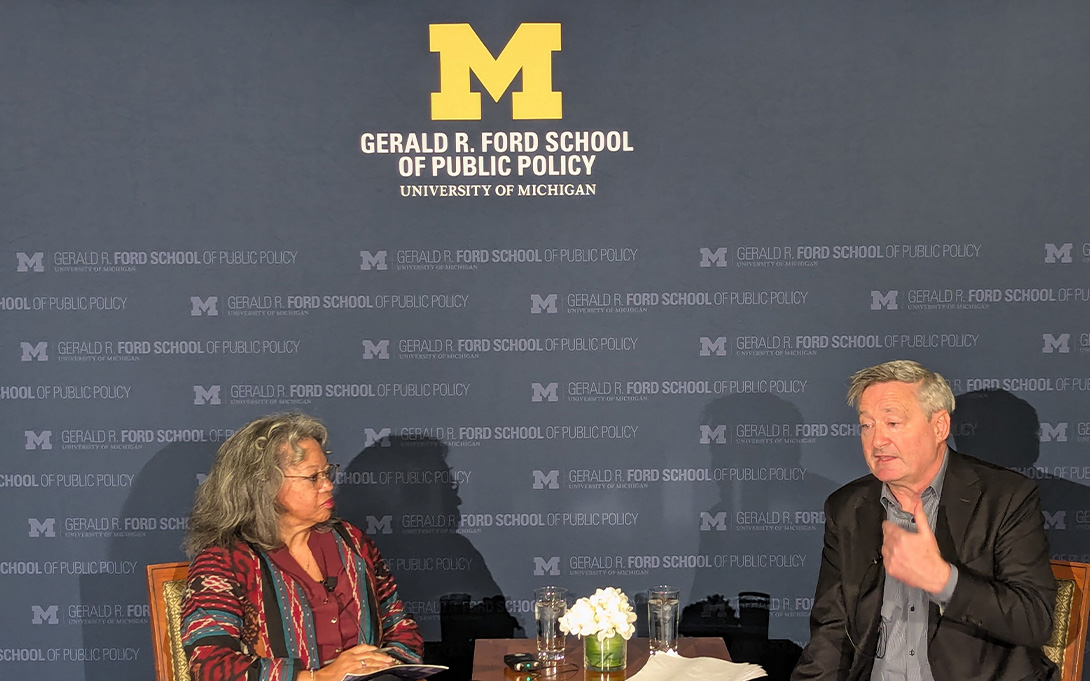
From his start at a quirky rural Irish newspaper to his ascent as a world-leading investigative journalist, Gerard Ryle's career has been marked by curiosity, ingenuity, and collaboration. He discussed his journey and lessons learned from his remarkable career during a Ford School event on October 20th titled "Systems of Secrecy: Journalism, Power and the Policy Gaps that Enable Corruption."
Gerard Ryle's first major report was on a company that claimed it had a pill for motor vehicles that could increase fuel efficiency by 20 percent and eliminate toxic emissions. Despite the outlandish claims, the founder raised over $100 million in capital from investors, plus over $600,000 in public grants from the Australian government. Ryle proved that the company was fake. They didn't have a pill at all—they didn't even have a factory to build it.
However, he said, the company "had penetrated deeply into Australia's elite. Many of them secretly held shares in the company, and they, too, thought they were going to be rich. When I exposed all of this as fraud, I spent my time defending four different lawsuits, public attacks in the Australian Senate, and I went through all of the despair and the doubt that all investigative reporters go through when powerful people don't want something made public."
The investigation eventually turned into a book, and after the book, Ryle received an anonymous package in the mail containing a hard drive. There were countless files on it, some about the magic pill company, but many more with information for which Ryle had no context. He realized that if he was to make sense of any of it, he needed to bring in other people, and he needed tools to assess the information. But these realities went against the instincts he had as an investigative journalist, someone used to keeping secrets closely guarded.
Ryle's organization, the International Consortium of Investigative Journalists, has subverted this tendency by leveraging modern technology to expose some of the largest corruption scandals in the world—some of which came from that mysterious hard drive.
He was brought on board to lead ICIJ just a few weeks after receiving the package, and there he saw an opportunity. At the time, ICIJ was just a skeleton staff, but the information on the drive gave them the chance to punch above their weight. Working with a team of other investigative journalists, he began the painstaking work of interpreting and hunting down information in that hard drive. "It was very difficult to read without a specialist's help," Ryle said. But he "was staring at the very machinery of corruption. This is a machine that defies all the best efforts of policymakers, a machine that relies on one thing, and one thing above all others: secrecy."
They started connecting with journalists around the world, eventually building a network of 376 reporters and 90 media partners. They adapted software originally used for a dating website to match journalists with stories. They transformed software used to share books between libraries to set up a virtual newsroom. This collaboration culminated in what is now known as the Panama Papers, which exposed a system of crime and corruption through offshore accounts.
After years of work on the Panama Papers, they were finally ready to publish. The stories, hundreds of them, were all published on the same day in April 2016. The reactions were immediate. Implicated world leaders resigned, made excuses, or tried to distance themselves from the scandal. Ryle won the Pulitzer Prize for his work.
Reflecting on today's media landscape, Ryle said, "There is no doubt we live in a shrinking world, and that the media has largely been slow to catch up to this. The issues we report on are more and more transnational. . .it seems staggering that journalism has been so late to tackle stories in a truly global way. And it seems staggering, too, that journalists have largely ignored some of the possibilities that technology brings, rather than being frightened of it."
Since the publication of the Panama Papers, ICIJ has continued to report on global corruption scandals and won numerous awards. Gerard Ryle is still their executive director, looking for the next big secret lurking around a dark corner.
