
Since the end of World War II, the United States has rhetorically championed the principle of “self-determination.” Yet today, more than four million Americans live in U.S. territories whose homelands are excluded from most maps and remain invisible to many Americans.
Residents of Puerto Rico, the U.S. Virgin Islands, Guam, American Samoa, and the Northern Mariana Islands are subject to the authority of the federal government as U.S. territories. However, they have no representation in the U.S. Senate, executive branch, or judiciary, and only limited representation in the House of Representatives. Moreover, because the U.S. Constitution has not been fully extended to them, territorial residents enjoy fewer rights than Americans living in the 50 states. While they can participate in local politics, these American citizens are far from living in a consolidated democracy.
There is also widespread discontent with these systems of governance across the territories, raising an important question: why haven’t they fully democratized?
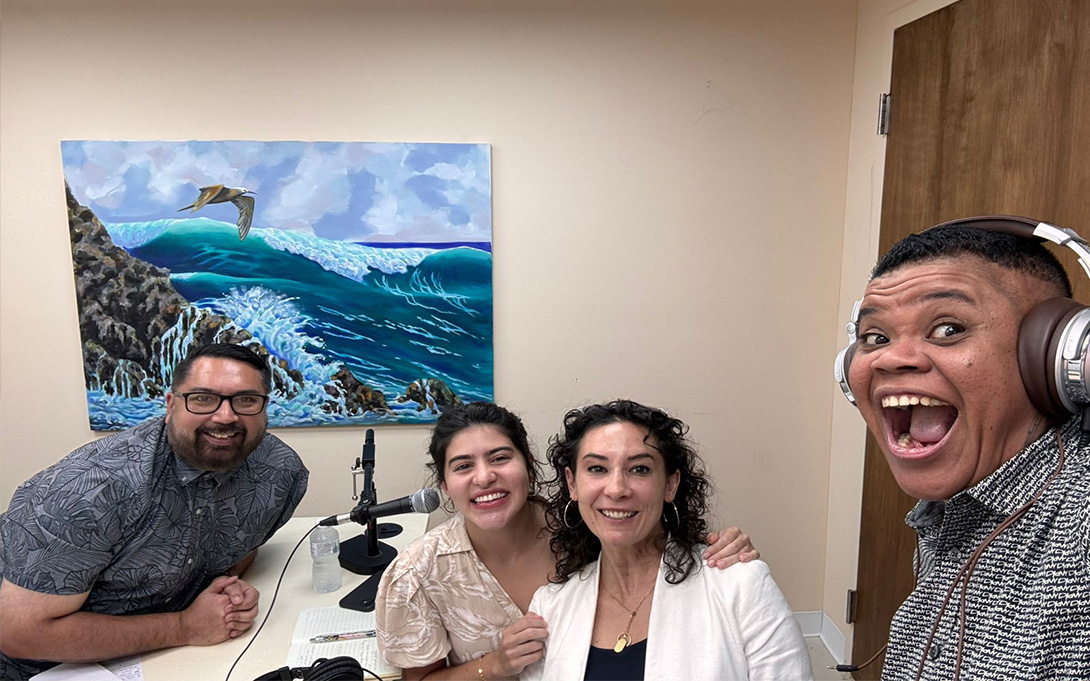
To explore this question, Mara Ostfeld, along with Ph.D. candidate Ignangeli Salinas-Muñiz, traveled to Guam to lead multiple focus groups examining local attitudes toward political status. "Our main goal with these focus groups is to better understand how people living in U.S. territories, including Guam, think about the political possibilities for their future," Ostfeld explained in an interview with The Wave 105.1 Guam.
Ostfeld and Salinas-Muñiz, who are also conducting public opinion research in Puerto Rico and the U.S. Virgin Islands, observe that military presence is a uniquely powerful factor shaping political attitudes in Guam. In World War II, the island was bombed on the same day as Pearl Harbor. Yet while the attacks on Hawaii received widespread national attention, the fact that Guam was also attacked—and then violently occupied by Japanese forces for three years—was largely overlooked by U.S. media and political elites.
These experiences continue to shape how residents view their relationship with the United States. Some see maintaining close ties as essential for protection from foreign aggression, while others believe the territorial relationship itself makes Guam a target for foreign militaries.
Ostfeld also underscores a broader challenge: the tremendous lack of public opinion data from U.S. territories. The limited data that does exist is often unrepresentative, and referendums, she argues, are so reductive that they fail to capture the nuances of residents’ views. The goal of her projects in Guam and other U.S. territories is to expand the availability of high-quality public opinion data. By drawing on findings from focus groups, interviews, and large surveys, Ostfeld is hopeful that policymakers can make decisions that align with the possibilities that residents U.S. territories envision for their future.
View the full interview segment with The Wave 105.1 Guam here.

