
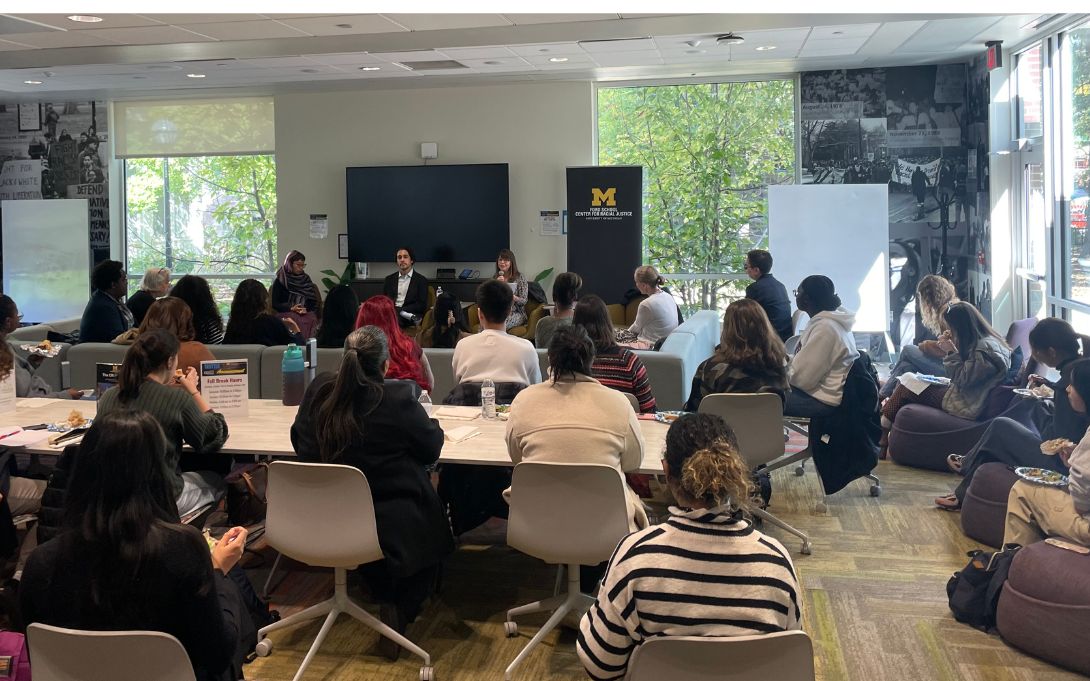
Each academic year the programming at the Center for Racial Justice (CRJ) looks a little bit different. We aim to create a vibrant, diverse community of racial justice leaders, scholars, and students engaged in social justice work and believe it's critical to provide spaces where students not only feel empowered to learn and ask questions, but also have a hand in curating the content discussed.
In Spring 2025, we sent our first end-of-year survey to everyone who attended our AY 24-25 events, asking them to suggest ideas for future programming. The result? A clear call for more informal, student-centered lunchtime talks addressing the many policy changes unfolding in the United States since January 2025.
In response we created a three-part "Let's Unpack That" series, providing students and community members with a space to slow down, share a meal, and deepen their understanding of the issues shaping our democracy. Co-hosted with the Trotter Multicultural Center, sessions were held in Trotter's Sankofa lounge, a space decorated with images of student activism at U-M. Notably, "Sankofa" comes from the Twi language of Ghana and literally means "Go back and get it!" a command to pay respect to the lessons and practices of the past and to draw on them to inform the present and the future.
Each session featured U-M experts who shared their research, lived experiences, and practical insights in a conversational setting. Below is a brief recap of each teach-in, with highlights from speakers responding to student questions.
Unpacking Immigration Policy: October 9, 2025
Speakers: Irene Romulo (Wallace House Center for Journalists), Dr. William Lopez (Public Health), Dr. Kristina Fullerton Rico (Ford School)

The first session traced the long, racialized history of U.S. immigration policy, from early exclusionary laws to today's militarized enforcement, and showed how these legacies continue to shape communities. Panelists emphasized that people have power: collective action has stopped harmful policies before, and small shifts can make institutions more accountable and communities more resilient.
"Let's look at ICE's $44 billion a year budget. What do you think we're going to do with that money when supposedly everyone is going to be deported? What are those agents going to do next? They're simply going to target another group. So it is about drawing those connections between advocacy movements now and as early as we can." -Dr. William Lopez
"The future is not a foregone conclusion, we're making the future everyday. The stories we tell, the things we speak out against, we decide what's right and what's wrong and what's allowed to continue." -Dr. Kristina Fullerton Rico
Unpacking AI Policy: October 23, 2025
Speakers: Dr. Yousif Hassan (Ford School), Dr. Molly Kleinman (Science, Technology, and Public Policy Program)

The second session explored the rapidly evolving world of artificial intelligence and its implications for civil rights and governance. Panelists emphasized that AI is not just a futuristic concern, it's already shaping everyday life and influencing decisions around criminal justice, privacy, and civil rights.
"AI has the potential to meaningfully impact the American public's rights, opportunities, and access to critical resources. That's the big picture of why we need to regulate AI. It touches everything already." -Dr. Molly Kleinman
"We as citizens and humans always have agency. We build these systems and can determine the future of these systems and how they should be built. AI policy is not just a technical conversation, it's about the kind of society we want to create and the ways we engage collectively to shape technology for the public good." -Dr. Yousif Hassan
Unpacking Election Policy: November 20, 2025
Speakers: Dr. Jowei Chen (LSA), Dr. Mara Ostfeld (Ford School)

The final session explored how redistricting and gerrymandering shape U.S. elections and influence voter engagement. Panelists explained that in heavily partisan districts, especially those that have a lot of racial polarization and segregation, historically marginalized communities may feel like their voices are irrelevant, which results in lower voter turnout.
"What you have to remember is the incentives of the legislators who are drawing gerrymandered districts is not to increase voter participation. Their main incentive is to maintain their ironclad supermajority. It's the communities who feel left out of the process, who feel that their voices are not being heard, who are the ones who have an incentive to change the system." - Dr. Jowei Chen
Katrina Hamann is the communications specialist for the Center for Racial Justice.
