
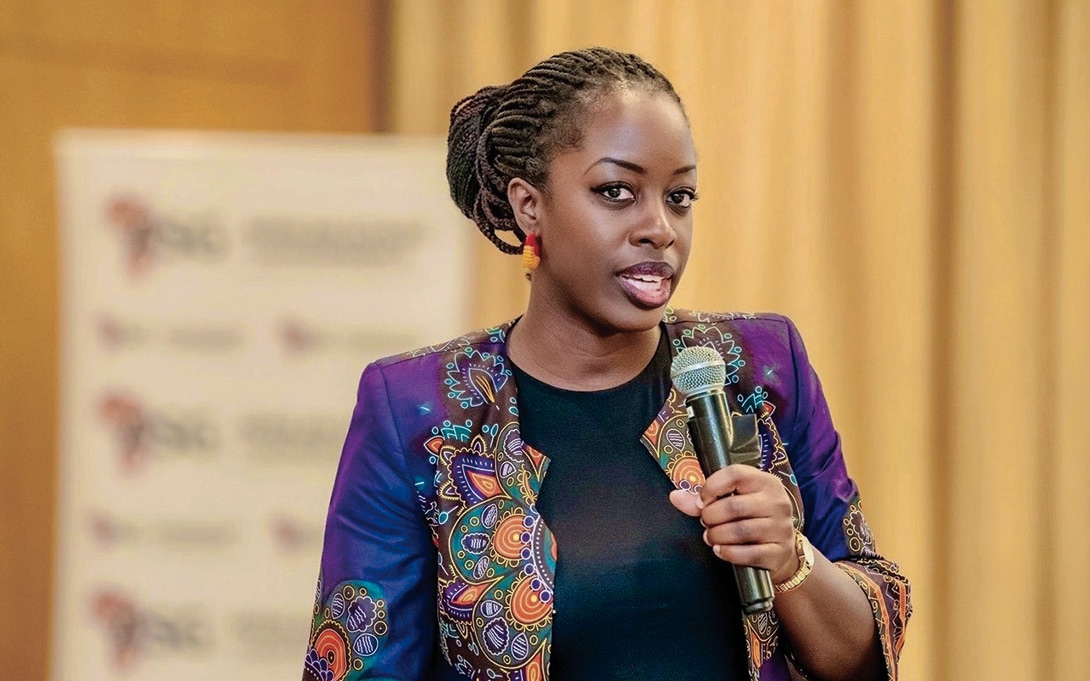
Ford School professor of practice Ambassador Kamissa Camara was among the expert panelists invited to discuss rising extremism in the African Sahel region at an event hosted by Columbia University's Kent Global Leadership Program. Camara and her fellow panelists discussed what drives terrorism in the Sahel, how states should address increased violence, and the Sahel's global implications.
In her remarks, Camara analyzed the current discourse around rising extremism in Sahelian countries, noting that policymakers often assume that a lack of state-provided public services is the primary driver of insurgency, and that the solution to extremism is to improve the operational capacity of state armies.
But Camara said these claims represent an incomplete diagnosis of the drivers and persistence of extremism in the Sahel. Instead, she asserted, the persistence of violent extremism is also a problem of how the state understands threats and how the threats are actually experienced by those on the ground.
"Violent extremism in the region is deeply embedded in local social and political dynamics," said Camara. "However, the state's response has been overwhelmingly shaped by security logics that prioritize military action, territorial control, and external cooperation—and this has created a misalignment between the nature of the problem and the form of the response."
Drawing upon her time as Mali's minister of foreign affairs and international cooperation, Camara observed that many Sahelian states invest the majority of their time, resources, and energy in supporting their armed forces instead of civil society. When they prioritize military interpretations of security threats, they institute actions that highlight state strength, such as military operations and checkpoints. As a result, civilians may perceive the state as law enforcement rather than as a governing authority, weakening trust in public institutions.
"Public services are important, but their absence is compounded when the state first appears as a coercive presence and only second as a governing authority," she said. "The response to violent extremism in the Sahel cannot be reduced to better equipment or more training or greater battlefield capacity, but requires a serious rethinking of the relationship between civilian authority and military power, and of how the state engages society at the local level."
Camara was joined by Arthur Boutellis, adjunct faculty at SIPA; Andrew Lebovich, research fellow at the Clingendael Institute; and Lori-Anne Théroux-Bénoni, senior research and policy advisor at the Institute for Security Studies. The panel was moderated by Jean-Marie Guéhenno, director of SIPA's Kent Global Leadership Program on Conflict Resolution.
Watch the full panel with Ambassador Camara here.
