
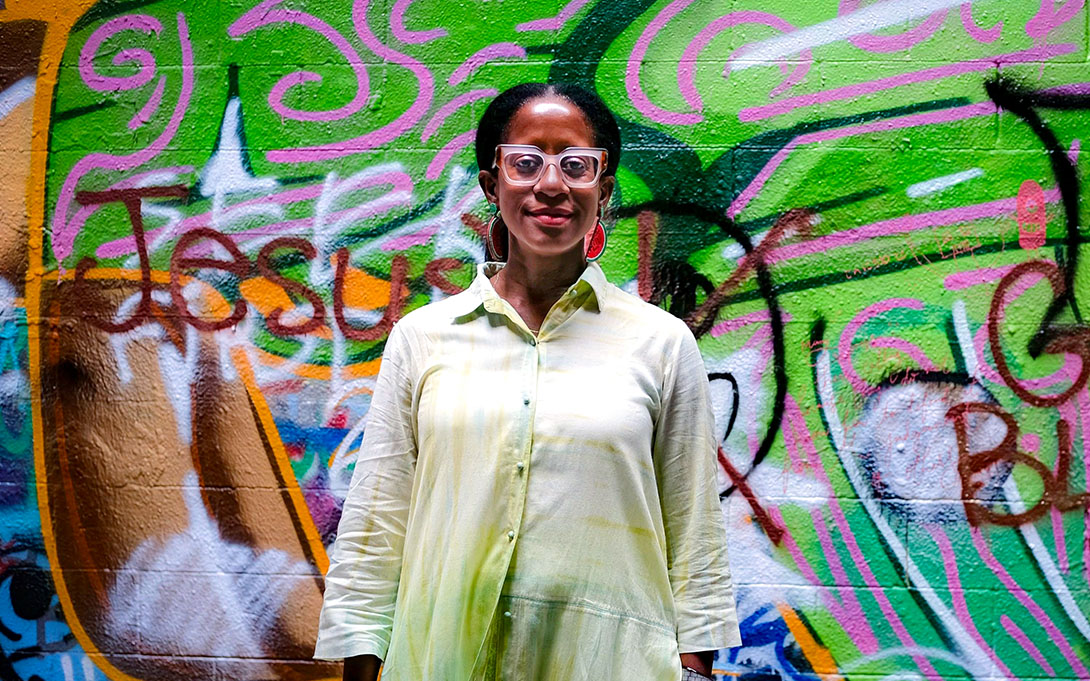
Artist Holly Bass holds these three truths:
- You can love your country while still holding it accountable.
- History is living and fluid, and we are all a part of creating it.
- Public policy work can be made more authentic by incorporating your creative practice.
As both the 2026 Roman J. Witt Artist in Residence at the University of Michigan Stamps School of Art & Design and Towsley Policymaker in Residence at the Ford School of Public Policy, Bass has carved out a synergistic niche for her socially engaged art and practice.
An award-winning, multidisciplinary artist who works across dance, theater, visual art and writing, Bass has collaborated with governmental agencies, cultural institutions, nonprofit organizations and academic communities to create innovative artistic experiences that foster connection and provoke new ways of thinking.
"We Hold These Truths," currently on view at the U-M Museum of Art, serves as the culmination of her Witt residency and is her largest exhibition to-date. In honor of America's semiquincentennial, the exhibit looks at moments in time over the past 250 years—1876, 1976 and 2026 (with a glimpse ahead at 2076)—and helps present-day audiences understand, or grapple with, these varied histories.
"I think for me, it's a way that I can honor my nation of origin—what I think of as the place that made me—in a way that feels genuine, and not based on perpetuating mythologies; to love with accountability," Bass said. "You can love your country, but still hold your country accountable."
She drew inspiration from her fascination with historic home museums, and represents each century of American history with a living space from that era: a parlor; a den; a family gathering table.
Bass spent much of her Witt residency, which supports leading contemporary artists by connecting them to U-M's full creative ecosystem uniquely situated within a research university, utilizing the historical Bentley and Clements libraries to inform the exhibition.
A central piece, "Century Table," is a 25-foot-long structure incorporating different styles of furniture from American history.
"It's kind of like a visual timeline, but it's also about the metaphor of the table as a place where we gather, where we break bread, where we share stories," Bass said. "I wanted to bring that idea to the space."
The symbolism doesn't stop there; every layer of the exhibition holds meaning.
Above the exhibition is the suggestion of exposed attic beams, which force visitors to view the exhibition from another perspective. Bass shines a spotlight on the hidden structures that typically go unseen, but are essential in keeping an infrastructure from crumbling.
"An attic is where you preserve things, but it can sometimes be where you hide things away. I'm really interested in that," she said. "This is really going to encourage you to look up and look out; to see things from different vantage points."
"We Hold These Truths" is the first exhibition held in UMMA's Lizzie and Jonathan Tisch Apse since its reopening following a nearly year-long renovation of its marble floor.
Throughout her time working with the Ford School, Bass infused artistic approaches into all of her workshops.
"I focus on how the arts can be used for public policy work and social justice work—for progressive change work. I would always try to bring in an art engagement activity," she said. "I also talk about art strategies, things like rehearsal and improvisation, and how that can be used for public policy. The arts and public policy definitely cross-pollinated with each other in ways that were very rich."
As part of her residency at the Ford School, Bass will teach "Arts-Full Strategies for Public Policy," stemming from her demonstrated practice rooted in American history, social justice, community engagement and the arts as a vehicle for public dialogue. She will lead public tours of her exhibition and use it to spark conversation about public policy issues and how they can be addressed in artful ways.
"I hope that when people are in this space, they understand that history is something living and fluid and that we are part of it; that we are making history," she said.
"We Hold These Truths" is free and open to the public, on view through Feb. 14, 2027.
Written by Jamie Sherman, U-M News
