
A stained pink backpack rests beside a poster of Uncle Sam: "I want YOU to pay for the murder of Iranian schoolgirls. Taxes due April 15." The piece is just one of 35 art installations created by students in Devin Judge-Lord's winter 2026 course: "Protest, Social Movements, Art, and Policy Change." Navid Fotovat (MPP ‘26, MD ‘27) created No War on Iran to "make the consequences of war visible and disrupt emotional distance, creating space for individuals to question their assumptions."

Developed in collaboration with the University of Michigan Museum of Art's (UMMA) American Sampler exhibit, Judge-Lord's course drew on the exhibit's exploration of visual strategies used in the interconnected movements for Black freedom, civil rights, and resistance to the Vietnam War. The class tasked students with examining the role of movement art in policy debates while addressing a central question: what constitutes a "successful" protest movement?
"Students see protest and social movements shaping policy debates and have long asked for a class that gets deeper into the research on what makes movements effective," said Judge-Lord.
The course asked students to consider how movements shape policy and the role of art in reframing policy debates, helping people to see issues in new ways, and persuading people to participate in organized civic activities like protests and advocacy.
"Policy decisions always involve more than rational policy analysis, especially in a democracy," explained Judge-Lord. "Effectively communicating our visions for the world and inspiring others to act are critical skills, and there is research about what kinds of actions can reframe a debate or inspire action in different contexts. Visual art is a powerful way to share a critique or vision. What we were doing here is ‘evidence-based art, with each student choosing a policy they care about."

Throughout the semester, students researched 20th and 21st-century social movements in the United States, with particular attention to how artistic expression can frame public issues and move policy ideas from the margins of debate into the mainstream, and, at times, help them become accepted as "common sense." The course also included guidance from UMMA and Arts Initiative staff on how color, ambiguity, and curation shape how audiences experience protest art. Students developed a theory of change based on their research.
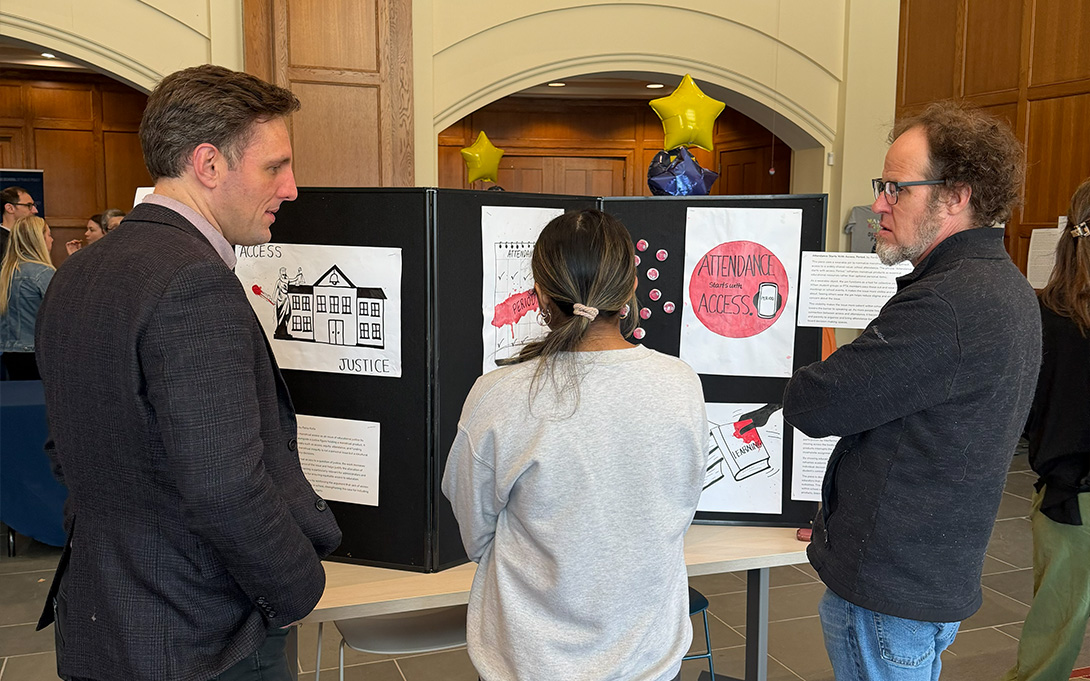
Their finished pieces addressed a range of issues, including disability justice, climate change, immigration, housing, and imperialism. Across topics, students faced the challenge of translating complex policy issues into visual forms that resonated with their chosen audiences and built support. Their work ranged from video and interactive installations to posters and was publicly displayed in Weill Hall in April.
Raina Kella's (BA ‘27) Marked Absent offers one vivid example: a stark school attendance calendar with a full week obscured by a spreading red stain stamped with the word "period."

"My piece aims to bring awareness to period poverty, the inability to access or afford menstrual products," Kella explained. "By making absenteeism legible and tied to access, the piece supports a broader strategy of framing menstrual products as essential to attendance and encourages district-level funding [for free menstrual supplies for students.]" In doing so, Kella sought to reach school administrators who prioritize attendance metrics but may not otherwise see menstrual access as an education equity issue.
Similarly, Fotovat's No War on Iran challenged him to approach a deeply personal topic while communicating its human consequences and a clear call for policymakers to end the current war in Iran.
"I am an Iranian-American, and a majority of my family is in Iran," he said. "I drew inspiration from U.S. anti-war protests, and the class pushed me to think about what art can do beyond raising awareness. Studying evidence-based policy movements helped me understand how a strong call to action can shift power, and how the people are the ones who have it."
By the end of the semester, Judge-Lord said, students had a clearer understanding of scholarly debates about how to define social movement success, including the roles of resources, organizing, messaging, and political context.
The exhibition did not suggest that protest art changes policy on its own. Instead, it showed students tracing the steps by which art can become part of policy change—to make harm visible, frame it as a public issue, identify an audience, and point viewers toward action.
Written by Katrina Hamann
