
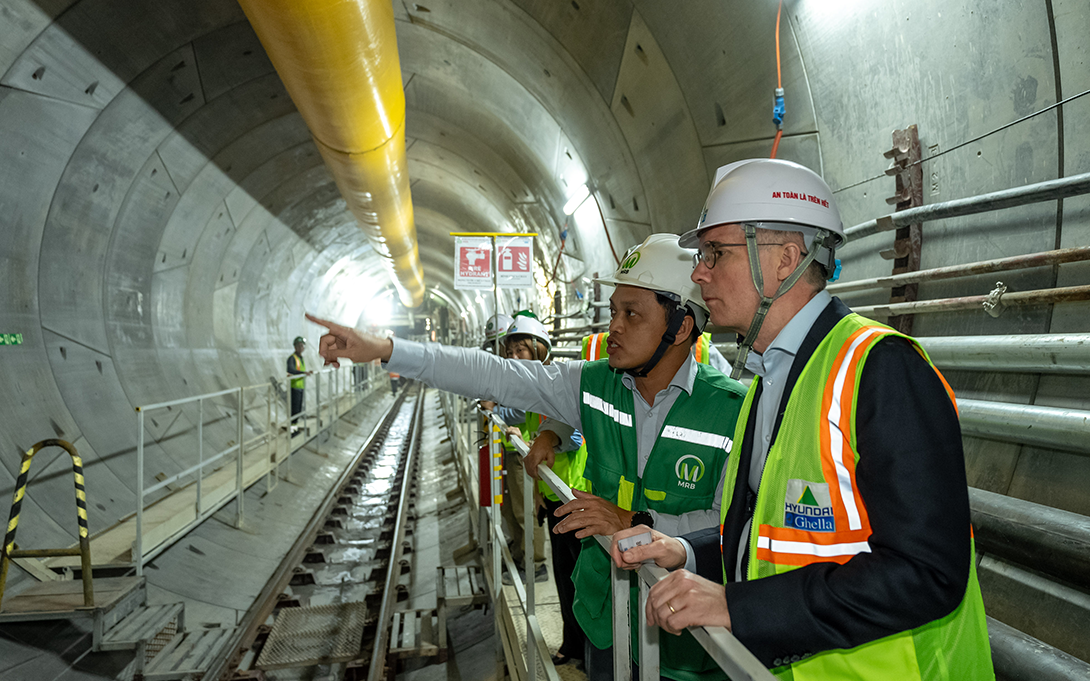
In a very practical way, my time at Michigan helped define some of the choices I made in the first half of my career."

Scott Morris
Scott Morris (MPP '94) advances clean energy transitions and regional partnerships as vice president for East and Southeast Asia and the Pacific at the Asian Development Bank (ADB). Overseeing a $45 billion portfolio, he works with governments across 25 nations on projects ranging from physical infrastructure to universal healthcare. Morris returned to Ann Arbor to share insights with students and faculty, as well as celebrate a new U-M collaboration focused on accelerating clean energy transitions and climate adaptation in developing countries.
What shaped your path into international development?
My interest in pursuing international policy began early. As a college student, I found myself drawn to global issues. We were on the heels of the Cold War, and people had a much more positive mindset around economic integration globally. This was an era when there was still forward momentum on global trade. There was also a tremendous sense of optimism about the opportunity for economic progress in parts of the world that had long been stalled.
My time at Michigan helped me shift from a broad interest in the world to exploring what my role could be. I graduated with a strong economic skillset and started out in U.S. economic policy before moving into the international sphere within a few years. In a very practical way, my time at Michigan helped define some of the choices I made in the first half of my career.
Tell us about an ADB project that excites you right now.

There's a growing desire across Southeast Asia to take a regional approach to reliable, affordable energy by developing an integrated power grid known as the ASEAN Power Grid. It's a hugely challenging endeavor, but momentum is building as new technology enables renewables to become a more reliable energy source. Success requires both advanced technology and strong political commitment from countries such as Cambodia, Thailand, Indonesia, and Singapore. The ADB has pledged $10 billion toward the initiative, and now we're working with these countries to create detailed blueprints for implementation. We see great promise in these countries as they work to reform their energy sectors and realize their commitments around renewable energy.
Our ability to make this initiative successful depends on what we can achieve in partnership with these countries over the next few years. This includes reforming key regulations in countries with existing market barriers and developing technical plans to attract investors. While $10 billion is substantial, the program actually requires hundreds of billions. Ultimately, we need private investors, and for them to commit, these other pieces have to start to fall into place.
How does ADB determine what to invest in?

In any given year, ADB commits about $30 billion to new projects—decisions that follow years of collaborative work with developing countries' governments and other partners. The way we identify projects varies widely. Some member countries know exactly what they want and provide a list of projects to finance. Others are less certain of their needs, so we may begin with technical assistance grants to help define and design a project.
A key principle that underpins everything we do is that the developing country client owns the project. Nonetheless, we collaborate closely with governments, providing clear guidance on standards and approaches. For example, in procurement, we ensure they establish transparent, competitive processes and guard against corruption. Ultimately, however, this is a country-owned process, not one controlled by ADB.
What are some core values and tools you use to guide your work?
I like to use the word empathy because we always try to think about the perspective of our clients. It's important we understand what is motivating or constraining their decision-making, and how the issues they face are informing the discussion and the relationship with us. If we're indifferent to that, we run the risk of not being able to move forward, which will ultimately be damaging to our mutual goals.
Also, an analytical approach to learning and innovation is an important tool to break out of institutional inertia. It guards against making decisions based on how we did it the last time around. There are new ideas that come from the countries we work with, our sector experts, and the academic community. Analytical decision-making allows us to look at the evidence and adopt different approaches in a systematic and structured way.
What's something important you took away from your time at the Ford School?
Even 30 years later, it's surprising how often I explicitly reference the coursework at the Ford School. The public policy program is deliberate and practical in its approach, and it responds to what the marketplace needs when it comes to the skillsets of public servants. The programs taught here, and particularly the analytical quantitative approach, really do pay off.
We're in a year that has introduced tremendous challenges and uncertainty about the future of the public service, both here in the United States and globally. But I remain confident that if young people acquire the sorts of skills that the Ford School provides, they're going to find themselves highly adaptable and ultimately prepared for leadership roles in the future.
By Rebecca Cohen (MPP ’09)
Related spring 2026 State & Hill stories
 Alumni Impact: Community led conservation
  Alumni Impact: Pathways for student success
  Alumni Impact: Families at the center of child welfare reform
 ← Read all stories in the spring 2026 edition State & Hill