
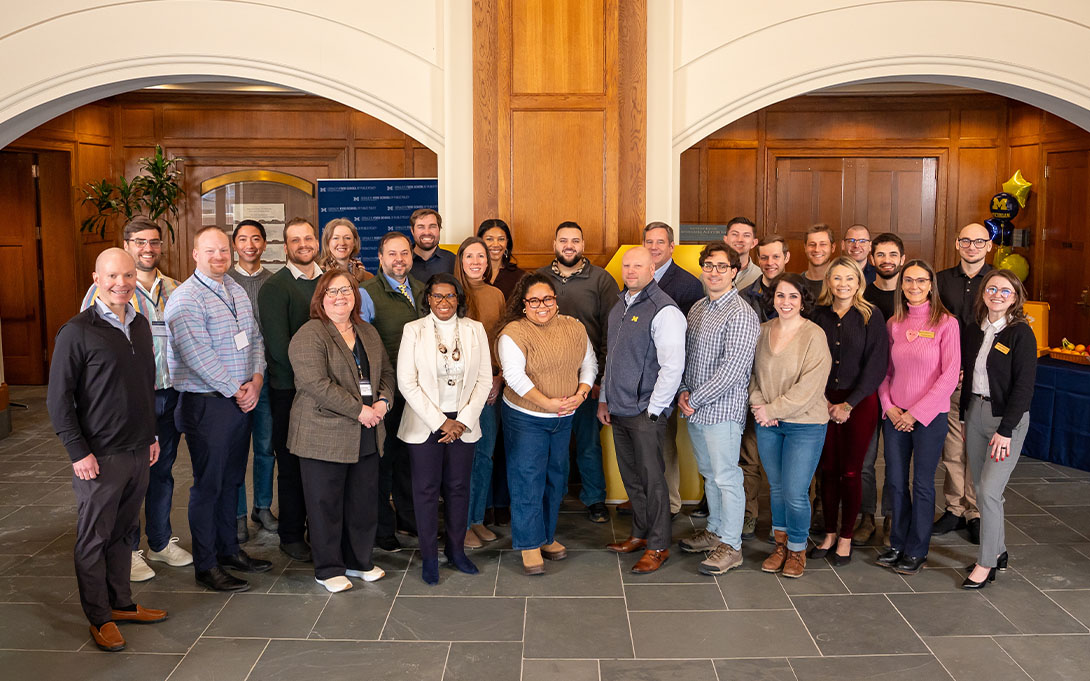
Sophia Cheng couldn't contain her enthusiasm, punctuating her story about graduating from the Master of Applied Data Science (MADS) program with words like ‘amazing' and ‘fun.'
A director of application development from Boston, Cheng traveled to Ann Arbor in April to present her capstone project, "Discovering Biological Signals in the Noise," at the University of Michigan School of Information's Annual Student Project Exposition. Cheng selected the school's MADS Online program so she could continue caring for her elderly parents while working full-time. Yet she knew making the trip, her second to campus, added value to the online program by allowing her to interact with classmates, share her project with faculty, and immerse herself in the U-M community once more.
"I'm not going back to school again unless there's a PhD somewhere in my future, so I wanted to make the most out of it," she said.
The MADS program invites its students to many of the school's in-person offerings. Most U-M online degree programs welcome their students to campus for traditional gatherings, such as commencement, homecoming, or career fairs. Some, however, have taken the extra step of adding required in-person experiences to their degree curriculum.
Mandatory on-campus residencies usually span a few days and draw online students to Ann Arbor one to three times over the course of their studies. Other programs require students to complete in-person experiences, such as internships and field projects, in their own communities.

While mandatory in-person elements may seem counterintuitive to the core purpose of online degrees, research shows they can enhance the overall program, adding a feeling of community, real-life learning scenarios, and networking opportunities (Campbell et al., 2022).
"Having a sense of belonging and connection helps students have greater success in their education," said Beth Kuzma, assistant dean and clinical associate professor at the School of Nursing, which offers a trio of online master's degrees. "They appreciate it, the opportunity to be on campus, to engage with their peers, engage with their faculty, get feedback and, really, a sort of personalized guidance."
Creating Community
Belonging is key to successful learning. Feeling part of a community is linked to students' academic performance, and online learners who participated in residency programs felt a deep connection to their peers and faculty (Kazmer, 2007).
Yet the 2025 Student Voice survey from Inside Higher Ed and The Generation Lab found that online students' sense of belonging lags behind their in-person peers. Requiring students to come together for face-to-face workshops and intensives has proven a successful antidote to isolation for the U-M online degree programs that implement them.
The Ford School's Online Master of Public Affairs program held its first on-campus residency this past winter, one of two required on-campus weekends that feature classroom time, leadership workshops, and networking events.

The Ford School held its first in-person residency for students in its Online Masters of Public Affairs earlier this year. The online degree program requires two on-campus residencies as part of its curriculum. Photo courtesy of The Ford School.
While the degree program was designed for working professionals, with evening virtual classes and flexible start dates, bringing students together in person was vital to welcoming them into the Ford School culture.
"We wanted the online students to feel part of the school—they're Fordies. Those were extremely high priorities from day one," said Elisabeth Gerber, the Jack L. Walker, Jr. Collegiate Professor of Public Policy and faculty director of the Online MPA program.
Some faculty and staff initially expressed concern that having a required residency would not be well received by students. Yet the early returns from Ford's first experience were overwhelmingly positive.
"I think that the online program time will look and feel distinctly different now that we've all met in person and established relationships," wrote one student in a post-residency survey.
"Being on campus made us feel like Fordies for the first time," another wrote.
The MADS program doesn't require in-person appearances of its students, but many do travel to the events offered, including the Expo, MADS On-Campus Experience (which is held over homecoming weekend), or the alternative spring and fall break trips. Year after year, online students praise the value of the in-person opportunities.
"Students really come away with that sense of belonging to the community, to actually meet these people they've been interacting on Slack with, being able to interact with the faculty," said Allison Sweet, senior assistant director of student life at the School of Information. "It's those relationships and being a part of the campus experience that has had a big impact."
Planning and Programming
Online students recognize and appreciate the work behind the in-person activities, starting with the scheduling. As many work full-time or live outside of southeast Michigan, advance planning is critical to students' ability to meet any residency requirements.
Candice Stegink, who recently completed the Health Infrastructures and Learning Systems-Online master's degree from U-M Medical School, said students were notified four to six months in advance when one of the school's in-person workshops were scheduled. The HILS program requires learners to attend three institutes on campus.
"The program is very crystal clear about that expectation, and I think the institutes were designed to be very purposeful," said Stegink. "That's where you get to see faces of all the online classmates, which is really nice, and it also helps build community within the cohort."
The Health Infrastructures and Learning Systems-Online master's degree program holds three on-campus institutes, bringing students together for a packed two-day itinerary of learning, networking, and socializing. Photo courtesy of Michigan Medicine.
Since they have just a few days with their online students, faculty and staff pack the schedules with immersive learning experiences, networking, faculty interactions, and social gatherings to make the most of the limited time.
Students in the Online Master of Business Administration program at Stephen M. Ross School of Business must complete three in-person residencies. The Leadership Crisis Challenge is among the most popular. Students arrive on a Wednesday evening, attend class sessions Thursday, then receive a crisis situation to solve. Teams work through the evening and into Friday on their solutions and present them to a panel of Ross alumni, who pick the winners. Students also receive media training from local media professionals, and close out the weekend with a debrief and more instruction.
"It is an intense weekend for them. They are a little bit nervous, rightly so, going into the Crisis Challenge," said Monica Worline, lecturer of management and organizations and faculty director of the Center for Positive Organizations. "They also come out having learned a lot. It plants seeds for growth."
"The Leadership Crisis Challenge pushed many of us out of our comfort zones," said Emily Clark, an Online MBA student from Utah. "It was an opportunity for many of us to grow, whether that was learning how to contribute effectively in a crisis, how to juggle differing personalities and emotions, and the importance of a shared vision and goal across your team. Overall, it was a fantastic experience."
The on-campus residencies also benefit the instructors, who connect with their students in a way that's difficult to do virtually. For nurse practitioner faculty and staff of the online School of Nursing program, the in-person intensives are just that: intense. The two-day schedule is full of observations and feedback on technique, skills training for medical exams, and practicing patient encounters.
"By the time we're done, I'm exhausted," said Beth Ammerman, clinical associate professor of nursing. "But it's really good for us, because we get to know the people even better. You can talk to somebody online, but when you talk to them in person, it's a lot better."
Real-Life Experience
The in-person, immersive experiences are particularly valuable to older learners, who make up a majority of the online degree cohorts. Experts reviewing the latest Student Voice survey pointed to students seeking educational experiences relevant to their career paths. Online courses that rely on traditional testing don't always resonate as powerfully as courses that use real-world scenarios to assess learners.
For the School of Social Work (SSW) online master's students, the program's in-person requirement prepares them for their future with professional experience. A quarter of the curriculum is devoted to a field placement, or internship, that's typically completed in the student's own community.
School faculty and staff work with students to identify, secure, and support field placements. With more than 800 connections in 40 U.S. states, plus Washington, D.C., there are ample resources for learners to successfully identify a placement and complete the required internship.
Erin Khang, director of field education and clinical assistant professor at SSW, said the value of the in-person element is much more than just diversifying the curriculum beyond online courses. The internships help students gain valuable field experience while providing a glimpse of their potential impact.
"For the students, specifically, it's to make them feel like they are part of something greater and a part of a community at their local level," said Khang. "It's social work. The word social is in our name. So interacting with folks in their local communities really does hammer home their purpose."
The School of Dentistry also has a community-based in-person requirement for students pursuing the online Accelerated AS-MS in Dental Hygiene master's degree. As part of a second-year course, students partner with local agencies to provide oral health education. Learners gain experience developing the education program with community organizations, from selecting the group to developing the contract to creating a program.
"It doesn't always go as planned," said Stefanie VanDuine, clinical instructor in dentistry. "Different challenges may arise, forcing the students to pivot, but that is a learning experience in itself."
In the end, online learners repeatedly say the in-person experiences are worth the travel and the time required, and ultimately enhance the overall value of their University of Michigan degree experience.
Looking back at her U-M journey, Cheng said she now appreciates the value of attending on-campus experiences.
"(Initially), the idea of coming to do in-person just seemed exhausting to me," she said. "But now that I have been here, I do wish I did more."
Considerations for Residencies
Requiring residencies for program completion may limit student enrollment. See our University of Michigan Distance Education Disclosures for a detailed review of university permissions to operate outside the state, and the rights and protections afforded online students from other states, territories, and countries.
References
Kazmer. M. M. (2007). How do students experience differ in online LIS programs with and without a residency? The Library Quarterly, 77(4), 359-383.
Campbell, M., Lucio, R., Louis-Canes, K., Wiest, C. (2022). The Role of Residencies in Promoting Student Engagement in Online Pedagogy. Advances in Social Work, 22(2), 318-337.
