
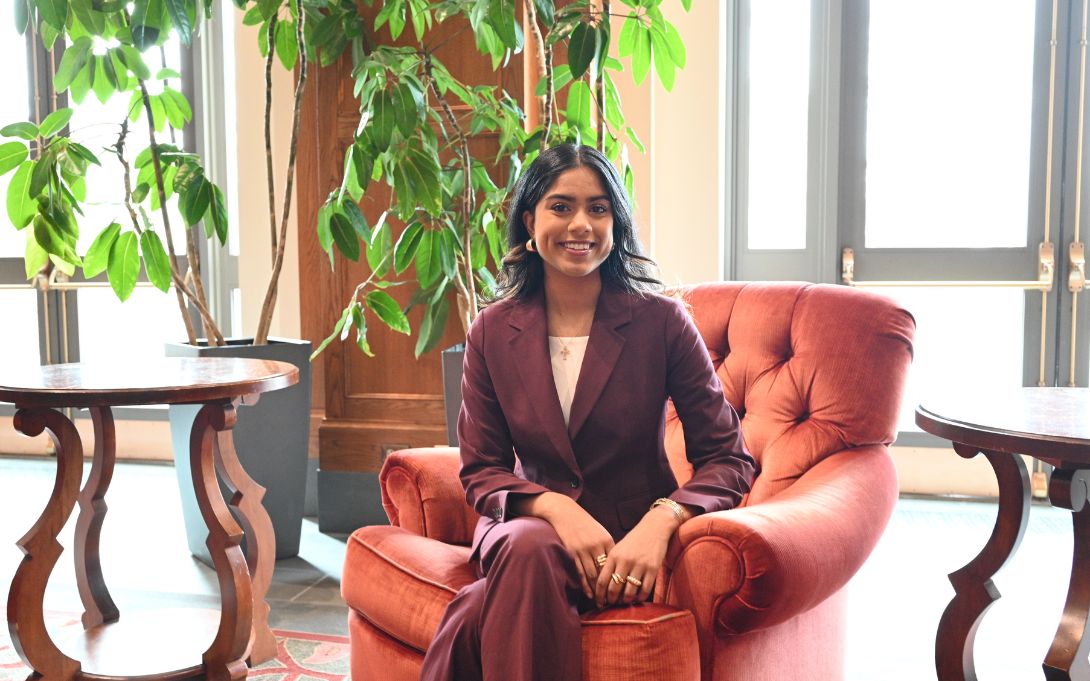
Kelly Beharry (MPP '26, MD '27) reflects on her NYC roots and how her dual degree influences her approach to global health and immigrant rights.
What experiences have you had that shaped how you think about public policy?
I grew up in New York City in a low-income household to parents from Trinidad and Tobago. I experienced firsthand what it's like to have inconsistent access to healthcare, social services, and food support. That really shaped my understanding of how public policy can impact human dignity and has the power to shape entire lives and futures. It has the potential to make invisible communities impossible to ignore.
One of the most impactful experiences I've had at the Ford School was the International Policy in Practice course with Dr. Amy Harris. We spent months learning about Colombia's history, culture, and the experiences of Afro-Colombian and Indigenous communities before traveling to Bogotá. There, I worked with the national university and community partners on a project focused on mitigating food insecurity throughout the country. We met with organizations and community leaders doing urban agriculture work across the city and learned about efforts to build capacity and expand food access.
While on that trip, we visited a woman who grows her own food through a self-sustaining vegetable garden. She described the fact that she can have an urban garden in her own home as an act of resistance. Trained as a chef, she prepared a three-course meal for us using only what she had grown, while explaining how her ability to sustain her crops has changed over the years. I felt so grateful and blessed to share in that experience.
Meeting her reinforced for me that policy isn't something that happens in a silo. It has to be dynamic, iterative, and grounded in ongoing conversations with the communities we're serving. It also clarified the kind of international policymaking I want to engage in: work that brings together the perspectives of academic researchers, international development leaders, and the communities it aims to serve.
How does that translate to the classroom?
As a dual-degree medical and public policy student, I see health and public policy as inextricably related. I believe healthcare is a human right, and public policy serves as the mechanism that ensures people can actually access that right. When I'm in the classroom, I pull from both my lived experience and my work in both global health and immigration rights. I see how public policy directly impacts the lives of the individuals I see in clinic, specifically how health systems benefit certain populations while excluding others. It has been incredibly meaningful to share those experiences and to learn from peers in public policy and other disciplines about different approaches to addressing these systemic challenges.
How have you navigated balancing medical school with your MPP, and what has that experience been like for you?
It comes with its own challenges, but it is one of the best things I have ever done for my professional career. The two fields complement each other really well, especially because I work in the global health space and immigrant rights space. Having the tools to understand both the systems that shape people's lives and how to change them has been incredibly fulfilling. It has strengthened my communication skills and pushed me to think more intentionally about ethics, my own positionality, and whose voices may be missing from the conversation when designing capacity-building projects both domestically and internationally.
Why did you choose the Ford School?
The Ford School's reputation stood out to me, especially its international policy curriculum, so it felt like a great fit for my personal interests. I connected early on with Dr. William Axinn and Dr. Amy Harris, whose work in international development showed me what it looks like to design policies that are both impactful and culturally sensitive. The school's emphasis on rigorous analysis, interdisciplinary learning, and engagement with community stakeholders and policymakers made it clear that this was the place where I could develop the skills to translate evidence into meaningful action.
What policy issues keep you up at night?
I'm deeply passionate about immigrant and refugee health. As a recipient of the Fellowship to Advance Research in Global Health and Human Rights with Physicians for Human Rights, under the guidance of Medical Director, Dr. Michele Heisler, I have been researching conditions in U.S. immigration detention centers and how both the policies and environments impact people's health and long-term well-being. At the same time, my clinical work with the University of Michigan Asylum Collaborative over the past few years has allowed me to hear directly from asylum-seekers about their experience and struggles. Over time, I've noticed shifts in who is able to access care, which has reinforced to me that ensuring safe and reliable access to medico-legal services for immigrants and refugees remains a critical policy challenge. As a future pediatrician, I'm also focused on equitable access to care, including ensuring that every child who needs it has access to Medicaid. These experiences have shown me, in very tangible ways, how policy issues directly shape health outcomes and the lives of the children I serve.
This story is part of the Featured Fordies series, a new initiative that celebrates the diverse backgrounds, work, life, and academic experiences that students bring to the Ford School community.