
Landon Myers' interest in collecting election history began in 2021 while he was browsing the Michigan State University Surplus Store and came across an old mechanical voting machine.
Likely built in the 1930s, the roughly 1,000-pound steel machine stood more than 6 feet tall when cranked into voting position. "I saw the machine and thought, ‘Wait, what is this?'" he said, laughing.
He placed the minimum $500 bid, and, as the only bidder, won.
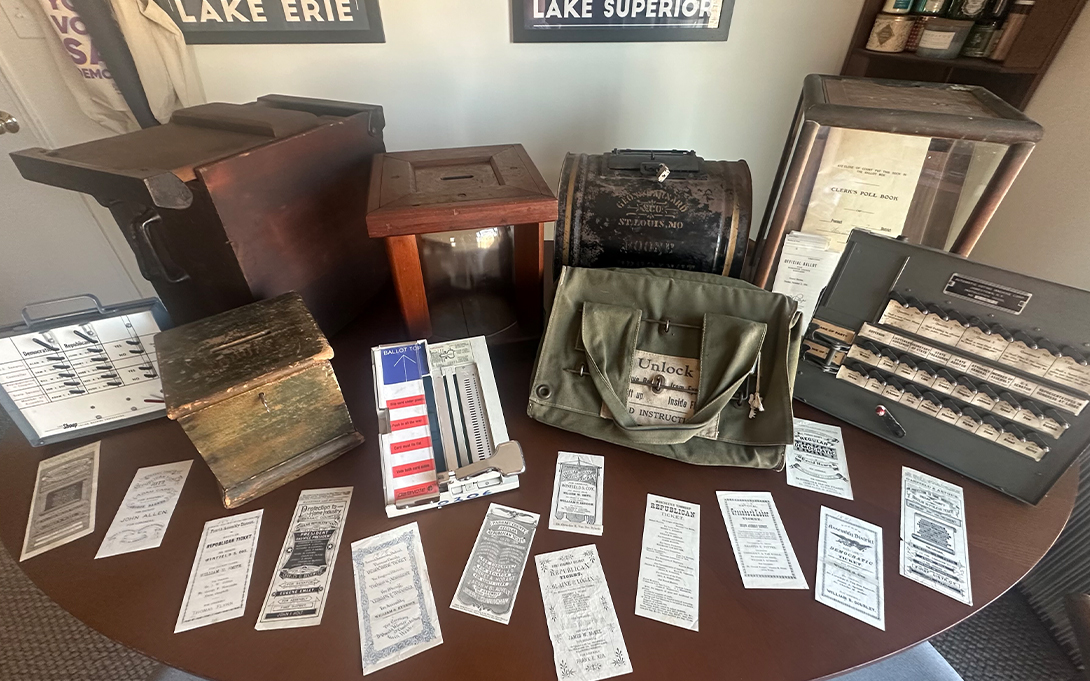
Five years later, Myers, program manager for U-M's Center for Democracy & Civic Empowerment, owns three antique voting machines, about a dozen ballot boxes, and stacks of ballots and other assorted election-related objects.
Some of those objects are currently on loan to the William L. Clements Library for "Who Counts? A History of Voting in America," an exhibit exploring how voting and the experience of Election Day have changed throughout U.S. history.
For Myers, his collection is less about campaign memorabilia than the mechanics of voting itself. "With my collection, I'm hoping to preserve this piece of U.S. history," he said.
An interest takes shape
It was as a high school student that Myers first realized that, although the U.S. government shapes everything from public policy to individual rights, he knew little about how its electoral system worked.
"That's when I really started looking into politics and elections, and I haven't looked back," he said.
At Monmouth University in New Jersey, where Myers earned a bachelor's degree in political science, he became involved in voter registration. As president of the Political Science Club, he helped lead a campuswide registration effort that registered more than 300 students in person and helped hundreds more obtain registration materials.
Myers later earned a Master of Public Policy from U-M's Gerald R. Ford School of Public Policy. He has described his voter-registration experience as helping set the direction of his career in civic engagement.
His collecting interest began shortly after he completed his master's, then quickly expanded as he perused eBay, auction sites and Facebook Marketplace. Unlike campaign buttons, which have a large collecting community, old voting equipment can be much harder to find.
"It can take months to find something new," Myers said.
An unexpected treasure
One of his favorite finds came not from the internet but from his father.
Last year, Myers' father was attending a community meeting in Oneida Township near Grand Ledge when he overheard a man talking about an old barn he was tearing down. Among the items inside the barn the man needed to get rid of was an old voting machine.
Myers' father told the man his son collected voting-related things, and the owner offered him the machine for free on one condition: Myers had to keep him updated on what he learned about it.
Research eventually identified the machine as an Abbott voting machine, developed by a Michigan inventor and used primarily in the state around the turn of the 20th century. Instead of small levers beside candidates' names, the machine used sliding bars that voters moved to indicate their selections.
"It took a while, but I finally figured out what it was," Myers said.
His third antique voting machine required a bigger retrieval operation. Myers spotted it on Facebook Marketplace while traveling in Connecticut. He bought the machine on the spot, then returned several weeks later with his father and a pickup truck.
That machine, dating to the 1920s, came in its original wooden storage box. A forklift hoisted it into the truck for the drive back to Michigan.
Older voting machines are particularly difficult to find, Myers said, because many were scrapped as newer technology replaced them.
Storage is another complication. Myers' machines are too large and heavy for his home, so friends with barns and garages have helped provide space.

What the objects reveal
Myers' collection extends further back than mechanical voting machines.
Among his roughly dozen ballot boxes are several made of glass, a design developed in the 19th century amid concerns that ballots could be hidden inside boxes with false bottoms or compartments. Making the box transparent allowed observers to see what was happening inside.
The Clements exhibit includes several ballot boxes from Myers' collection, including one designed to be transported by mule or horse, as well as a wooden "Congress" ballot box and a glass 1884 "National Ballot Box."
It also includes several of his 19th-century ballots, including an 1864 soldier's field ballot from Branch County, Michigan, and a Republican ticket for a Boston mayoral election in 1868.
One of the more unusual pieces is an 1880 glass globe torch designed to resemble a ballot box. These torches were carried in political parades, with oil held inside the glass and a wick burning at the top. The object is now part of the Clements exhibit's section on 19th-century efforts to mobilize voters.
Collecting the artifacts has also pushed Myers to learn the history behind them.
A pair of ballots he purchased at auction, for example, introduced him to the practice of counterfeit ballots. Before governments routinely printed official ballots, political parties produced their own tickets — and an altered ticket could resemble one party's ballot while substituting another candidate's name.
Discoveries like that have helped Myers understand how voting systems evolved in response to the problems of earlier systems.
"I do think these early election materials tell important stories about our history, about the voting process, and insights that we can learn from and apply to today as well," he said.
That overlap between history and civic education is also where Myers sees the connection between his personal collection and his work at U-M.
The Center for Democracy & Civic Empowerment, now housed at the Gerald R. Ford School of Public Policy, focuses on building understanding of democracy and civic participation. And with his collection, Myers hopes to offer more than a glimpse of unusual technology from another era.
"Education and understanding are the most important parts of my collecting," Myers said. "It's about preserving history and being able to share it so that we can continue to think about the past when we're designing our electoral systems for the future."
Written by Genevieve Monsma, The University Record
