
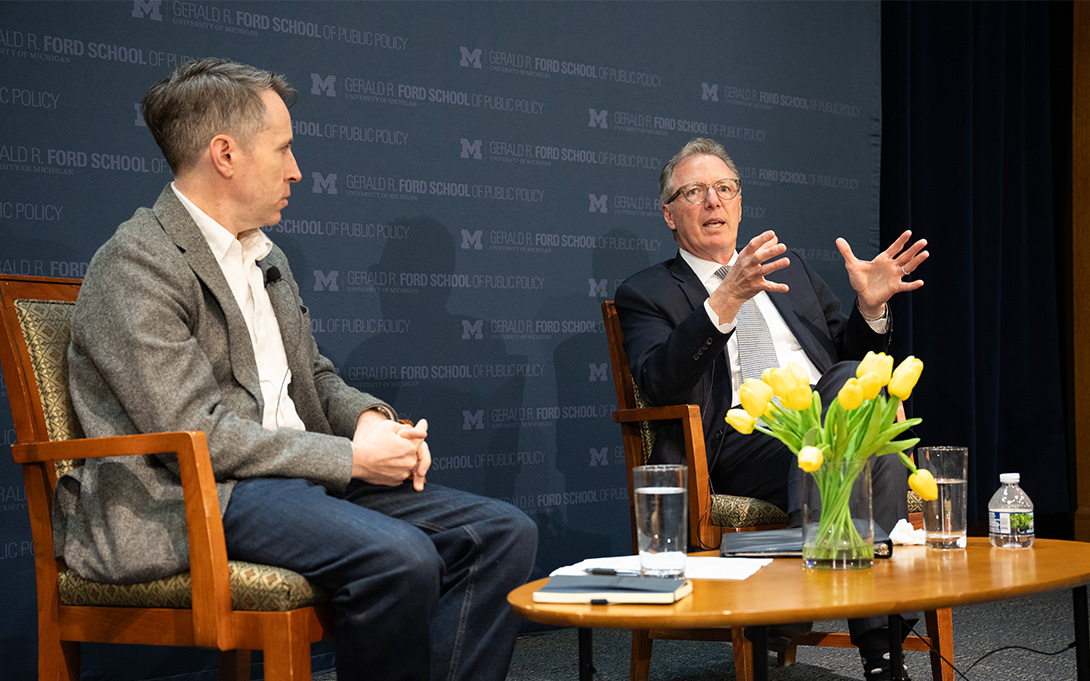
After Donald Trump took office in January 2025, a flood of executive orders cracked down on federal employment, many targeting independent government oversight agencies. Paul Martin, former USAID Inspector General, discussed ways in which the Trump administration has threatened independent checks on the government that have been in place for many decades.
Introducing the conversation, Threats to independent government oversight, with Ford School professor Don Moynihan, about independent government oversight, Martin explained exactly why these offices play critical roles in government operations. "The American public should care because if done correctly, this in-house oversight provides an apolitical, expert, independent check on agency personnel and programs. Moreover, IG audits and investigations have saved tens of billions of dollars over the years by identifying true waste, fraud, abuse, and mismanagement across the government," said Martin.
He also said that IG's are in place specifically to benefit government efficiency, not to help boost any particular agenda. Martin stated, "We write an issue, fact-based, evidence-based report. It's not to embarrass the particular president or agency or agency head or pump them up or do anything. It is fact-based that then the policymakers, either within the agency or in Congress, can use this bit of factual information to make better decisions." Noting that Congress has limited ability to conduct such in-depth checks, or neglects to, Martin raised concerns of increased fraud and corruption in the absence of independent government oversight officers.
"Congress does not have the staff or the capability to conduct such detailed agency-based oversight. IGS, on the other hand, are part of their agencies, and have access to all documents and personnel, and have been doing these kinds of reviews for decades… I am deeply concerned that the removal of 20 IG's without explanation, a requirement under the IG statute, and their replacement in several cases by nominees who publicly have pledged to support the president's agenda, has resulted in a distortion of the IG act and a chilling effect on aggressive, independent oversight," he said.
Commenting on the lack of communication from the Trump administration's decision to dismantle USAID, Martin expressed confusion over the reasoning. "I think if people, if adults, knowledgeable folks had gotten in the room and discussed these issues in a substantive way, they could have played a positive benefit. I mean, clearly, USAID, every organization I've worked in, the Department of Justice, NASA or USAID had their issues, had their problems, had their fraud, waste and abuse. But did USAID have it appreciably more than the Department of Justice or NASA? I would argue no… But that type of substantive ‘let's get to a positive end for America' never, never occurred in this instance," said Martin. Looking ahead at what's to come after the removal of 20 IG's, Martin offered his predictions for the future of independent government oversight.
"Let's just say, hypothetically, the Democrats take control in three years. What should be the Democratic response?... The Democrats take the high road and say, we want to get the system back the way it was. They don't change. Or should they fire them all and bring their own in? And the minute you fire them all and bring their own in, there's going to be a presumption in your mind that every new attorney general or every new secretary of state gets to bring his or her IG with them, and their loyalties will be for the agency head that brought them in. It's just different."
Martin conveyed uncertainty for what's to come for IG's under the next administration.
You can see the entire conversation here.
