
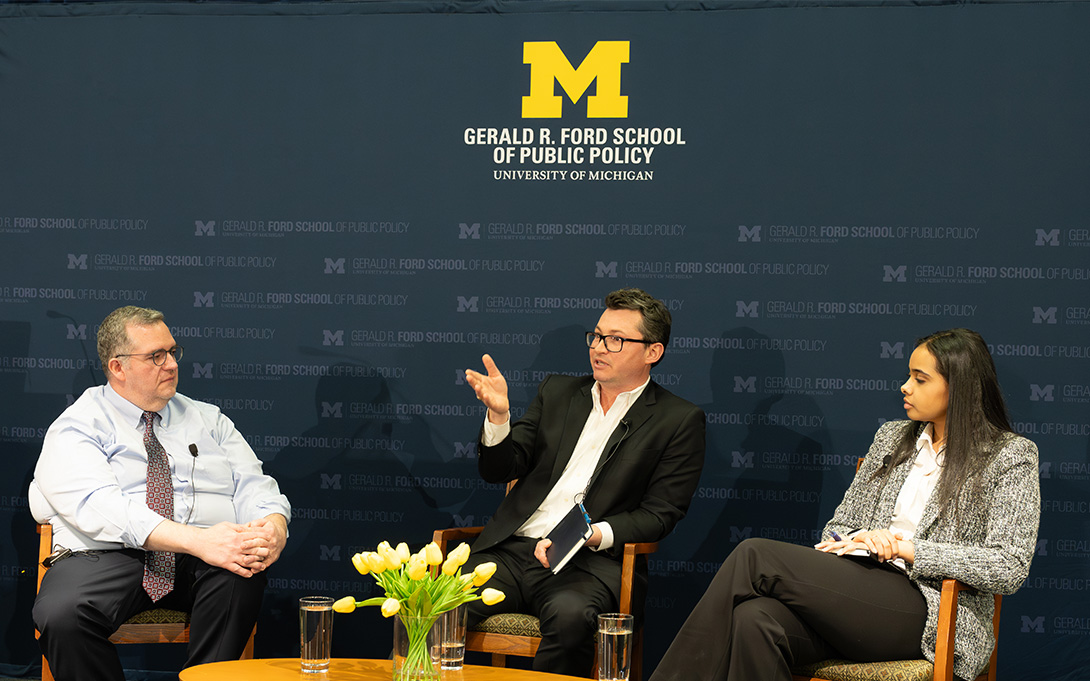
The Ford School's recent event on gun violence made two things clear: gun violence is preventable, and using public health tools to fight the crisis has already saved many lives. Rob Wilcox, President and CEO of the Fund for a Safer Future, joined School of Public Health professor Patrick Carter and Ford School student Jadden Kirchoff on March 24th. The discussion was sponsored by the Gilbert S. Omenn and Martha A. Darling Health Policy Fund.
Wilcox opened, "[Michigan State Chief Medical Officer health Dr. Natasha Bagdasarian] said, ‘Gun ownership isn't a public health issue, but getting shot is.' And I think that is the reason why it has been so important to take a public health approach to this crisis that doesn't just think about how we solve yesterday's shooting, but how do we stop tomorrow's?"
The conversation covered the landscape of the gun violence prevention movement, and the panelists shared that they have started to see encouraging signs. "We are seeing reductions in gun violence like we have never seen before," said Wilcox, noting that every major city across the U.S. hasn't had homicide rates as low as they are now in decades. Wilcox and Carter championed a four-part, public health-driven plan they've seen employed.
First, they said, is prevention—addressing the root causes of population-level violence, such as food security or economic security. Next are intervention strategies, which identify those most at risk of harming themselves or others, and provide the support they need to keep incidents of violence from occurring. Third, after a gun violence incident happens, is response: solving criminal cases and cracking down on illegal gun trade. The final part is recovery, which helps individuals, families, and communities recover from the act of violence and exposure to it.
However, there are still major gun violence challenges the country faces. While homicide rates are declining, firearm suicides are increasing. Additionally, some populations face more frequent harm from gun violence than others. Young people face higher rates of suicide and interpersonal violence with guns. Older adults, particularly older white men, also have higher suicide rates. Women are at greater risk of experiencing gun violence than men—intimate partner violence is especially a problem, with gun violence being the leading cause of death for pregnant women. Young children also face risk because of unsecured firearms.
The speakers also highlighted the need for more research. Experts aren't completely certain how homicides have dropped so significantly, and they are "still developing the evidence base. It's sort of like building the plane while you're where you're flying it already," Carter said. Studies are costly and take years to complete, making time and money barriers to more fully understanding the crisis.
Still, the experts are celebrating the evidence that large-scale change on gun violence is achievable. "I think we have a lot of good evidence-informed interventions. And so the sort of trick in the space is we can't let perfect be the enemy of the good." Wilcox said. "We have to continue to move forward with things we think are probably evidence-informed and that will work in this space."
If you missed it, you can watch the recording of "An Update on the Gun Violence Prevention Movement" here.