
Which histories enter public memory? Which remain in family archives or marginalized communities? And how might art create a setting in which inherited national ideals can be reconsidered?
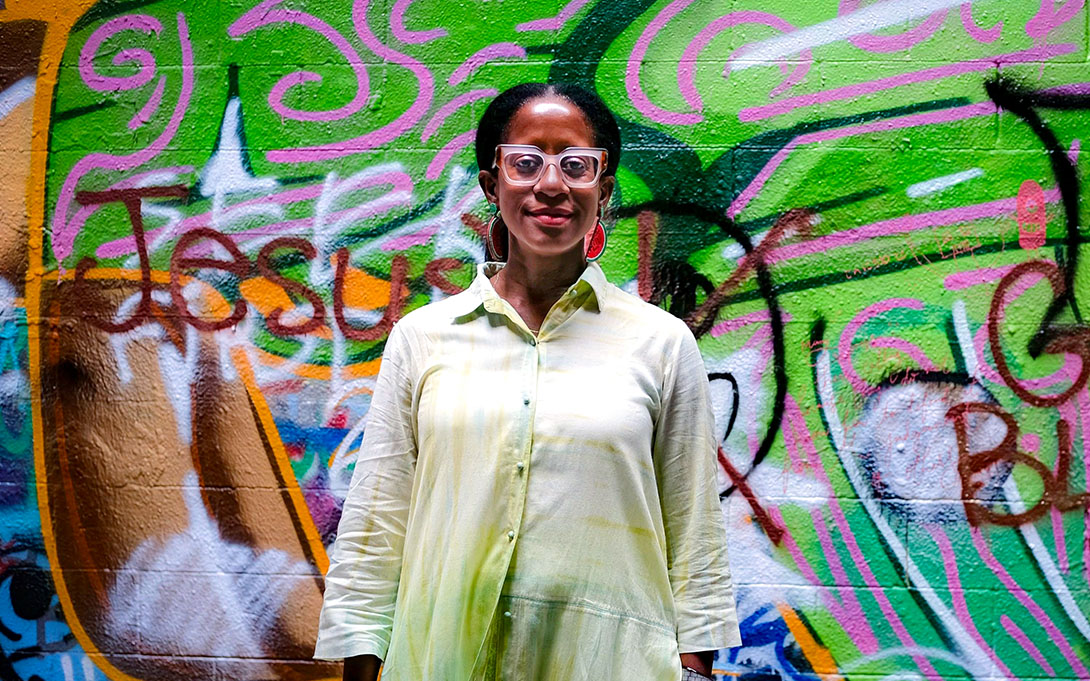
Holly Bass, the Ford School's fall 2026 Towsley Policymaker in Residence and U-M's 2026 Roman J. Witt Artist in Residence, explored these questions and more as part of a special Penny Stamps Speaker Series during the University of Michigan's Democracy Week—and previewed "We Hold These Truths," her exhibition opening Oct. 3 at the University of Michigan Museum of Art.
The exhibition examines 1876, 1976, and 2026—three major anniversaries of the nation's founding—to explore how Americans celebrate, debate, revise, and perform the national story. Inspired partly by historic house museums, Bass is transforming the museum's Apse into an environment that considers how public ideals are preserved in private spaces and passed across generations.

To open her talk, Bass asked the audience to share their wishes for their fellow Americans to inform an interactive performance. She also discussed her ongoing project "Cultural Preserves," inspired by watching her mother make preserves throughout her childhood. The community story collection project, which has taken place in Washington DC, Ann Arbor, and Detroit, asks event participants to write what they find most beautiful and most heartbreaking about America on strips of brightly colored paper and place them into jars, mimicking fruit preserves.
"I started thinking about the idea of preservation, and the phrase ‘cultural preservation,'" Bass said. "And usually when we hear that phrase, we think about buildings, landmarks. But the culture of a place is really defined by the people—we the people—who live there, and our stories."

Bass also asked the audience to answer two questions to inform a group performance: What makes a nation a home, and what blessings would they bestow upon their fellow Americans? At the end of her talk, she led the audience members through collective choreography, signaling each respondent's hopes for their fellow citizens with a movement repeated by the entire auditorium.
Bass' multidisciplinary practice spans visual art, dance, theater, journalism, education, and community engagement. As a Towsley Policymaker in Residence, she connects artistic practice to the Ford School's consideration of how public narratives influence political life.

As part of her residency at the Ford School, Bass will teach "Arts-Full Strategies for Public Policy," which will explore how artistic strategies can be applied to the development and implementation of public policy, as well as how the arts have been deployed as effective solutions for long-standing policy issues in areas as disparate as public health, education, and criminal justice. The course, offered to undergraduate and graduate students across the university, will offer experiential learning opportunities, including guest lectures and field trips, to encourage participation in the arts.
"I'm not a historian, and I'm not a policy expert. I learned about government from watching ‘Schoolhouse Rock' as a child," Bass said. "But I do know that in order for there to be a functioning democracy, ‘we the people' have to be involved. We have to participate beyond just voting. And I firmly believe that participating in the arts is a really beautiful and effective way for us to practice working together in our communities."
Watch Bass's full talk.
