
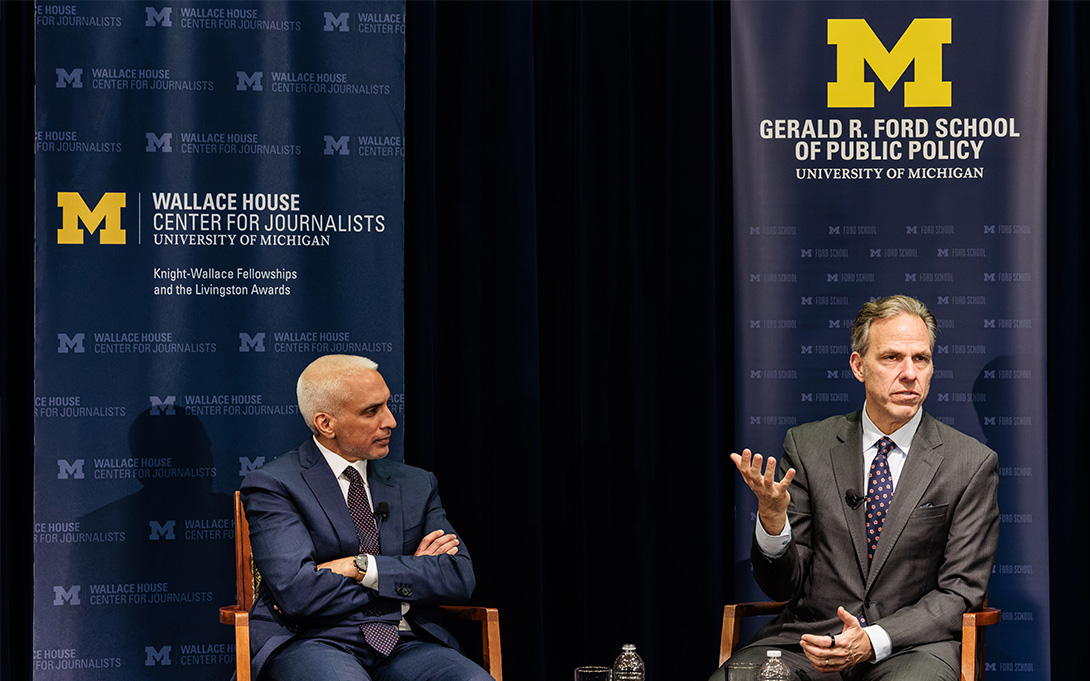
One of the most meaningful things a journalist can do is honor the lives of others by telling their stories, according to Jake Tapper as he set out to tell the stories of two American heroes in his book, "The Race Against Terror." The book covers the case of an Al-Qaeda member who was tried and prosecuted in the United States for the murder of two American soldiers who fought in Afghanistan in 2003. Tapper joined the Ford School's Javed Ali to discuss the book, the Al-Qaeda killer Spin Ghul, the fallen heroes, and the importance of positive storytelling.
(See the video here.)
"The Race Against Terror" follows the story of Al-Qaeda member Spin Ghul and the case that led to his conviction years after his attacks. Throughout the book Tapper highlights the efforts of U.S. law enforcement to work with foreign governments and trace back years of war evidence to build a strong case.
He noted one of the main difficulties in convicting Spin Ghul was that he had to be tried in a U.S. court. "[When we bring] these people to the United States to prosecute the… then they get rights and then judges treat them like a common defendant and then they get a fair trial and that means that they might actually not get convicted… So bringing Spin Ghul here was very risky by Bitcower," said Tapper of the U.S. attorney assigned to the case.
Another aspect of struggle in trying Spin Ghul was his defense claims of insanity. Tapper discussed a Jihadist tactic he utilized in court to strengthen these claims of incompetence. "There was this term, I'd never heard of it, but it's called the jihad of annoyance, which is there's nothing he can do to the west other than just be as difficult as possible and that is what he's going to do. He was just not cooperative and he would do inappropriate things in court, behind the scenes, etc., etc. And then at some point, his defense attorney started saying, ‘He's not competent to stand trial, as you can tell by his behavior.' And that became a big debate."
At the end of the day Tapper labeled Spin Ghul to be just as irrational as any extremist. "I don't think that it's really all that different from any extremist, no matter what the cause. A right-wing extremist or a left-wing extremist in the United States, people, young men who don't know what to do with their lives and are all of a sudden given some sort of mission. He found his calling or his mission and then he wanted to excel in that. And that was the art of terrorism. And then that was like the dark side of him." Tapper argued that the Al-Qaeda killer, in a search for self-purpose, was led down an unfortunate path pursuing terrorism. He declares Spin Ghul's upbringing is no different from other extremists, even seen through recent acts of political violence in the United States.
More importantly, Tapper wanted to share the stories of the fallen American soldiers who were victims of Spin Ghul's attack. Tapper spoke of the victims statements given before Spin Ghul was given a life sentence. Specifically, he focused on the statements made by Renley Dennis on behalf of his brother, U.S. soldier Jared Dennis.
"Renley felt the presence of Jared in the courtroom, and he talked about how he forgave Spin Ghul. And he talked about how maybe if he had been born in that circumstance, he'd be different, and maybe, if Spin had been born in his circumstance, he'd be different. And he was not going to spend his life hating Spin Ghul because Jared had lived and was always going to be with him… Being able to tell those stories is the best part of being a journalist because that's a story none of you would have heard if I hadn't written this book. And it is so meaningful and so moving to me, just the humanity of just the common, not just Americans, but obviously in this case of a common American guy from Oklahoma, just talking about how he was dealing with the worst thing that had ever happened to him. And that's why I wrote this book to tell those stories," said Tapper.
The conversation with Ali also went beyond the book, discussing the state of American media and growing polarization across the country. "The culture is meaner and nastier than I've ever seen it. Now that's not just because of Donald Trump. It's for a whole bunch of reasons. It's social media and the algorithms, you know, promoting conflict," Tapper described how new social technologies are constantly promoting negative narratives.
Tapper concluded the conversation with advice and sentiments of hope. "I would encourage people to consider the source and why people are saying what they're saying… There are a whole bunch of people in different information silos whose job it is to demonize other people… I see things all the time on social media that are just false, that are just completely inaccurate... Just don't just take anything at its word would be my advice." Although the information silos and misinformation are often discouraging, Tapper added that the younger generations give him hope. "I have hope because I see Gen Z, I see your generation having a sophistication about this and having a sophistication about how unacceptable it is. I have hope that we will be in a better place at some point."
