
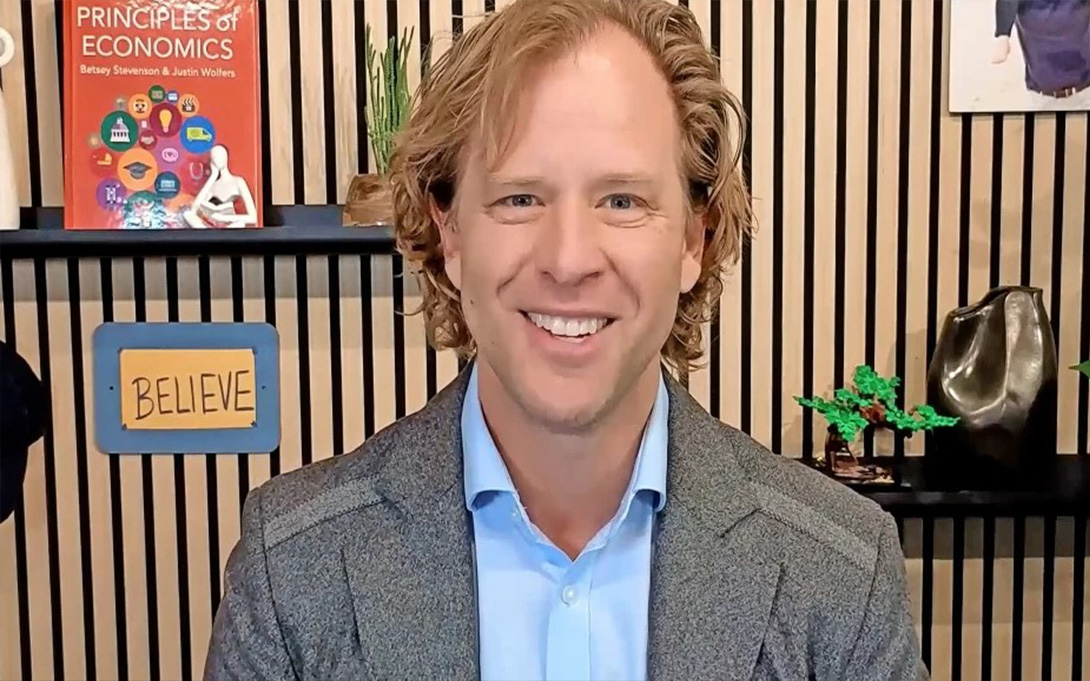
Economics is often treated as something distant, reserved for policymakers, markets, and experts. Justin Wolfers sees it differently. To him, economics is a practical tool for understanding everyday choices, public policy, and the forces shaping people's lives.
That belief is at the heart of Platypus Economics, a new public education platform launched by Wolfers, a Ford School professor of public policy and economics. Platypus uses videos, podcasts, newsletters, and social media to meet people where they are, helping them better understand the choices, trade-offs, and policy debates shaping their lives.
Wolfers sat down with the Ford School to discuss the urgent need for economic literacy, the meaning behind the platform's unusual name, and how Platypus aims to help people make sense of today's economy and political climate.
>>See also: A profile about Platypus Economics in the New York Times.
Why does the world need an economics explainer right now?
I guess we all have different theories of what ails the world right now. But I look at many of the things that worry me and think they actually stem from economic illiteracy. At the highest level, some of the biggest economic shocks we're facing are self-imposed and result from failing to understand introductory economics.
But it's not just about the big issues. Think about the choices you make and the decisions that really matter. Should you buy a house or rent? Should you lease a car or take a ride-share? Should you get married while you're young or keep searching? Is now a good time to pursue higher education or stay in the workforce?
These are all questions where economic logic can guide the way, light the path, show you the true trade-offs, and help you make a better decision. They're enormously consequential.
What does the name Platypus Economics signal about your approach or point of view?
Platypus is an amazing character. First of all, he's Australian, which naturally, I'm sympathetic to. The first time the British saw a platypus—it's an incredible story—one of them asked for scissors to cut it up because they were sure it was a stuffed dummy that someone had sewn together: a duck's beak, a beaver's tail, and some other animal parts in between. The platypus defied all categories.
So, confronted with evidence of a new type of animal, they rejected that evidence in favor of their models, which said a mammal can't lay eggs. They didn't believe what was right in front of them. It's a story about sticking too closely to your prior theories instead of facing reality squarely.
Well, a platypus shows you the world can be pretty weird. It's like the economy. At Platypus Economics, we want to be eclectic. We want to be realistic, reality-driven, and maybe even a little bit irreverent sometimes.
What's the biggest misconception about economics you want to correct for a general audience—and what do you wish people understood instead?
On the first day of class, I usually begin with one sentence: "Economics is not about money," which many students find surprising. They think of it as being about the stock market, about money, and about supply and demand. But it's not. Economics is about, in the words of
Alfred Marshall, people in the ordinary business of life.
It's the choices you make every single day, the trade-offs you face, the plans you make. They're all economic in nature. Think about the factors you have to consider when you decide what time to set the alarm tomorrow. You're thinking about the cost of time, the risk of being late, and the possibility that the bus won't arrive on time. You're comparing the costs and the benefits, and you're thinking about the alternative things you could do with that time. This is all fundamentally economics.
How do you hope busy working adults will use Platypus in their daily lives?
Platypus economics is two things. First, it's a bloke in his office with a camera. And second, it's a new media company that meets people where they are, because I think the gift of economics is beautiful.
I understand how busy your lives are, and I want to meet you there, whether it's on a podcast while commuting to work, or sneaking in a few moments of YouTube between meetings. If you're someone who likes to read, I'll see you on Substack. If you're a busy parent and the best you can do is the occasional guilt-scroll late at night when the kids aren't around, I'll see you on your social media feed. My hope is that the insights of economics prove useful, and every time someone encounters and interacts with Platypus Economics, they walk away feeling a little smarter and a little better prepared for life.
Let me also just acknowledge that right now, life and the economy feel fraught. A lot of people feel enormous anxiety, and so understanding the sources of those deeper currents that are driving our lives can be a tremendous salve to that anxiety.
What's one recent economic story where Platypus would help people interpret what they're seeing?
I've been very vocal about the trade war and helping people understand it. Rather than writing down complicated models or showing lots of complicated graphs, I'm bringing it down to an even more fundamental lesson from economics. President Trump tends to see an economy as being about competition: If you lose, we gain. But actually, economists understand the economy as being about cooperation. How can you and I work together? Whether we're friends, roommates, lovers, or people in different countries, how can we work together? How can we divide up the tasks that make each other better off? Once you understand that insight, you understand the beauty at the heart of economics, but also the folly at the heart of trying to prevent international trade.
I'll give you another example because it's very much in the news and on my mind right now: the war in Iran. The Pentagon just released a number saying the war so far has cost $25 billion. Sounds like a lot, but in macroeconomics, it's not that much. The economic costs of war are enormous. It's not 25 billion; it's hundreds of billions of dollars, maybe even trillions. As the country considers what it wants to do in Iran, yes, there are moral issues, ethical issues, yes, and foreign relations issues. But economics also tells you that the stakes are enormous for the American people. Analyzing a particular war in real time is not normally something academic economists do, but it seems essential that we pencil these things out in real time so people understand the consequences of the choices we make.
What's something you've learned from your students that directly shaped the format, tone, or topics for Platypus Economics?
The format for Platypus comes straight from my students. As academics, we're used to the printed word. That's where the prestige is. That's where our dusty old journals are. That's where reputations are won and lost. But what I've learned from my students is that's not necessarily how they consume information. They spend hours on podcasts and many, many more hours on YouTube than on television.
If I want to teach them, I have to meet them where they are. And if that means that, at age 53, I have to learn what TikTok is and how to package economics into two-minute sound bites, that's what I'm going to do.
I've also learned that young people are full of dreams, hopes, and ambition. Each of them has enormous dignity and aspirations that deserve to be taken seriously. What I want to do is teach in a way that gives voice to those aspirations and helps them live up to them. I never want it to be just about the book, the textbook, or what's on the next test. I want it to be about giving them the equipment to make better choices and live better, richer, fuller lives.
