
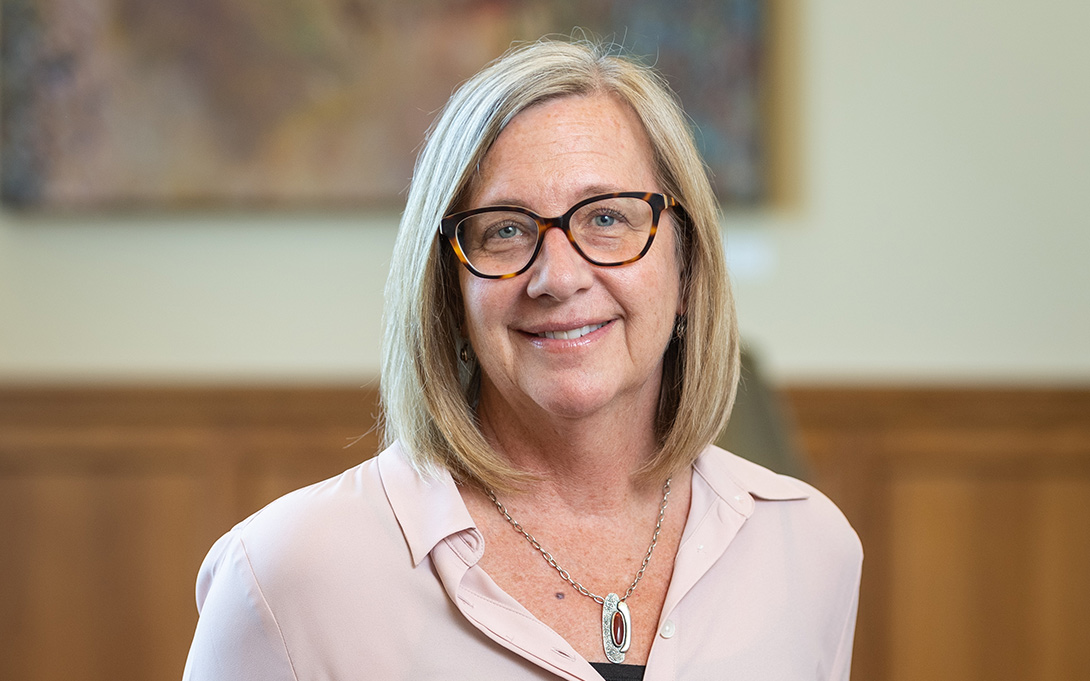
Paula Lantz, whose work has helped shape national conversations about social determinants of health, will retire from the University of Michigan on May 31, 2026.
Lantz is the James B. Hudak Professor of Health Policy at the Gerald R. Ford School of Public Policy. She is also a University Professor of Diversity and Social Transformation and a professor of health management and policy in the School of Public Health.
A social demographer and social epidemiologist by training, Lantz's research has examined the role of public policy in improving population health and reducing social disparities in health. Her recent work has focused on abortion policy, housing policy, and how health care systems and insurance plans are attempting to address patients' social needs.
In recognition of her work, Lantz was elected to the National Academy of Medicine in 2012 and the National Academy of Social Insurance in 2018. She received the University of Michigan Distinguished Faculty Achievement Award in 2023.
During her 28-year tenure at U-M, Lantz taught and mentored more than 3,000 students and postdoctoral fellows. Reflecting on the lessons she hopes students carry with them, Lantz pointed to a combination of analytic rigor and recognition of values.
A Ford School education, she said, "helps to bring together objective analysis, recognition of the role of values and ethics in policy and politics, and strong communication and leadership skills. Together, this is the magic that allows our community to work in service of and contribute to the public good."
She has extended that approach beyond the classroom through her Michigan Online course, "Using Public Policy for Social Change," reaching more than 20,000 non-degree learners worldwide.
At the Ford School, Lantz played a central role in advancing significant curricular and co-curricular initiatives. These included developing policy concentrations in the Master of Public Policy program, launching the one-year Master of Public Affairs degree, and creating the Ford School's Leadership Initiative. She also helped strengthen the school's core curriculum and advising structures, with a focus on the student experience and leadership development.
"Paula has defined what it means to do public policy in service of health and equity," said Celeste Watkins-Hayes, Joan and Sanford Weill Dean of the Ford School of Public Policy. "She has influenced a generation of scholars and policy professionals through her scholarship, teaching, and leadership. We are deeply grateful for her many contributions to the Ford School and the University of Michigan."
Lantz held several leadership positions at the Ford School, including associate dean of academic affairs (2016-2021), associate dean of research and policy engagement (2015-2016), and undergraduate program director (2022-2025). She also served as chair of the School of Public Health Department of Health Management & Policy (2005-2011) and directed U-M's Robert Wood Johnson Scholars in Health Policy Research Fellowship Program (2002-2011).
Throughout her career, Lantz led major, policy-relevant research initiatives. Colleagues credit her with shaping national conversations about the social determinants of health and bringing clarity to the policy implications of addressing social needs.
"Paula is a leading scholar whose work has been foundational for understanding the role of public policy in addressing health-related social needs, and particularly the implications of such policies for the most vulnerable, high-risk populations," said Denise Anthony, Rubin Department Chair of Health Management and Policy at the School of Public Health. "Her ongoing contributions to health policy have played an important role in improving population health in Michigan and across the country."
Lantz's research helped inform the passage of the Breast and Cervical Cancer Prevention and Treatment Act of 2000, enabling state Medicaid programs to expand coverage for uninsured women diagnosed with cancer through a CDC screening program. "All states ended up opting for this Medicaid expansion," she noted, and the change significantly reduced breast and cervical cancer mortality among low-income women.
More recently, Lantz has helped clarify policies that do not work as well as hoped. Her work on social impact bonds, often called "Pay for Success," highlighted both its potential and challenges, and helped temper policymakers' enthusiasm for the model.
As a regular contributor to The Milbank Quarterly, Lantz has written widely read commentaries on current population health issues, and she has continued to speak publicly on the health and equity implications of restrictive abortion policy. During the COVID-19 pandemic, she served on the National Academy of Social Insurance COVID-19 Task Force and was the lead author of an amicus brief supporting Michigan Gov. Gretchen Whitmer's use of emergency powers.
In retirement, Lantz plans to continue teaching in a limited capacity, writing policy opinion pieces, and supporting amicus briefs with research and evidence. She also plans to remain active in local service, including board roles at Packard Health, while pursuing personal goals that include finishing her personal trainer certification, traveling and hiking, expanding her culinary skills, and spending quality time with family and friends.
