
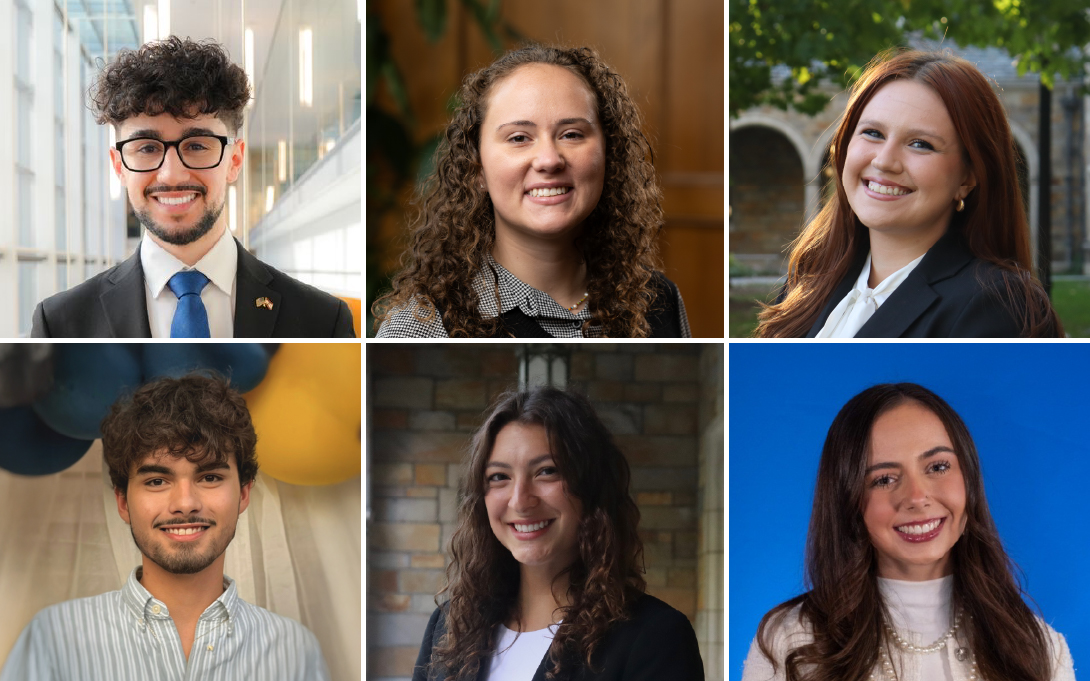
In a rapidly changing international order, understanding where exactly the United States stands is crucial for national security and international relations policymakers. Last semester, I had the privilege of doing just that as a team lead for the Ford School's undergraduate Diplomacy Lab team alongside Pilar Steward (BA ‘27).
The Diplomacy Lab is a State Department-run partnership with accredited colleges and universities across the country, providing undergraduate and graduate students with the opportunity to conduct research on foreign policy and diplomacy. As one of the State Department's official partners, the Ford School's Weiser Diplomacy Center (WDC) regularly sends teams to work with leading foreign policy professionals.
Having just recently been admitted to the Ford School, I was eager to seize any opportunity that came my way. I put together a team of a few Fordies I knew were passionate, strong leaders—Pilar Steward, Amr Brown (BA ‘27), Allison Tate (BA ‘27), Emma Macaluso (BA ‘26), and Gabriel Sanroman (BA ‘27)—with backgrounds in global health, diplomatic relations, foreign affairs, national security, and peacekeeping policy. We chose a focus titled "Out-Negotiating China" from the DipLab project guide, an analysis of China's influence on G77 relations at the United Nations, particularly within the 2nd Committee, and whether U.S. or Chinese bilateral investment into five sectors—defense, foreign direct investment, foreign aid, trade, and remittances—had any impact on a country's political alignments at the multilateral level. As a team of five juniors and one senior, we weren't expecting our project proposal to move very far. But the State Department's Bureau of Economic Affairs (BEA) took a chance on us, and we were lucky enough to be selected as one of 100 teams in the nation for the 2025-2026 academic year.
Thrilled at our good fortune, we jumped into action immediately. As a team lead, I coordinated meetings across continents and time zones—our team members had policy internships in Ann Arbor; Traverse City, MI; Washington, DC; Amman, Jordan; and Cape Town, South Africa—to begin the data collection process and prepare to meet our contacts at the State Department.
Our enthusiasm was quickly halted after a series of setbacks brought on by sweeping federal policy shifts. In July, our research shifted to new supervisors in a different department, the International Organizations Bureau, since the BEA had been shuttered and its personnel laid off or reassigned. In September, the government shutdown meant our contacts at the State Department had to cut off all communication with our team. For many of us, this was our first quantitative research project, so it would be an understatement to say we were lost about how to navigate such conflict.
Ultimately, we pushed forward. After conducting interviews with many Ford School faculty members—Ambassador Kamissa Camara, Ambassador Susan Page, and Professor Amy Beck-Harris—to gain a better understanding of the U.S. position abroad, we measured voter coincidence at the United Nations to understand how frequently G77 countries aligned with the U.S. and how often they aligned with China.
Once we had the voter coincidence data, we had a better picture of what the U.S. engagement with the G77 at the UN looked like, but we needed to better understand bilateral engagement to compare U.S. alignment bilaterally and multilaterally. We chose 5 major investment sectors—foreign direct investment, defense, trade, remittances, and foreign aid—that both the US and China engage in. These sectors are universal, in that investment is not limited to a specific country or region, and are highly relevant to many of the developing countries in the G77. After collecting over 16,000 individual data points and meeting with staff at the Policy Analysis Learning Lab (PALL), we conducted a statistical analysis that mapped out how economic and diplomatic relationships shaped voting patterns at the multilateral level. Our findings showed no statistically significant correlation between bilateral investment and multilateral alignment—meaning that diplomacy between the U.S. and its G77 partners doesn't translate into partnership on the global stage.
Earlier this month, we presented our findings and final research brief to senior DoS leadership, the final step of our very nontraditional Diplomacy Lab experience. Whether working without State Department guidance or just trying to keep our project alive, we faced several months of obstacles that could have jeopardized our research and chose to persevere, learning the intricacies of foreign policy and diplomacy and the value of creative problem solving. We couldn't have done it without the incredible support from the Ford School faculty and staff, and we're forever grateful for such a formative experience.
You can find more information about the WDC's past projects here.
Margaret Peterman is a junior at the Ford School from Rochester Hills, MI. She is studying U.S. national security policy and hopes to pursue a career in intelligence, defense, and/or foreign policy. At U-M, Margaret serves as the Director of External Affairs for Central Student Government, the Director of Legislative Affairs for the Association of Big Ten Students, and a national security researcher for the Michigan Foreign Policy Council.
