
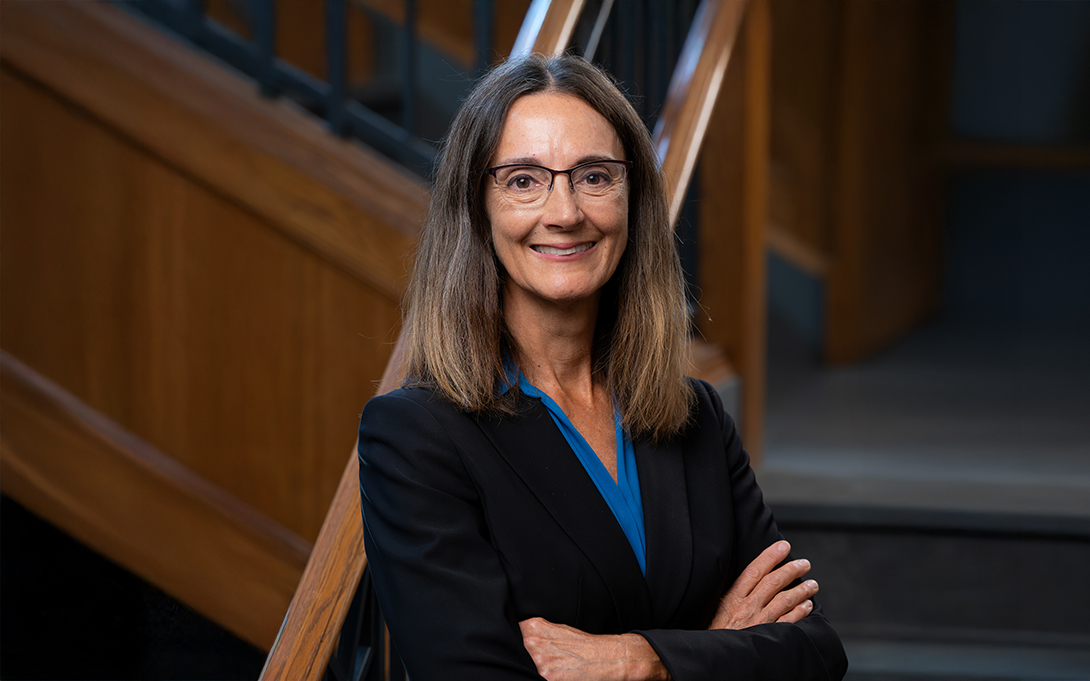
— Written by Elisabeth R. Gerber, Jack L. Walker, Jr. Collegiate Professor of Public Policy and faculty director of the Online Master of Public Affairs program, for The University Record.
At the Ford School, I have spent many years thinking with colleagues about how people learn to lead in public life.
Public leadership is not something that happens only in city halls, legislative chambers, or nonprofit boardrooms. It happens in the messy spaces between them — in budget meetings, neighborhood conversations, emergency responses, coalition-building efforts, and moments when institutions are asked to earn public trust.
The people doing that work are often deeply committed to the public good. They are managing problems, serving communities, leading teams, analyzing data, responding to crises, and trying to make systems work better. Many are also often balancing family responsibilities, financial constraints, and commitments to the places they live and serve.
For many public leaders, a graduate degree would provide new skills to help them advance their careers and further serve their communities. But the traditional model of graduate education — full time and in-person — is out of reach. It would require them to leave their job, relocate to Ann Arbor, and step away from the very communities where their leadership is needed.
That tension has stayed with me.
A new online program
At the Ford School, we teach increasingly essential skills: policy analysis, public management, strategic communication, negotiation, leadership, economics, and evidence-based decision-making. We prepare students to ask hard questions, weigh tradeoffs, communicate clearly, and act with integrity. But if the tools are available only to people who can pause their careers and come to campus full time, we are leaving too much talent on the sidelines.
So when Dean Celeste Watkins-Hayes asked me to serve as faculty director of the Ford School's new Online Master of Public Affairs program, I saw an opportunity to help carry forward a vision many Ford School faculty and staff had been carefully shaping for years.
The question was never simply, "Can we put a degree online?" The more important question was, "Can we expand access to a Michigan public policy education without losing what makes that education meaningful?"
For me, that meant beginning with what we know about learning. I have spent many years experimenting with engaged teaching and learning approaches, including using client-based projects and role-playing simulations to help students step into complex policy problems, inhabit different perspectives, and practice decision-making in realistic settings. These approaches foreground a key insight: People learn best when they are active participants, when others' perspectives challenge them, and when they can connect ideas to real problems.
The pandemic also taught us important lessons about online education. We learned that simply moving a 90-minute lecture to Zoom is not enough. Online learning must be designed differently. It needs shorter bursts of content, intentional interaction, collaborative work, live discussion, and multiple ways for students to engage across time and distance.
Most of all, it needs community.

Leaning into our strengths
One of the Ford School's greatest strengths is that we are small enough for students, faculty, and staff to know one another. Our students learn not only from faculty but from classmates whose experiences stretch across sectors, disciplines, and communities. As we built the Online MPA, we were determined that online students would not feel peripheral to the school. They would be Fordies.
That is why the program includes small cohorts, weekly live engagement with faculty, strong student support, and two required residencies in Ann Arbor. When our first cohort came to campus in January, the value of that choice became clear. Students who had met online were suddenly talking over meals, working together in leadership sessions, walking through Weill Hall, and seeing themselves as part of the University of Michigan community.
One student wrote afterward that the online program would feel different now that the cohort had met in person and formed relationships. Another said being on campus made them feel like Fordies for the first time.
That sense of belonging matters. It is not separate from academic rigor; it strengthens it.
Our inaugural cohort included 22 midcareer professionals from government, higher education, health care, law enforcement, the military, and the private sector. This fall, 25 new students will join the program, further broadening the range of perspectives, professional experiences, and community commitments represented in the classroom. These students bring real-world experience and practical urgency. They are not preparing someday to serve communities. They are serving them now.
That is especially important here in Michigan. Online education can reach across the country, but it also gives us a powerful opportunity to support leaders close to home. Through generous support from Nancy and Arn Tellem and The Skillman Foundation, the Ford School is expanding financial access for students with connections to Metro Detroit. As The Skillman Foundation's Sarida Scott has said, "There's nothing more powerful than homegrown solutions."
I agree. Public policy education is most powerful when it strengthens the people already working to improve the places they know best.
Life-changing education
The University of Michigan's promise of a life-changing education should not be limited by geography, schedule, or life circumstances. If we are serious about developing leaders who can advance the public good, we must design pathways for people whose lives do not fit the old model of graduate education.
That does not mean lowering standards. It means raising our ambition.
It means asking how we can preserve rigor while increasing flexibility; how we can build community across distance; how we can connect research, teaching, and practice in ways that serve people beyond campus; and how we can recognize leadership potential in those who are already doing the hard work of public service.
For me, the Online MPA is one answer to those questions. It is not the only answer. But it reflects a larger commitment that should matter across the university: excellence and access are not competing values. At our best, they strengthen one another.
