
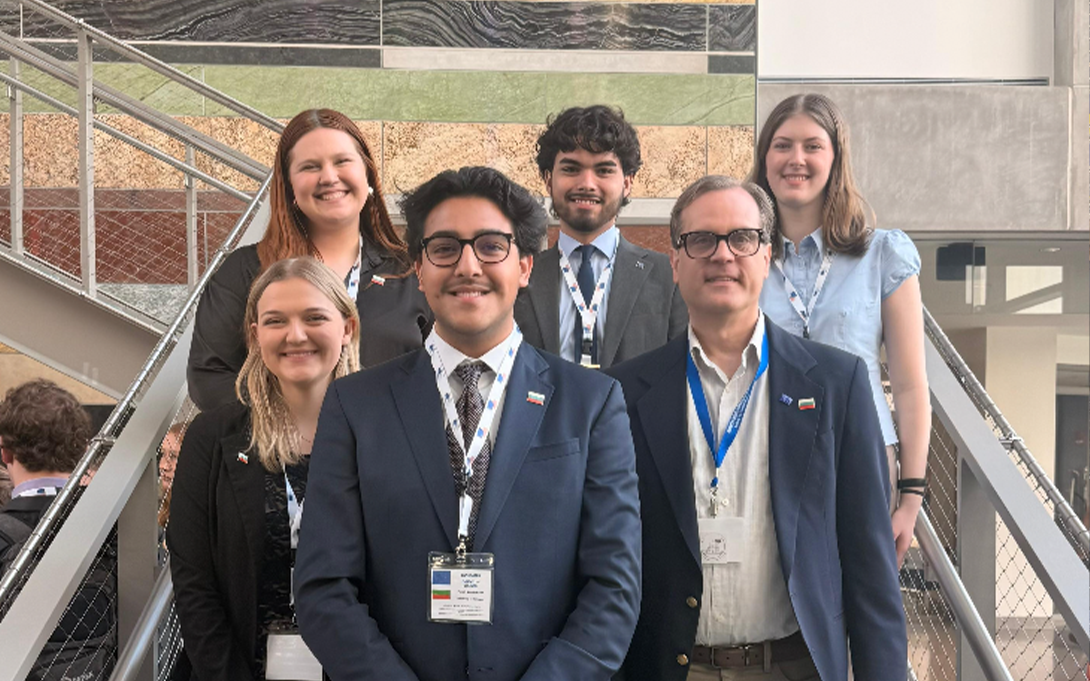
Ford School students Margaret Peterman (BA ‘27) and Edra Timmerman (BA ‘26) won awards for their performance at the Indiana University–Bloomington Hamilton Lugar School's 2026 Midwest Model European Union (MMEU) competition.
Peterman, Timmerman, and three other Ford School students—Gabriel Sanroman (BA ‘27), Patrick Szendro Arceo (BA ‘26), and Leah Adams (BA ‘27)—represented members of the Bulgarian government at MMEU in April, working to navigate international crises and address the most pressing issues facing the European continent today.
After three days of proposing, amending, and debating legislation, delegates from over 20 colleges and universities around the country voted on the top three representatives in each EU committee. Peterman won first place for the Economics and Finance Committee, while Timmerman won third place for the Environmental Affairs Committee.
Peterman said the experience taught her how states leverage multilateral institutions to advance their legislative agendas, and how international policy is often shaped by the domestic politics of member states.
"It's easy to only view international issues through the perspective of American interests and politics," Peterman said. "Competing as the Bulgarian financial minister helped me develop a new understanding of transatlantic security, economic, and social issues."
Timmerman said MMEU helped her expand on the content she learned during PubPol 480: "Global Engagement Seminar"—an experiential learning course that brings undergraduate students to Brussels, Belgium—and practice her public speaking skills.
"After working on environmental policy my entire undergraduate career, it was an honor to be recognized for my passion and policy recommendations as Bulgaria's environmental minister," she said. "This competition was the perfect way to finish my undergraduate career and showcase the culmination of my experiences at U-M."
Jonathan Hanson, Ford School lecturer and faculty advisor for the U-M delegation to MMEU, said policy simulations like Model EU can help students dive into foreign policy issues.
"A really great thing about a policymaking simulation like Model EU is that it forces the participants to put themselves in the shoes of other people," Hanson said. "They have to internalize the motivations and preferences of different decision makers and stakeholders, as well as learn the rules of the governmental system in which they are operating. A simulation has a way of making this more engaging and real than regular classroom activities."
By Margaret Peterman (BA ‘27)
