
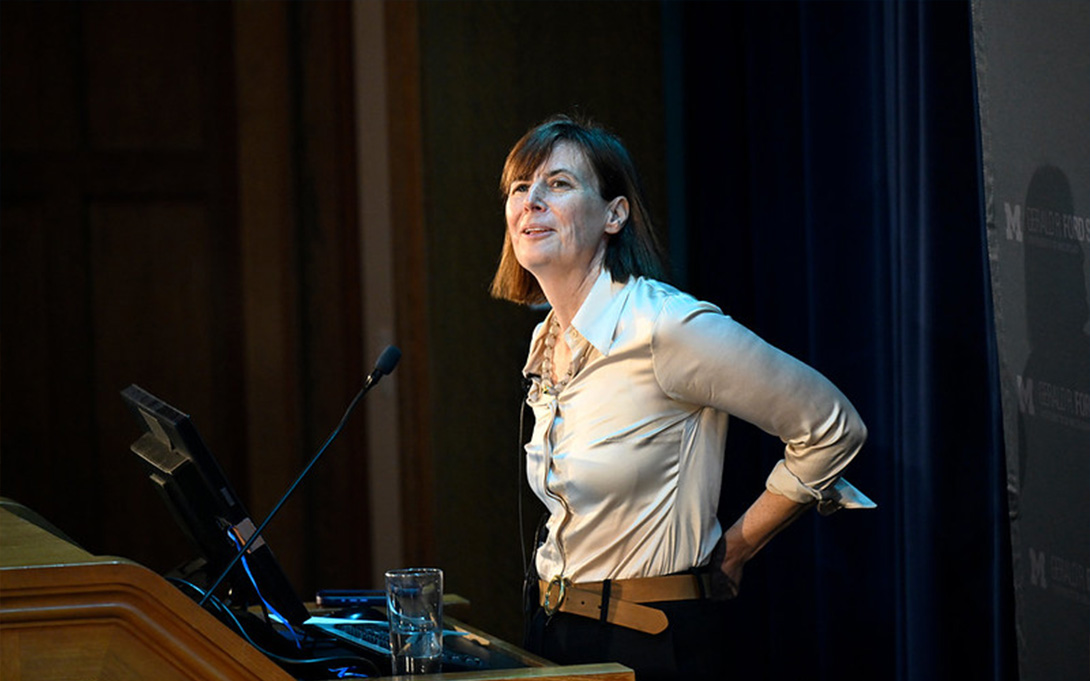
Administrative barriers are burdening the already disadvantaged Americans seeking life-saving benefits and aid. That was the theme of the Ford School's Pamela Herd as she delivered her inaugural lecture as the Carol Kakalec Kohn Professor of Social Policy, titled "Making it hard: How administrative burdens affect inequality."
Herd's professorship is an aspect of the Kohn Collaborative for Social Policy, an initiative launched by Hal and Carol Kohn at the Ford School in November, 2021, which catalyzes interdisciplinary research and policy impact to promote social equity and inclusion for all U.S. residents.
The Kohn Collaborative consists of six endowed professorships, and Herd is the fourth to be named. The other pillars of the Collaborative are the Kohn Scholars, and a focus on policy impact.
In her discussion of the associated costs that Americans face when they apply for government benefits, Herd argued that administrative barriers are deepening inequalities across America.
She described how administrative burdens effectively violate the government's stated goals. "Policies… are promises to help us oftentimes in moments when we are the most in need, when we are the most vulnerable, but we really fundamentally break that promise when we put all of these hurdles in the way," said Herd.
Herd highlighted three specific costs: "Learning costs, compliance costs, and psychological costs." She explained that learning costs are the efforts expended to understand a government program and the qualifications for receiving benefits. Compliance costs are the time spent filling out paperwork and making phone calls to gain enrollment into government programs. And psychological costs are the emotions one experiences throughout the administrative process, whether it be stress, frustration, sadness, or anger. These costs are the burdens Americans face each time they sign up for or renew enrollment into a government benefit program, and they are forcing inequalities on those who must access these programs to survive.
Burdens are tricky because they are often imposed behind closed doors to sneakily restrict access to certain programs. Herd stated that the "Thing about burdens that makes them effective as a political tool or form of policy making by other means is that it is an easy way to hide what you are doing. Most of us really don't want to pay attention to the underlying bureaucratic processes in your own university… or your workplace, let alone in government. It's hard to see that stuff. We are oftentimes not aware of it, we don't understand how the processes work, and there's a lot going on beneath the surface. So, it becomes an easy place to jigger with things without people really understanding what's going on."
Americans face more than frustration when accessing government services; difficult administrative interactions can also erode trust in government "When you have a ton of negative interactions. Your ability to trust the government moving forward is probably reduced," declared Herd.
Herd closed with an encouraging sentiment: the bureaucrats who administer these programs want to see them succeed and work well. She hopes that with their help, administrative processes can be made more efficient and less burdensome for the people they serve.
