
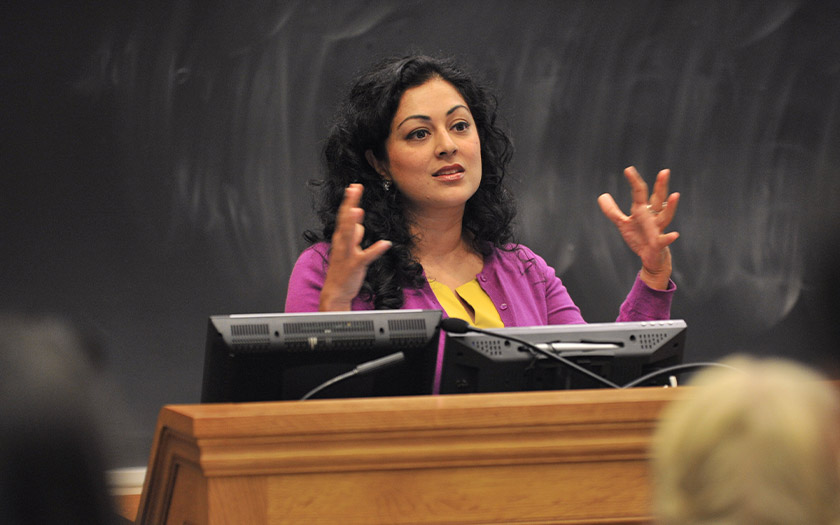
In her latest column for Science, Ford School Professor Shobita Parthasarathy argues that while governments and tech industries oppose regulation in order to stimulate innovation, marginalized communities face compounding risks in the process, becoming "sacrifice subjects," building on the idea of "sacrifice zones" developed in environmental justice discussions. She advocates for tech policies that consider these harms, pointing to the innovative approach of ANSES, the French risk assessment agency.
Read the column below. In case you missed it, here are the first two columns:
- "Repairing trust in science requires a more inclusive understanding of innovation," published January 2026.
- "Beware the Drive to Scale Technology", published September 2025.
"Sacrifice subjects" and a proposal for people-first technology regulation
By Shobita Parthasarathy for Science
In March 2026, juries in California and New Mexico found Meta and YouTube liable for user injuries, including addiction, anxiety, depression, and thoughts of self-harm. After years of dashed hopes for meaningful governance, analysts of technology rejoiced. Citizens had led the way, deciding that technology companies had not just designed unsafe products but turned a blind eye to their harms even after the risks were clear. These judgments have laid the groundwork for thousands more plaintiffs and established expectations that product liability lawsuits may be the best strategy for reining in Big Tech, as they did with Big Tobacco.
But the courts are, at best, a partial solution to managing the risks of emerging technology. Litigation is expensive, takes years, and begins only after damage occurs. It is extremely narrow in scope; available only to those who can demonstrate direct injury. And, it cannot address how the harms of technology aggregate in communities that are already marginalized.
Consider MiDAS, the artificial intelligence (AI)–enabled system instituted by the state of Michigan in 2013 to identify unemployment fraud. From the state government's perspective, it was effective. It enabled staff reductions, fraud detection jumped five-fold, and the state garnished wages (and exacted extremely high penalties) from the 40,000 people the system flagged. However, it soon became clear that the algorithm was flawed, and after filing a class-action lawsuit a group of falsely identified people received a $20 million settlement along with $20.5 million from the Michigan state legislature. But these results took 9 years, and the settlement was a paltry sum for each individual. In the interim, the victims—who were under severe stress after losing their jobs—experienced additional anxiety and a loss of money that, for some, led to home foreclosures and other precarity. All of this could have been avoided with regulation that included holistic risk evaluation.
The victims of MiDAS are what we might call "sacrifice subjects." Writer and researcher Steve Lerner coined the term "sacrifice zones" to refer to areas surrounding heavy industry and military bases. In the name of industrialization and national security, the people who live in these places—invariably low-income communities and people of color—experience poor health, environment, and economic conditions. But their sacrifices go unrecognized and uncompensated and are often made without their consent. Similarly, some people are harmed systematically as the public and private sectors pursue technological innovation without appropriate governance. These sacrifices often accumulate in historically marginalized communities, exacerbating inequality and injustice.
Many people with disabilities, for example, depend on technology—from wheelchairs to screen readers. But they often struggle to find assistive interventions that meet their needs and budgets. Once they do, these technologies become central features in their lives, but they may pose risks. Consider how people who rely on long-term intubation must contend with the problems that microplastic shedding can bring. Over time, a developer might go out of business or simply update a technology, rendering the old version difficult to repair or simply obsolete. Even if a disabled person is able to manage the disruption that comes with a new technology, it is often unaffordable.
Meanwhile, when people with disabilities seek employment, they increasingly confront a hiring landscape guarded by machine learning algorithms. Employers sometimes use these technologies to identify promising applications and even to evaluate the suitability of a candidate's personality traits based on video interviews. But these technologies are shown to discriminate against people with physical disabilities and those who are neurodivergent.
Historically disadvantaged people of color are in a similar situation. Racial bias is baked into many medical technologies including the spirometer, which incorrectly presumes that Black people have inferior lung capacity. This design bias affects medical care and health outcomes as well as opportunities for compensation when injured at work.
Like people with disabilities, communities of color also experience algorithmic discrimination when applying for jobs. And they are subject to increasing government control through a wide variety of surveillance tools. Such technologies don't just produce false arrests and expand what counts as criminal behavior, they also increase feelings of social alienation. Adding insult to injury, communities of color have become lucrative sites for data centers to power these technologies, which increase energy costs, water scarcity, noise pollution, and risk of Legionnaire's disease.
The conventional approach to regulating technology does not consider how certain types of technologies tend to impact society historically, and it ignores how harms tend to accumulate in certain communities. It does not offer solutions for the cumulative risks that sacrifice subjects experience. And, it neglects how different users might experience and balance risks differently and overlooks how technologies produce social, moral, and political change on a large scale.
Instead, concerned that oversight will "stifle" innovation, governments tend to focus narrowly on quantifiable risks to individual health, the environment, and sometimes the economy. They then balance these risks against a technology's utility and benefits—understood broadly—to determine approval for widespread use. Even the precautionary principle— a more comprehensive strategy that guides some European policies—tends to ignore people's everyday experiences with technology.
This isn't just inequitable and unjust. The lack of appropriate regulation is depressing public trust in technology. Even leaders on the political right have recognized this problem. In 2025, former Republican congressional representative Marjorie Taylor Greene forced the Trump administration to remove prohibitions to state-level AI regulation in its signature law, the One Big Beautiful Bill.
It is well past time for governments to develop regulatory regimes that assess technologies in society. This will require the inclusion of new experts, including those who study the historical and social dimensions of technology, representatives of marginalized communities, and average citizens. It should also include frameworks for managing the multifaceted, collateral impacts of technology.
I sit on the Scientific Council for ANSES, the French Agency for Food, Environmental, and Occupational Health & Safety, which is developing one such approach. As France's main risk assessment agency, ANSES advises the government on pesticides, genetically modified organisms, workplaces, and so on. For each new topic—usually, a question generated by government, or by nongovernmental organizations or trade unions—the agency gathers a group of external specialists, which evaluates the scientific evidence available and provides recommendations on safety.
Until recently, this was a purely technical evaluation. But in 2022 ANSES established a Social Sciences, Economics & Society Department, bringing in sociologists, economists, political scientists, and science and technology studies scholars for the first time. This group reviews relevant scholarly publications and interviews stakeholders and publics, aiming to foster more comprehensive and nuanced risk evaluation. With this approach, it published a 2023 Opinion on novel genomic technologies that encouraged attention to the broad social and political implications rather than a narrow focus on risk. Both the French government and private actors have used it in policy discussions.
Another ongoing effort invited farmers to discuss safety measures to manage bird flu. To prevent the virus from spreading, entire flocks of ducks or chicken are usually killed, which can devastate farmers' livelihoods. ANSES hoped that incorporating their knowledge might offer pathways to simultaneously limit the circulation of the virus while addressing social and economic vulnerabilities, which might also improve farmers' trust in future policy decisions.
ANSES's venture is still new. But this kind of experimentation is vital to ensure that technological innovation truly serves the public interest and that harms experienced by sacrifice subjects are limited.
