
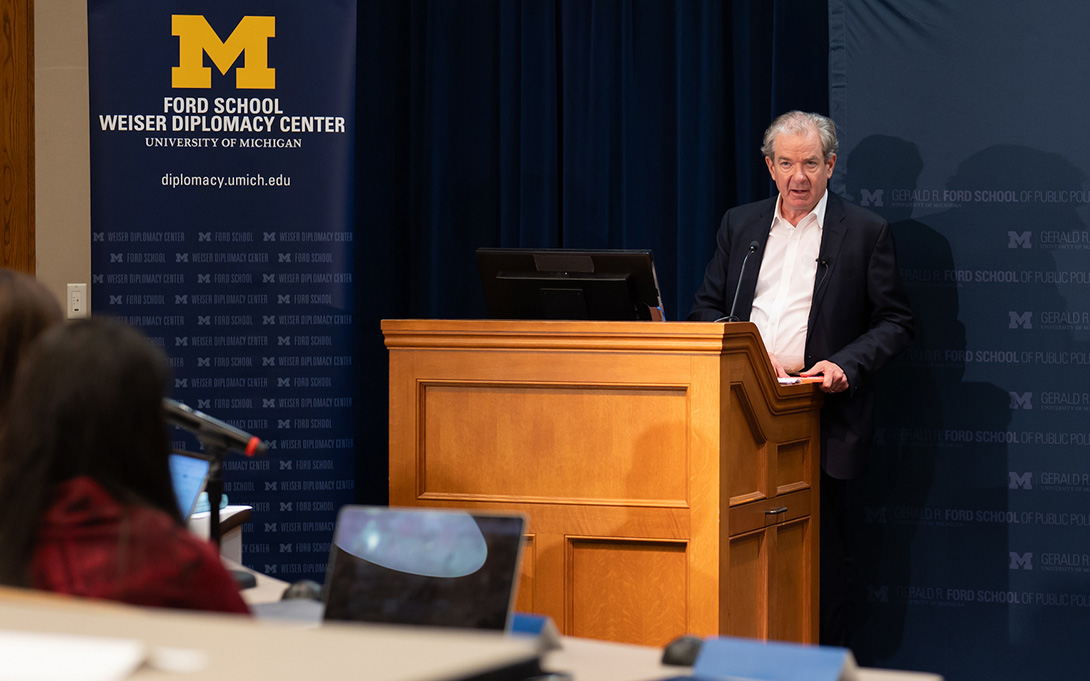
The journalist and author traced how decisions made after September 11 continue to shape American foreign policy, national security, and presidential power.
"9/11 had a long tail," journalist and author Peter Bergen told an audience at the Ford School. "Many people in the room weren't born at that time. … But it wasn't an event that just stopped. … The resonances of it continue to this day."
Those continuing consequences were the focus of Bergen's Josh Rosenthal Education Fund Lecture, "25 Years After 9/11: Reflections on the U.S. War on Terror," hosted by the Ford School's Weiser Diplomacy Center. Bergen, CNN national security analyst and vice president for global studies and fellows at New America, drew from his new book, All the Presidents' Wars: Twenty-Five Years of America's War on Terror. His remarks were followed by a conversation with Javed Ali, associate professor of practice at the Ford School who previously held positions in the Defense Intelligence Agency, the Department of Homeland Security and the Federal Bureau of Investigation.
The lecture series was established in memory of Josh Rosenthal, a 1979 University of Michigan graduate who was killed in the World Trade Center attacks on September 11, 2001. It brings leading public policy figures to Ann Arbor to foster dialogue and deepen understanding of the causes and consequences of 9/11.
That mission is especially relevant for today's policy students, many of whom have no personal memory of the attacks but are preparing to confront their lasting effects. Bergen said he wrote the book in part for students who were not yet born, or were children, on 9/11.
"The war on terror … has had as much effect on American foreign policy, national security, politics and our standing in the world as any other big epoch," he said.
Bergen framed much of the book as a series of "what ifs," including the decision to wage a broad war on terrorism rather than a narrower campaign against al-Qaeda. He credited the U.S. with real successes, chief among them the absence of another attack on the scale of 9/11. But he asked whether those goals could have been reached at a far lower cost in lives and money than the wars in Iraq and Afghanistan required.
His central theme concerned the steady growth of what he calls the "imperial commander in chief"—the increasing, centralized, and unaccountable power of the president to unilaterally wage war anywhere, anytime, and however they want. Bergen traced that development to the 2001 Authorization for Use of Military Force in the wake of 9/11 and has accumulated across successive presidential administrations.
To illustrate that expansion of presidential power, Bergen described the attempted bombing of a Detroit-bound flight on Christmas Day 2009. Subsequently, President Barack Obama expanded the use of armed drones in Yemen and Pakistan.
Bergen also argued that U.S. policy repeatedly faltered because decision makers failed to understand the societies in which they were intervening.
"One of the many lessons of this book is you have to understand the environment," he said.
He contrasted the costly occupation of Iraq with the later campaign against ISIS. The ISIS campaign was more effective, he argued, because it applied lessons from earlier interventions by relying on local partners and maintaining a limited U.S. footprint—an approach he summarized as "go light and go long."
"We tend not to learn as much from our own history as we should," Bergen said. "I just hope that we do learn from our history."
In his conversation with Ali, Bergen discussed producing Osama bin Laden's first television interview for CNN in 1997. He recalled traveling blindfolded through eastern Afghanistan at night to meet bin Laden, who offered a political and religious critique of U.S. policy in the Middle East.
Asked what was known before 9/11, Bergen said the problem was less a failure of imagination than "a failure to process the intelligence you have and give it credence because it just doesn't fit with your mental map."

Audience members asked Bergen about artificial intelligence in counterterrorism, the designation of drug cartels as terrorist organizations, and the competing narratives of unity and division that followed the attacks.
Honoring Josh Rosenthal through policy education
Josh Rosenthal grew up in metro Detroit, graduated from the University of Michigan in 1979. He later earned a master's degree in public policy from Princeton University, and his interest in policy analysis and international affairs led him to a career in international finance.
After he was killed in the South Tower of the World Trade Center, his mother, Marilynn Rosenthal, a longtime University of Michigan faculty member, sought to create something constructive from the family's loss. Together with Josh's relatives and friends, she established the Josh Rosenthal Education Fund at the Ford School.
The fund supports lectures, special seminars, student research, internships, and other programs intended to encourage deeper understanding of international issues.
At the 2026 Rosenthal Fund Lecture, Weiser Diplomacy Center director Susan D. Page introduced Josh's sister, a former member of the New York City Council, who recalled how their mother responded to his death.
"My mother's response to his death, while deep in grief, was to try to understand, to make sense of the nonsensical," she said.
Rosenthal noted that Bergen's book documents how warnings about Osama bin Laden's intentions went unheeded before the 9/11 attacks. "The disconnect between the experts, our presidents and the American public, I think, is worth exploration," she said, adding that she was proud her mother established the series at the Ford School, "where you are all connecting the dots and shaping our future leaders."
