
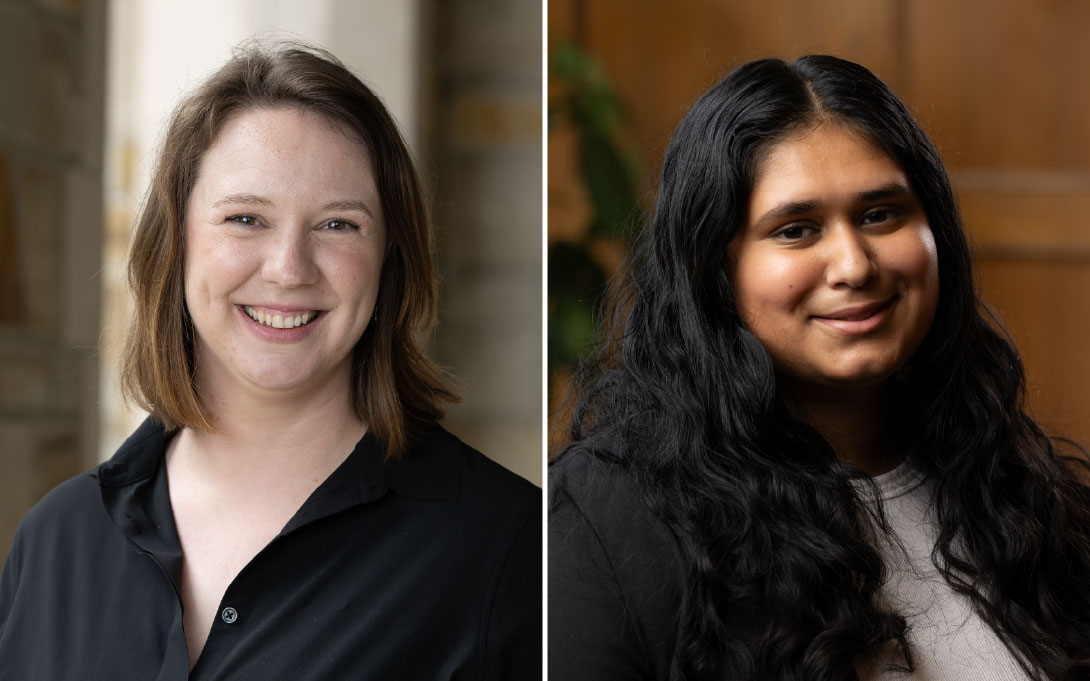
Sarah Peterson (MPP/MBA ‘28) and Juhi Pawar (BA ‘26) have won the Ford School's 2026 Ali Family Memorial Writing Prize for written work examining health-related policy concerns.
Peterson won first place for her paper, "Addressing Medicalized Death: A Community-Centered Policy Framework." Pawar received second place for her policy memo, "Patents Over Patients: Reforming TRIPS to Advance Global Health Equity."
"Sarah and Juhi both successfully articulated ways that policy can either exacerbate or help address pressing public-health problems," said Beth Chimera, Ford School teaching professor in policy writing and chair of the award committee. "Their entries represent the breadth and depth of Ford School work on health-related policy, confronting both domestic and international challenges."
Peterson is a former director of supportive and palliative care at a Seattle-area medical center. Her paper argues for shifting the American approach to death and dying away from institutionalized settings and toward community-based care. She calls for greater investment in public death literacy and in the networks of unpaid, non-clinical caregivers, such as family, friends, and neighbors, who help make community-based end-of-life care possible.
One judge noted that Peterson's rigorously researched piece was written in a way that maximizes its relevance for a wide range of stakeholders, "from people working on end-of-life issues to a general reader who has never thought about this issue or heard the phrase ‘medicalized death.'"
Pawar wrote a policy memo on the World Trade Organization's Agreement on Trade-Related Aspects of Intellectual Property Rights, known as TRIPS. Her memo argues that while TRIPS helps protect pharmaceutical innovation, its patent rules can also limit access to affordable medicines in developing countries. Pawar recommends strengthening compulsory licensing protections and shielding countries from retaliation when they use TRIPS-approved mechanisms to expand access to essential medicines during public health emergencies.
A judge praised Pawar's memo for providing "an exceptional comparative analysis" and for illuminating the "global power imbalances and disparities" that affect the "development and provision of life-saving medicines across the Global South."
The judge wrote that Pawar "provides strong political vision, policy position, and intellectual clarity on an issue too often obfuscated by corporate money interests and transnational power inequities."
Together, the two winning papers show how health policy operates at deeply personal and global scales, shaping experiences of people at the end of life and access to life-saving medicines.
About the Ali Family Memorial Writing Prize
The Ali Family Memorial Writing Prize is awarded annually to a Ford School student or group of students for written work that researches, analyzes, or contributes to a further understanding of health-related policy concerns.
The prize was established with a gift from associate professor of practice Javed Ali and his sister Meher Ali to honor their parents, Dr. Shafqat and Dr. Zaheda Ali. Dr. Shafqat Ali and Dr. Zaheda Ali were born in India and spent their lives as medical professionals practicing in New York and Great Britain before settling in southeast Michigan in the early 1970s.
