
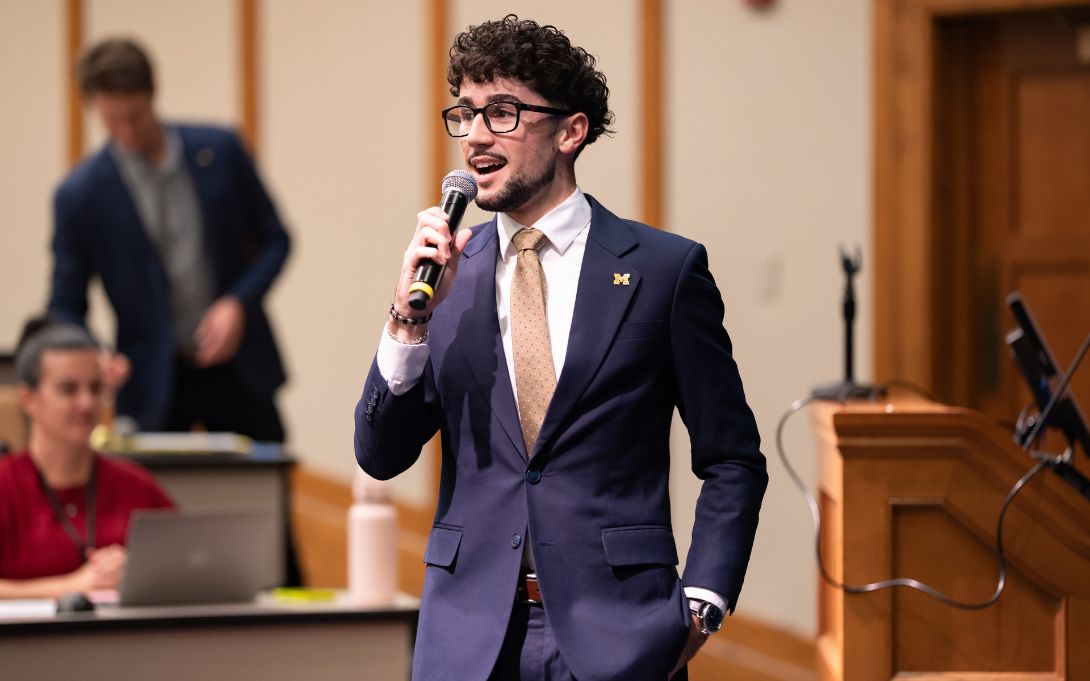
Seven undergraduate and five graduate students competed in the Ford School's 9th Annual Policy Pitch Competition in early September. In a TEDTalk style presentation, students gave three minute speeches highlighting their policy impact, lessons learned, and key deliverables from their internship experience. First, second, and third place winners were chosen by a group of celebrated alumni judges, and the audience selected an Audience Student Prize winner. See all of the photos from the event here.

Audience Student Prize winner Amr Brown (BA ‘27) reflected on his experiences for the Ford School's Policy Matters blog.
Curiosity, humility, and adaptability. These are the pillars that will define the next generation of diplomats.
So much so that a few weeks ago, I was finishing a meeting with the Vietnamese Embassy in Washington DC, and a Vietnamese diplomat looked at me—a 21-year-old intern—and told me he wished more students took the kind of initiative I had. That sentence would prove to change the way I think about diplomacy.
My name is Amr Brown, and I'm a senior here at the Ford School studying diplomacy and human rights. This past summer, I worked at the Center for Emerging Global Leaders (CEGL), an organization built around one core idea: the next generation of global leaders needs real, on-the-ground exposure to diplomacy, not just theory in a classroom. My job was to help design and launch CEGL's newest initiative, a groundbreaking diplomatic immersion program in Vietnam that combines scholarship, diplomacy, and leadership training, and will send 20 American scholars to Hanoi for six weeks next summer.
Now, you might ask: why Vietnam? It's a fair question, and the answer is pretty simple. Vietnam is one of the top emerging middle powers in the world, and its relationship with the US is both strategically vital and historically fragile, making it exactly the kind of posting future diplomats need to learn how to navigate.
Over the summer, it was my job to build the program's entire curriculum from scratch. I started by asking a question that sounds simple but, in reality, proved to be more difficult: what actually makes someone a good diplomat?
I thought back to my time interning in Jordan last summer, where I watched labor policy stall for months because the EU Delegation and the Jordanian government couldn't fully understand each other's institutions. These reflections taught me that a good diplomat needs a rigorous understanding of the country they're posted in, not just goodwill.
So that's what I did. I researched where US and Vietnamese interests frequently overlap, and I built five research tracks for the program: geopolitics and international relations; trade and commercial affairs; environmental studies; emerging technologies; and global health.
But here's the part I'm most proud of—those five tracks are now a permanent capstone of the immersion program. I was fortunate enough to brief my work directly to officials at the US Embassy in Hanoi and the Vietnamese Embassy in Washington. Both called it central to the program's success and expressed their support. Today, they're now two of our program partners.
This experience taught me something I didn't expect going in. It made me realize that I don't just want to study diplomacy. I want to build the systems that train the next generation of diplomats. I want to be a part of the change we so often talk about at the Ford School. And that's exactly what I'm doing right now at the Stimson Center, researching and developing US grand strategy across the globe, in hopes that it takes me to the US Foreign Service, carrying the same three things CEGL and the Immersion Program taught me: curiosity, humility, and adaptability.
Amr Brown (BA ‘27) is a senior at the Ford School studying diplomacy and human rights. His work spans national security and development across international organizations and the Middle East. Recently, Amr became a non-resident Foreign Policy Futures Fellow at the Stimson Center, where he focuses on reimagining US grand strategy in international organizations.