
Nearly four million people live in U.S. territories. They cannot vote for president, elect senators, or send voting representatives to Congress, even as federal decisions shape their budgets, laws, land, infrastructure, trade, and security.
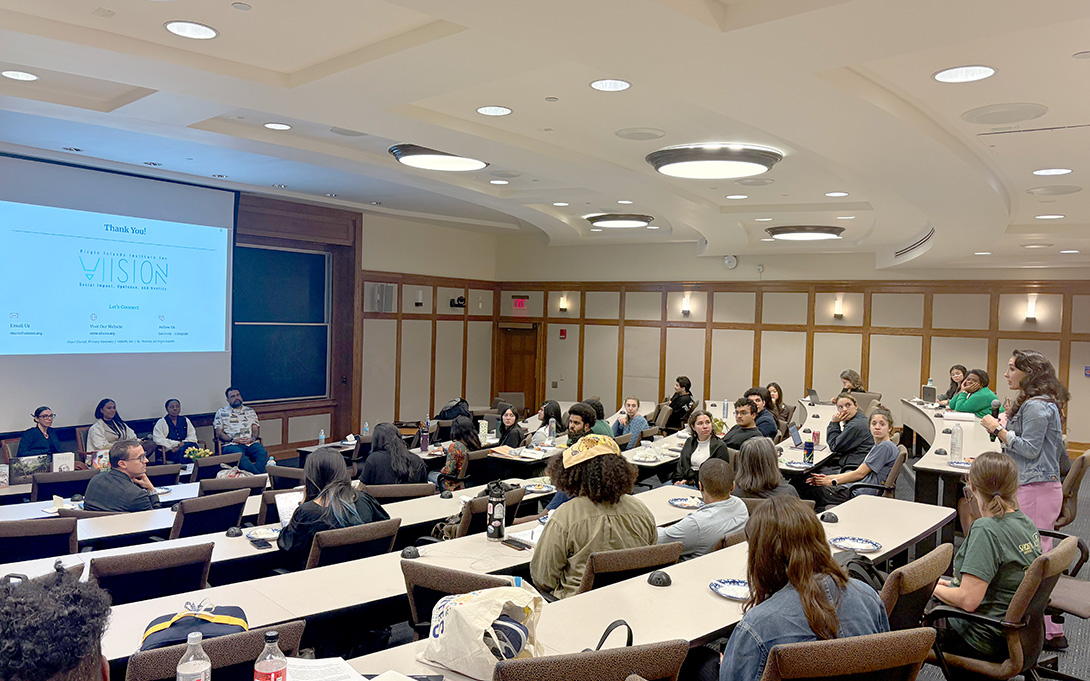
At a Ford School event during the University of Michigan's Democracy Week, "Decolonizing imagination: Narratives, memory and political possibility in the U.S. Territories," Ford School associate research professor Mara Cecilia Ostfeld led panelists in examining democracy from places whose residents are U.S. citizens or nationals but lack full representation in the federal government.
Ostfeld studies how territorial residents understand their political relationships and imagine their futures. Working with U-M doctoral candidate Ignangeli Salinas-Muñiz and partners in Puerto Rico, Guam, and the U.S. Virgin Islands, Ostfeld is building a locally grounded public-opinion dataset through surveys, focus groups, and interviews.
Her early findings point to a complex relationship with the United States. Residents may understand the US as both a source of funding, security, and infrastructure and a constraint on self-governance—one that can contribute to displacement and expose communities to geopolitical risks they had little role in choosing.

The panel of speakers demonstrated how cultural and civic institutions can broaden political imagination even without formal changes in political status.
Victoria-Lola Leon Guerrero, director of publishing at the University of Guam Press, described a community-led effort to create place-based social studies materials rooted in CHamoru (the Indigenous language of the Mariana Islands) and Micronesian histories, cultures, and values.
"Growing up in Guåhan [Guam], we didn't have books that taught us about ourselves," Leon Guerrero said. "We really didn't see ourselves in the classrooms."
Developed with local educators, historians, artists, families, and students, the curriculum introduces Guam's history beginning in kindergarten rather than first addressing it in fourth grade. It aims to help children understand themselves as active participants in their communities and the wider world.
Michael Lujan Bevacqua, curator of the Guam Museum and founder of the first CHamoru Studies Program at the University of Guam, explored how museums and language revitalization can restore value to histories and identities diminished by colonial rule.
"What is the purpose of a museum?" Bevacqua asked. "Is it a mausoleum—or is it a place where you visit community, where you connect?"
He described efforts to repatriate ancestral remains and cultural materials taken from Guam, as well as his online CHamoru-language classes connecting learners across the island and its diaspora. Both forms of work challenge narratives that treat CHamoru people and culture as belonging only to the past.
Hadiya Sewer, an Africana philosopher, community organizer and Environment and Democracy Fellow at Right to Democracy, examined how colonial power shapes not only legal arrangements but also what futures communities believe are possible.
"Colonized people are not granted—and often don't grant ourselves—the right to democratic failure," Sewer said. "There has to be a decolonial will to make imperfect transitions: to fail, to build again, and to keep moving toward a horizon we may never finally reach."
Sewer's work through the Virgin Islands Studies Collective and St. JanCo, the St. John Heritage Collective, connects scholarship to land rights, cultural preservation, food sovereignty, disaster preparedness, and the arts. These practices create space for Virgin Islanders to produce knowledge about themselves and build capacity for self-governance.
Imani Daniel, executive director of the Virgin Islands Institute for Social Impact, Opulence, and Noetics and a delegate to the U.S. Virgin Islands Constitutional Convention, brought those questions into constitution-making.
"A constitution does more than organize the branches of government," Daniel said. "It defines the source of political authority—whose consent justifies governance."
Yet territorial constitution-making proceeds within boundaries ultimately determined by Congress. That tension led Daniel to ask, "Where is the self in self-determination?"
Daniel also described how residents located elders, distributed food and medicine, cleared roads, and shared generators after Hurricanes Irma and Maria. Such actions, she argued, were not merely neighborly assistance but governing functions grounded in trust and local knowledge.
The speakers' work gave concrete form to the political possibilities Ostfeld and her collaborators are documenting in residents' own understandings of governance, belonging, and freedom.

