
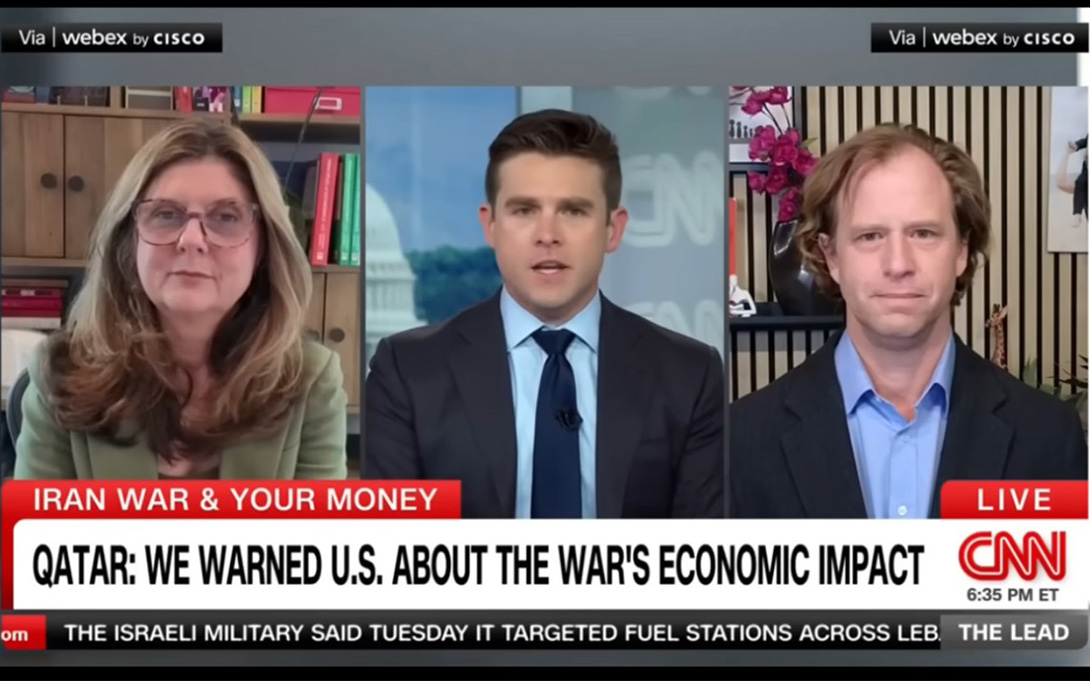
On CNN's The Lead with Jake Tapper, professors of public policy Betsey Stevenson and Justin Wolfers discussed why markets are currently swinging so violently and why the biggest question is how long will the energy shock last.
Wolfers began the discussion, stating that "the reason you're seeing this on-again, off-again from markets is because the president is an unusual sort of a character…[and] it does feel like policy is being made on the fly."
In response to a question about when an energy shock becomes anchored in the broader economy to the point where monetary policy must address it, Stevenson highlighted how typically the Fed wants to just look through energy shocks. "The problem is if people start to expect that this is going to lead to higher prices overall," Stevenson explained, "if we start to expect that we're going to have inflation running three or four or five percent a year, and so we start to act as if that's happening, that's when the Fed are going to have to take action." This action would likely be raising rates to deal with prices. That is a problem, Stevenson argues, because the United States has a slowing economy, and in dealing with a slowing economy, rates need to be lowered, not raised.
Wolfers explained that, even if the Iran war were to end, it would take at least a couple of months for gas prices to come back down. "At a minimum a couple of weeks before we get a ton of relief, but there's a real possibility we're stuck with higher oil prices and therefore higher gasoline prices for months and possibly years," stated Wolfers.
Stevenson concluded by discussing what kind of data people can look at to help them understand where the economy is going. "It's important not to take your eyes off of what's happening with employment and the sort of broader macro economy," Stevenson stated. She anticipates that "we're stuck in this for a little bit" as companies like United are making strategic cuts in their spending to prepare for higher oil and gas prices.

