
Be it a feature or a bug of our political system, it can often feel impossible to make a difference in our government. As young people, we're afforded few opportunities to have our voices heard, and when we do, it often seems like our words are dismissed. This is why STPP's experiential learning opportunity was important: we were encouraged to let our passions for policy guide our research, and we collaborated with experts to explore how far our ideas could go.
The Opportunity
We were able to work in collaboration with State Representative Jason Morgan's office to see how we could implement our work in a real-world, legislative context.
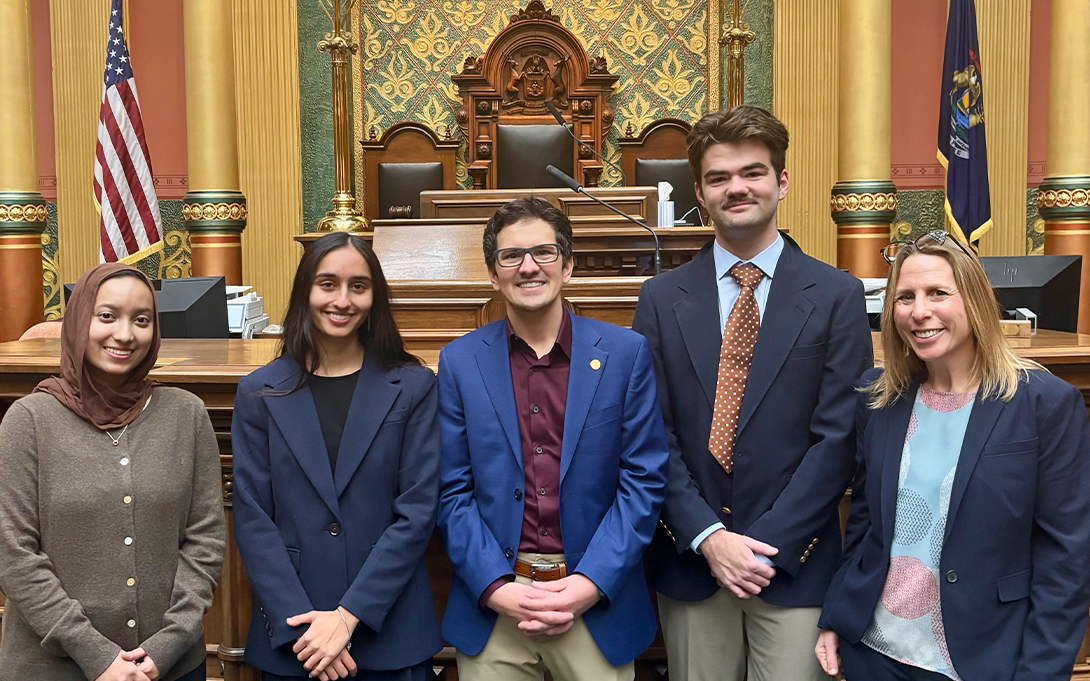
For the fall semester, we met weekly with our coordinator Julie Berson Grand, and frequently with Rep. Morgan's legislative director Josh Winslow, and conducted independent research projects that were developed in collaboration with Rep. Morgan's office. These projects spoke both to Rep. Morgan's legislative priorities and our individual interests as policy students. This work culminated in a trip to Lansing at the end of the semester to present our findings, meet with legislators, and tour the capital. We were immensely grateful to be afforded a seat at the table to advocate for science and technology policy we believe in.
Henry Smith (BA '27): Data Privacy Research
My research focused on an ever-evolving, critical topic in the digital landscape: data privacy. Like many states, Michigan does not yet have comprehensive data privacy legislation. Because of this, Michiganders have little agency over how their personal data is collected and used, giving companies free reign to collect and sell our personal information to whomever they please.
Through my research, I realized this didn't have to be the case. Many states have adopted effective data privacy laws, curtailing companies' abilities to covertly collect data. What's more, legislation enshrines special rights to sensitive data like biometric information and data collected from minors. As data collection via A.I. becomes all the more efficient and powerful, restrictions like these safeguard privacy and safety.
My research endeavored to find ways to make legislation like this more bipartisan in the state legislature. Luckily, Democrats and Republicans alike realize that data privacy is a pressing issue. I compared proposed data privacy legislation in Michigan to successful proxy bills across the country, finding ways to make data privacy more agreeable through alleviating business burden and making compliance easier.
Aanvi Arora (BA '27): Energy Affordability Research
At the intersection of science, technology, and public policy, my research centered on making energy more affordable for Michiganders.
Through detailed exploration, one takeaway of mine was that energy affordability and the renewable energy transition are dually linked objectives — renewable energy of all forms, from geothermal to wind, has lower operating and maintenance costs and lesser pass-through to consumers. Other key insights were that the disappearance of federal tax credits for household energy efficiency projects must be substituted by state-level investment, and that emphasizing permitting geothermal and hydropower could maximize utilization of uninterrupted federal tax credits for long-term gain.
My research pointed to creative policies, such as a statewide cap-and-invest program for emissions to fund the state tax credits I spoke of, subsidized home energy assessments to point homeowners in the right direction for cost-saving upgrades, and retrofitted dams to produce clean energy.
Visiting Lansing
Approaching its steps at the culmination of our experience, the Capitol had a different air with one semester of the Ford School behind us than during our elementary school visits to the Michigan and Ohio legislatures. Now, it felt within reach. We could interact with it, whether by researching and proposing policy via a community partnership, or by advocating for policies by directly calling or emailing the legislators that serve us.
Representative Morgan and his team walked us through the building, and numerous details caught our eye along the way: portraits, seals, and engravings hinting at a deep history. Walking to the head of the House floor, observing its stillness out of session, one could easily imagine what in-session might look like, the room packed with representatives and staffers. That image was confirmed when we peered over the Senate observation deck, with several familiar senators spread about the floor in conversation and President Pro Tem Jeremy Moss standing near the dais, perhaps preparing to call a vote. Our access as constituents and public policy students was again proven when Senator Jeff Irwin stepped out of session to meet us, eager to converse.
Reflections
This experience revealed that introducing technical solutions, or solutions to technical challenges, into the policy world requires placing yourself on middle ground: studying recent science and technology developments, but applying practical and political considerations. It also highlighted that if you are passionate about a policy topic, there are always people who will openly listen. Presenting our research to Josh Winslow, Representative Morgan's Legislative Director at the Ford School, and to Representative Morgan during our Lansing trip, made us feel heard. It was clear that our representatives in Lansing are responsive; it is worth advocating for the change we hope to see.
Written by Aanvi Arora (BA '27) and Henry Smith (BA '27)