
Amid evolving global political, economic, and security challenges, a new policy brief from the University of Michigan's Weiser Diplomacy Center (WDC) and two prominent nongovernmental organizations based in Washington, D.C., calls on leaders in the United States, Mexico, and Canada to adopt a more integrated approach to North American cooperation.
Recommendations include a strategic framework that more closely links diplomacy and statecraft surrounding security, trade, labor mobility, innovation, energy, and cultural and educational exchange.
"North America is facing a period of rapid transformation across trade, energy, technology, and workforce development," said Nayab Ali, international diplomacy program administrator at WDC and co-author of the report. "Our policy brief reflects the practical recommendations and shared priorities that emerged from conversations with experts from the U.S., Canada, and Mexico. We hope that it supports stakeholders working to strengthen trilateral cooperation."
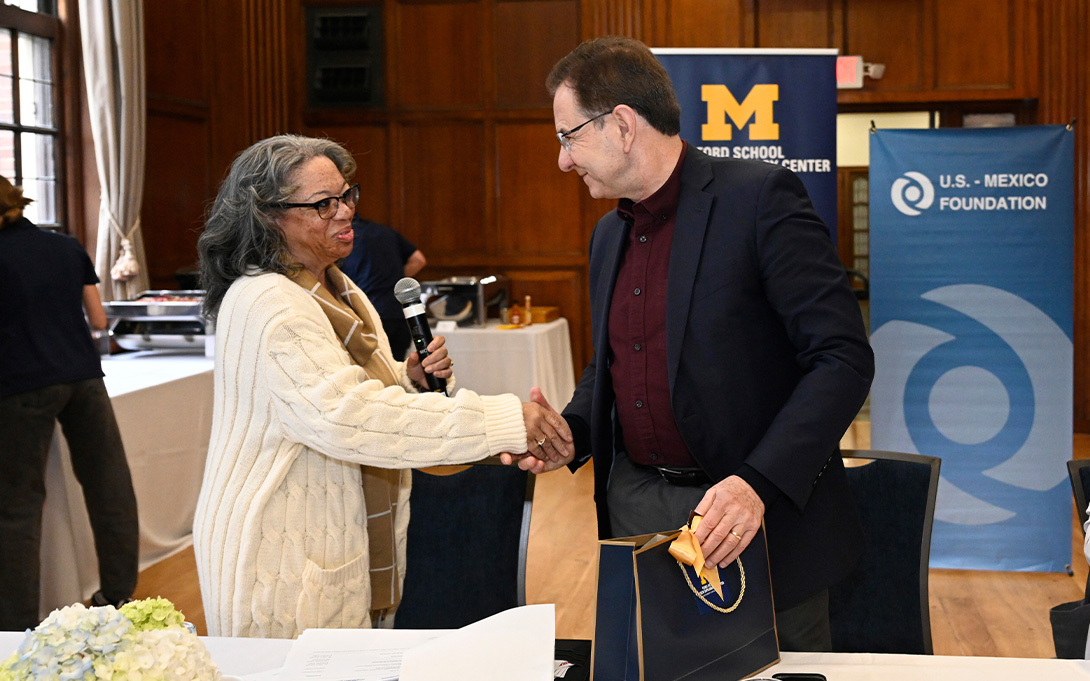
WDC hosted Convocation 5.0, a high-level trilateral policy forum, in partnership with the U.S.-Mexico Foundation and the Mexico Program of the Inter-American Dialogue. The forum brought together current and former diplomats, government policymakers, and industry experts from three countries to examine issues shaping the future of North America.
"The United States, Mexico, and Canada share significant policy objectives and longstanding relationships that have led to mutual benefit. But continued trilateral cooperation cannot be taken for granted," said former Ambassador Susan D. Page, WDC director and professor of practice in international diplomacy at the Ford School. "Convocation 5.0 underscored the need for a forward-looking North American strategy that connects all areas of diplomatic statecraft, including security, economic competitiveness, human capital, energy, and professional exchanges."
In the near term, participants emphasized the importance of reducing uncertainty, modernizing policy tools, and preserving political space for pragmatic cooperation among the three countries. Over the longer term, the brief calls for investments in institutional resilience, human capital, critical infrastructure, and a more coherent regional posture in an increasingly contested global environment.
The recommendations include:
- establishing clearer trilateral benchmarks for cooperation;
- treating security and economic competitiveness as mutually reinforcing;
- modernizing labor mobility and workforce systems;
- advancing a coordinated strategy on strategic industries and energy infrastructure;
- strengthening preparedness in response to China; and
- expanding educational and professional exchanges through more durable trilateral programming.

About Convocation 5.0
Hosted in Ann Arbor from March 19–21, 2026, Convocation 5.0 brought together former and current ambassadors, senior policymakers, and industry experts from across the United States, Mexico, and Canada for strategic discussions on the trilateral relationship. The forum also included immersive engagements highlighting Michigan's leadership in innovation, mobility, industry, and diplomatic statecraft, including education and culture, with visits and programming connected to Michigan Central, Newlab Detroit, the Gerald R. Ford Presidential Library, and (University of ) Michigan Stadium. The Ann Arbor gathering marked the fifth convening of Convocation and the first time the University of Michigan hosted the forum.
Beyond the policy sessions, participants engaged with Michigan's political, economic, and cultural landscape through curated engagements across Ann Arbor and Detroit. The convening also featured a high-level executive reception with corporate leaders, elected officials, current and former diplomats and government officials, and policy experts from the three countries, including Congresswoman Debbie Dingell, Mexico's Ambassador to the United States Esteban Moctezuma Barragán, Ildefonso Guajardo, former Secretary of Economy of Mexico and lead Mexican negotiator of USMCA, Mary Ng, Canada's Former Minister of Export Promotion, and Michigan Representatives Jennifer Conlin, and Jason Morgan.


