
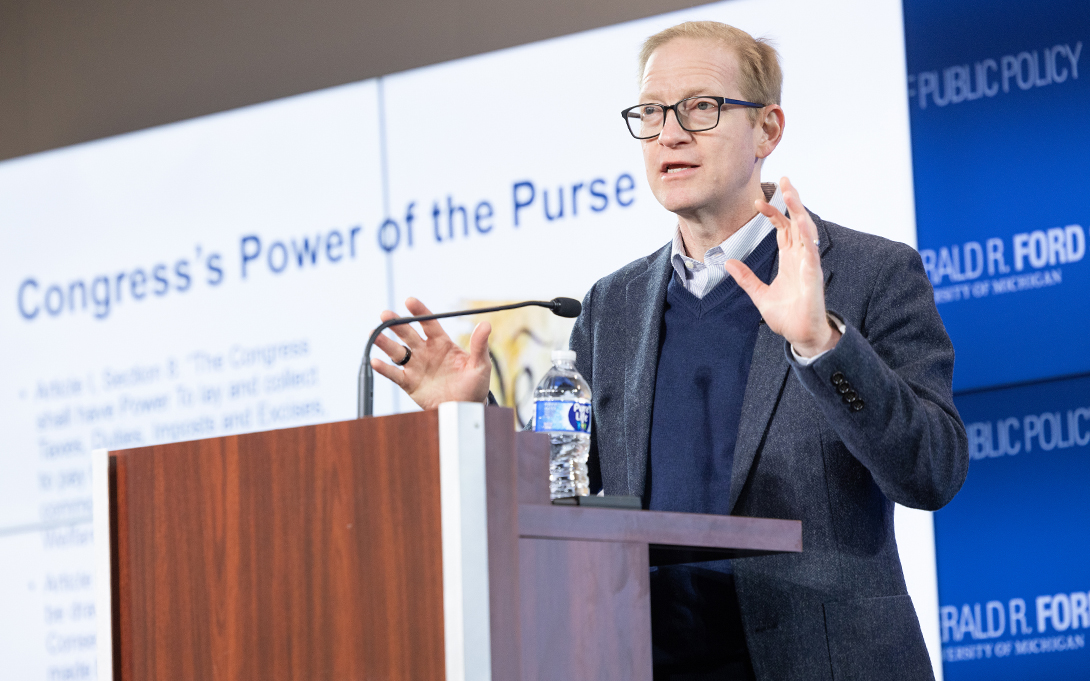
In a response to Zeynep Pamuk's "How to Save Science," University of Michigan law and public policy professor Samuel R. Bagenstos examines the relationship between science, politics, and democratic governance. His essay is part of Boston Review's Forum, which brings writers, scholars, and activists into dialogue about fundamental issues and pressing challenges.
Bagenstos argues that the Trump administration's efforts to reshape scientific research and public health policy have been enabled by an expansive version of the "unitary executive theory," which gives the president broad control over executive-branch agencies and officials. While rejecting the idea that science can—or should—be entirely separate from politics, he contends that scientific policy should not be dictated by a president's unilateral priorities.
Instead, Bagenstos calls for a more democratic approach that combines scientific expertise with congressional authority, public participation, peer review, and meaningful oversight. Both unchecked presidential control and complete scientific autonomy, he concludes, limit democratic participation in decisions about research and public health.
The unitary executive assault
Written by Samuel R. Bagenstos for the Boston Review
In just two years, Trump and his appointees—notably OMB Director Russell Vought and HHS Secretary Robert F. Kennedy Jr.—have devastated scientific research, silenced sources of scientific information, and subverted health regulation to support a narrow, partisan agenda. But how have they managed to wield this power? The answer lies in another alarming development: the Supreme Court has consolidated and entrenched an extreme version of the "unitary executive theory," under which the president can control everything that happens in the executive branch—including formerly independent agencies—by firing any high appointee who won't do his bidding. (Never mind the Court's wholly unprincipled exception for the Federal Reserve.)
Many in the scientific and public health communities have responded by urging that we should keep politics out of science. There is an important kernel of truth in what they say. But as Zeynep Pamuk convincingly argues, the key questions here are not purely scientific. Science and public health policy are political at their core. That doesn't mean that any politics goes, and certainly not Trump's. We need to address these issues through a process that is richer, deeper, and more democratic than what the unitary executive theory provides.
Indeed, the administration has refused to fund research involving topics that clash with its political priorities—topics such as health disparities, vaccine hesitancy, gender identity, and COVID-19. It has done so even in many cases where Congress specifically required the government to fund research into these topics. And it has also sought to sideline peer review in awarding grants—although, once again, Congress has specifically required peer review of grants at agencies like NIH and NSF. Vought is currently trying to codify these proposals in a set of new government-wide regulations that would make peer review entirely advisory, place political appointees in charge of the awarding of grants, and empower the executive branch to terminate grants at any time if they no longer reflect the priorities of the incumbent administration. And research is not the only focus of Trump's battle with the scientific community. Trump and Kennedy are also imposing their own anti-vax views on vaccine policy—substantially narrowing the childhood vaccine schedule and purging the outside advisory committee that recommends vaccines for the public.
Science and public health policy are political at their core. That doesn't mean that any politics goes, and certainly not Trump's.
All of these actions rest on the premise that scientific research is nothing more than an instrument to achieve the current president's policy goals, and they thereby rely on the unitary executive theory—and the Supreme Court's willingness to run interference for the Trump administration by blocking lower courts from enforcing congressional checks on the executive branch.
The Court justifies its extreme version of the unitary executive theory on the grounds that it is necessary to serve democracy. The basic idea is that the president is the only official elected nationwide, that the people have to be able to hold him accountable for what he does in office, and that enabling his subordinates to act independently undermines that path of accountability. But this is a thin, and unpersuasive, understanding of democracy. We don't just elect a president; we also elect members of Congress. Despite the barriers to full participation in congressional elections—and the limitations of elections alone as the means of exercising democratic will—laws passed by Congress over time have greater democratic authority than the unilateral decisions made by a single president at a particular moment. Those decisions may be based on nothing more than whims or idiosyncratic preferences, and there is no reason to think that the decision to vote for a presidential candidate entails agreement with that candidate on any but the very most highly salient policy issues.
But it's equally a mistake to insist that science should be separate from politics. To be sure, science and health policy need to be based on the best understanding of empirical facts—that some diseases are caused by pathogens, for example, as well as how those pathogens spread and how the spread can be stopped. A science policy that short-circuits these facts in favor of a particular ideology will prove disastrous. Examples include former South African President Thabo Mbeki's HIV denialism, as well as the climate denialism that has captured energy policy in the United States. Once we have our best understanding of the empirical facts, though, the key questions are political. That is certainly true of regulation. Science can perhaps tell us the effects of regulatory interventions, but it can't tell us how to weigh incommensurable costs and benefits: to health, to liberty, to the economy, and beyond.
Furthermore, as Pamuk shows, even questions of how we discover new empirical facts and update our knowledge of those facts are often political. We have to decide what resources to devote to what researchers performing what sorts of research. These decisions require scientific knowledge and literacy, but they also require value judgments (about which areas are the most pressing, about the balance of basic to applied research, and so on). Too much deference to particular professional communities can entrench the unquestioned orthodoxies and in-group preferences of the cadre of scientists who have risen to leadership positions in those communities.
In a democratic polity, all of these questions must be decided according to a process with democratic legitimacy. But that does not mean that a single elected president should be the one to decide them. When Congress decided, multiple times over many years, to fund research into health disparities and vaccine hesitation, it acted with a democratic warrant that far surpasses the warrant Trump possessed when he stopped that research.
Nor does democratic legitimacy require that an elected official or a political appointee decide all of these questions. To the contrary, Congress might decide that it wants to achieve certain scientific or health outcomes, and that in some circumstances the best way to do so will be to delegate substantial authority to particular scientific communities. When Congress requires the president and his appointees to defer to scientific communities (through requiring peer review for grants, through requiring outside scientific advisors to weigh in on the vaccine schedule, and so forth), it is not thwarting democracy. It is exercising democratic power.
The key institutional design question is how to ensure that the people retain control over these important decisions once they are delegated. Robust congressional oversight, as Harley Kilgore imagined, is one means of ensuring democratic control; public participation in the administrative process—including through novel mechanisms such as citizen oversight juries, as Pamuk suggests—is another. Both are worthy of exploration. The bottom line is that any delegation to executive branch officials or professional communities must necessarily be provisional and subject to democratic alteration. The extreme alternatives of unitary executive theory on one side and strict scientific autonomy on the other are both undemocratic. They fail to appreciate the political nature of science policy, and they unduly limit public participation in the development of that policy.
Samuel R. Bagenstos is Frank G. Millard Professor of Law and Arlene Susan Kohn Professor of Social Policy at the University of Michigan. He served as General Counsel at the U.S. Department of Health and Human Services and the Office of Management and Budget in the Biden administration.
