
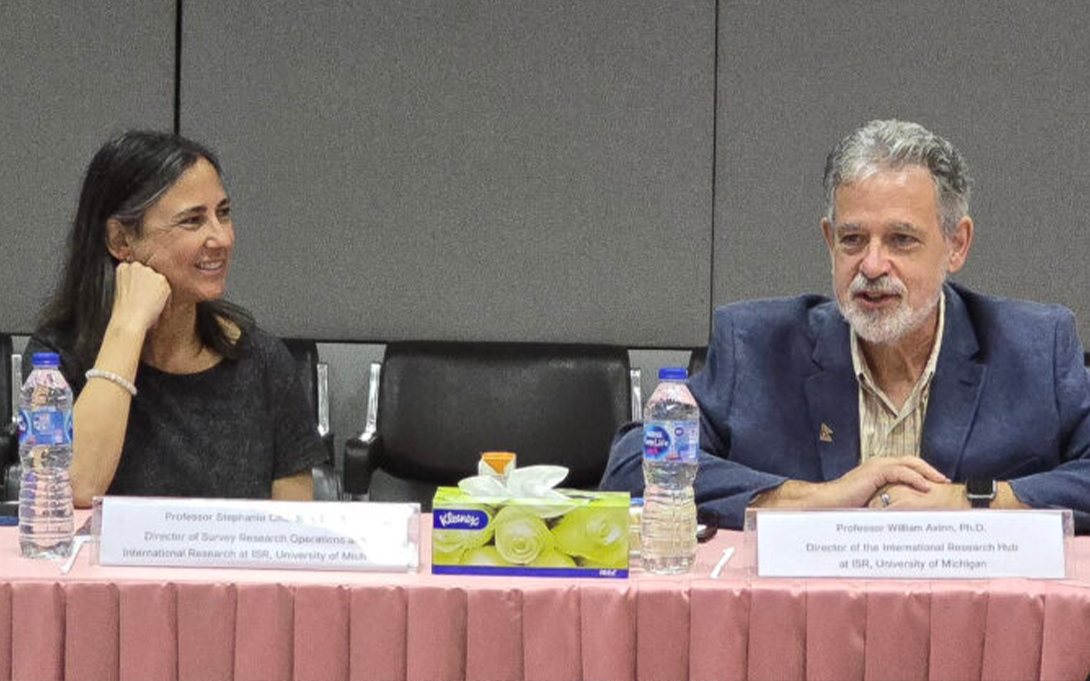
The World Mental Health (WMH) Survey Consortium, which harnesses cross-national data to inform and support policies around education, interventions, and treatment, has now moved to the University of Michigan. This new phase is led by William Axinn, inaugural director of U-M's Institute for Social Research's (ISR) International Research Hub, and Stephanie Chardoul, director of Survey Research Operations at the Institute for Social Research's Survey Research Center. Together, they lead efforts to conduct and analyze coordinated surveys in more than 30 countries and regions across the globe.
Mental health and substance use disorders are among the leading causes of disability worldwide, including in the United States. Not only do these health issues create substantial impairments, but they generally begin in adolescence or early adulthood and create episodes of impairment in the critical areas of education, employment, and relationships throughout the life course. The adverse consequences of these conditions place immense strain on millions of families and on healthcare systems around the globe, and contribute significantly to the global burden of disease.

Axinn, who also serves as the co-director of the Chitwan Valley Family Study in Nepal and interim director of the International Policy Center at the Ford School of Public Policy, said, "This worldwide consortium is important to both advancing science and improving the health and well-being of the population. It is an honor to bring it to Michigan and to work toward extending the consortium into the future."
The WMH Survey Consortium was created by psychiatric epidemiologist Ronald Kessler of Harvard University (formerly of the University of Michigan), who launched the first generation of surveys over two decades ago in collaboration with the World Health Organization and a core group of esteemed mental health practitioners from around the world.
Since then, the WMH Survey Consortium has become one of the most influential social science projects of this century, resulting in 8 books, 1100+ articles, and over 200,000 academic citations.
The next generation of WMH surveys
Under Kessler's and Chardoul's leadership, the standardized questionnaire used for WMH was updated to reflect the latest mental disorder definitions set by the DSM-5 and the ICD-11 classifications. The reliability of the data depends on a key ingredient: A survey instrument carefully designed and consistently implemented in a general population to generate diagnostic measures with high clinical validity across languages and cultures.
Each time a new country or region is added, the WMH survey must be translated and questions adapted to reflect local languages and culture, explained Chardoul, who leads training and data collection efforts.
"We work with each research team to apply a rigorous process of language translation and cultural adaptation. This process includes expert review, in-depth interviews with community members and mental health professionals, and a thorough consideration of the local context and experiences. These are complex and personal concepts—the experience of symptoms and how those symptoms impact a person's ability to function in their environment are unique to each setting. We work hard to make sure our surveys are locally tuned and validated. This allows us to make high-quality global comparisons."
Recent events, including worldwide consequences of the COVID-19 pandemic, have motivated a new generation of these studies. Nationally representative DSM-5 surveys have been completed in Norway, the Philippines, Qatar, and Türkiye, and a regional survey was completed in Hong Kong. Even more are underway or being launched: national surveys in Brazil, Japan, Kenya, Republic of Korea, a new regional survey in Murcia (Spain), and an expanded Hong Kong sample. New surveys are also being planned in Colombia, Mexico, Nepal, Poland, Spain, Sweden, and the United States.
These expansions mean we can provide a more complete picture of global mental health," said Axinn. "By bringing the survey to new regions, especially those historically underrepresented in research, we create the means to identify solutions from one place that have not been tried yet in other places."
Global and local impact
With large, representative samples collected at national or regional levels, WMH survey data offer policymakers and researchers a clearer picture of both unmet need and effective treatments for mental health issues. By creating a repository to share the standardized data, the initiative enables comparisons of causes and rates of mental illness and how policies and programs shape access to care and outcomes in countries around the world.
This comparative approach doesn't just identify differences: it makes it possible to identify successful strategies in one region that could be adapted elsewhere, with the potential to reduce mental illness and substance abuse, and improve access to care. Moreover, because mental health challenges often go hand in hand with physical illnesses such as chronic pain, arthritis, heart disease, diabetes, and cancer, improving mental health can have a powerful ripple effect throughout a population's overall well-being.
The WMH Survey Consortium's shift toward a managed and secure open-access data repository will create new opportunities for scientists and decision-makers to deepen research and drive policy improvements. Due to WMH's scope, its influence stretches around the globe, and will help to inform our understanding of the impact of mental health on the entire life course.
"For example, identifying specific childhood experiences that increase mental illness in adulthood guides interventions to reduce the occurrence or severity of those illnesses," said Axinn.
New opportunities for U-M students and scholars
With the WMH Survey Consortium now anchored at ISR's Survey Research Center, the project aspires to connect U-M's expertise across centers, including the Population Studies Center, the Eisenberg Depression Center, the Center for Global Health Equity, and the Ford School of Public Policy. The long-term goal is to provide opportunities for U-M scientists and students to engage more in mental health work, either directly or as it connects to other parts of life. As the opportunities to engage grow, this project will increase the breadth of options for U-M faculty and students to gain direct experience in international research and public health policy.
Stephanie Chardoul noted, "We are honored to have the opportunity to extend and curate the WMH Survey Consortium here at Michigan. Our work will focus on continuing to support local research teams to collect the highest quality data using gold-standard techniques of survey methodology, and then making those data available for the first time to researchers outside of the consortium."
William Axinn agreed: "Moving WMH Survey Consortium to Michigan means expanding both the science and the impact. We're building new partnerships, broadening the scope of inquiry, and inspiring the next generation of researchers. From medicine, to policy, to methods, to social and economic science, mental health affects everything else we study—as WMH survey opportunities grow, we will be able to learn more about the worldwide differences in problems, solutions, and things that make very different people still have much in common."
By Rebecca Cohen (MPP '09)
