
The U.S. has officially declared a drought disaster for parts of Puerto Rico, where more than 180,000 residents have been rationing water since Aug. 7 due to drought and infrastructure problems. University of Michigan experts are available to discuss a variety of issues related to this crisis.
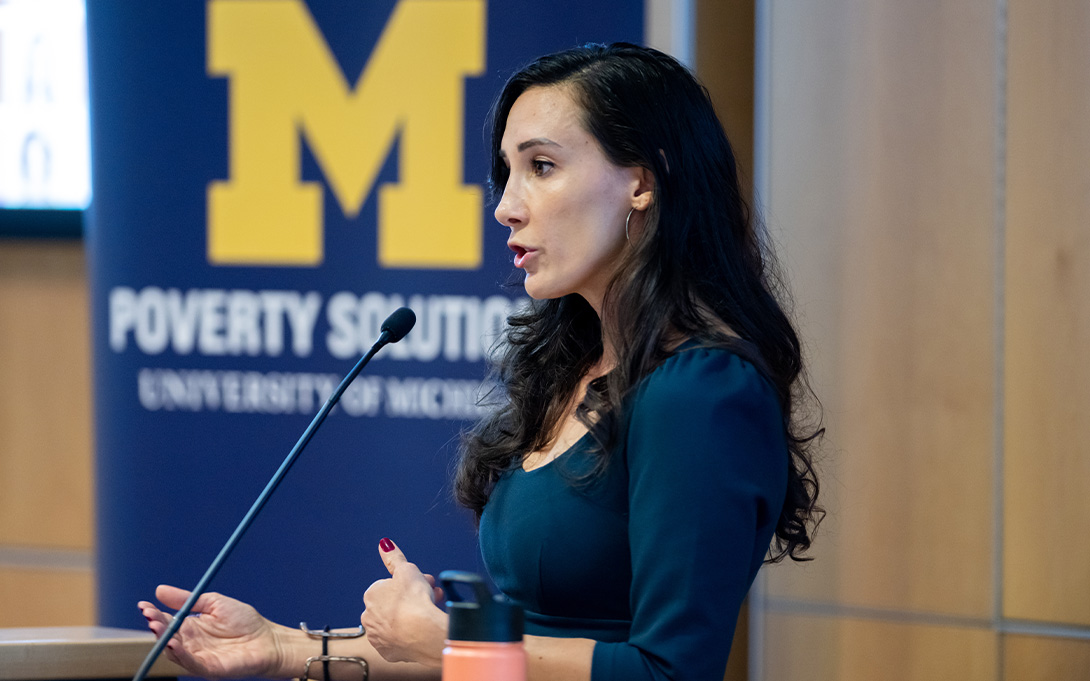
Mara Ostfeld is an associate research professor at the Ford School of Public Policy and faculty associate at the Center for Political Studies.
"On its face, Puerto Rico's water shortage is the product of aging infrastructure and climate change. But what turned those pressures into a crisis is the set of federal policy decisions that constrained the island's ability to invest in its own infrastructure," Ostfeld said. "This includes the federal government's cultivation of an economy built around corporate tax incentives and then the abrupt phase-out of those same incentives; a constitutional debt structure—reinforced by Congress excluding Puerto Rico from federal bankruptcy protections—that required debt payments to take priority over infrastructure upkeep; and the unelected Fiscal Oversight Board's continued control over capital spending since 2016.
"Our surveys through the Laboratorio Puertorriqueño de Opinión Pública capture how residents experience this: 68% believe the oversight board has more power than their elected government over the island's laws, and 72% say Puerto Rico's government has little or no power to make independent decisions without U.S. federal intervention. A water crisis lands directly on top of that—it's read not as an isolated failure, but as one more example of decisions being made for Puerto Rico rather than by it."
Jonathan Overpeck, professor and dean of the School for Environment and Sustainability, is an expert on climate and weather extremes, sea-level rise and the impacts of climate change and options for dealing with it. He served as lead author on the authoritative Intergovernmental Panel on Climate Change 2007 and 2014 reports.
"Both the intensifying strong El Niño and human-caused climate change are likely driving the current observed drought conditions in Puerto Rico," Overpeck said. "Whereas the El Niño influences will likely diminish as we get into the fall, climate change—and in particular rapidly warming global temperatures—will increase the odds of drought persistence beyond the fall. Puerto Rico and other parts of the Caribbean will continue to see increases in the risk of drought until climate change is halted, and will thus need to adapt water infrastructure and water use strategies going forward in order to build resilience to the worsening drought risk."
Olivia David, doctoral candidate at the School for Environment and Sustainability, is involved with several interdisciplinary programs at U-M, including the Science Technology and Public Policy Program based at the Ford School of Public Policy. Her dissertation is a comparative study of the politics of drinking water affordability in Detroit and Cape Town.
"Puerto Rico's current water provision failures are a reminder that infrastructures are not merely technical objects—they embed political values and decisions, with real social consequences. Infrastructural failure and disrepair are not inevitable—nor are water service interruptions, even in the face of drought," David said.
"Puerto Rico's drought-induced water crisis is part of a larger national conversation around not only climate change adaptation, but also the need to humanize technical decision-making processes. It joins a set of crises—including here in Michigan with, for example, contamination in Flint and affordability in Detroit—that emerged as a result of government decisions privileging fiscal austerity over public impact, partly due to federal disinvestment in water infrastructure.
"In global context, Puerto Rico's struggles recall Cape Town's 2015-2018 'Day Zero' drought crisis (among others), which similarly exposed the politics of severe drought's production and impacts, including the reproduction of existing socioeconomic inequalities. In both cases, the water crises brought attention to the fact that marginalized populations—mainly rural communities in the Puerto Rican context—have been living under similar crisis conditions for years. Ideally, municipal and national governments will harness these emergencies and their lessons to both prevent future crises and redress the preexisting disparities that they underscore."
Sara Hughes, adjunct professor at the School for Environment and Sustainability, is a senior policy researcher at RAND and professor of policy analysis at the RAND School of Public Policy. Her research focuses on designing and evaluating solutions to water, climate change and environmental policy problems from the local to the global.
"Puerto Rico is a reminder to communities everywhere that a water crisis can develop long before the day the taps run dry," Hughes said. "Climate variability, aging infrastructure and growing demands can gradually erode a system's margin for error. The challenge for policymakers is to recognize those warning signs and make investments before a drought or other shock turns vulnerability into a crisis. Water security isn't simply having enough water in a reservoir. It means having a system that can reliably deliver safe and affordable water even when conditions aren't normal. That requires infrastructure, financial capacity, good information, coordination across government and, importantly, public trust."
Written by Matt Davenport, U-M News
