
Diplomacy and the Indian Subcontinent
Ambassador's Forum in partnership with American Academy of Diplomacy
Date & time
How to attend
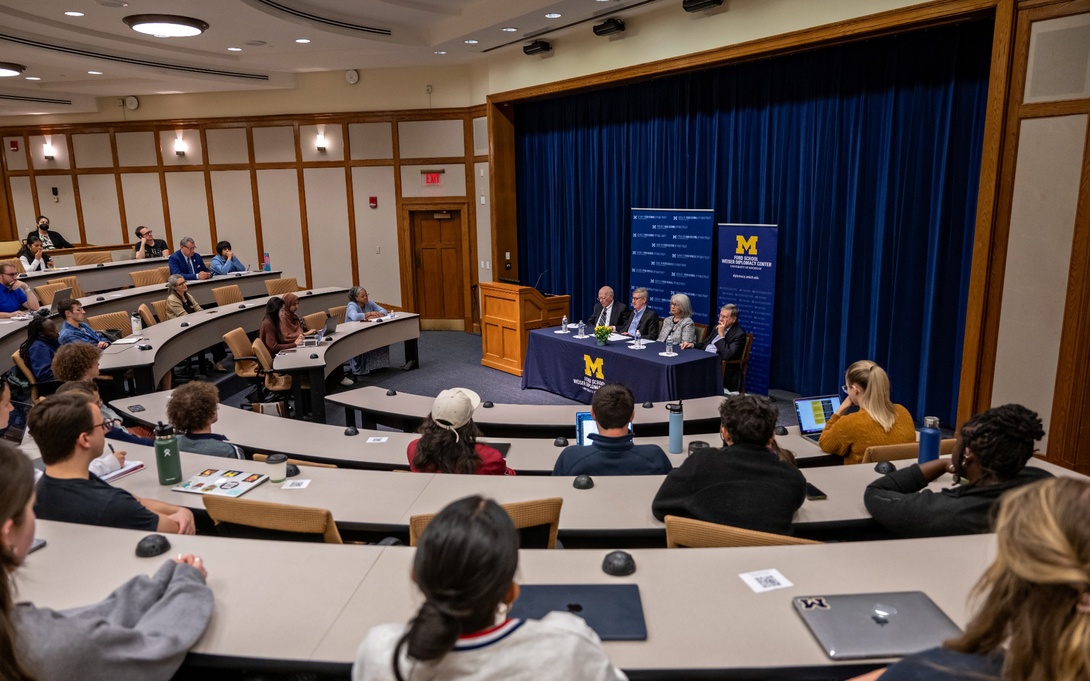
The Asian subcontinent is an immense region of great significance to the United States. While the eyes of most are on China, Pakistan and India are both nuclear powers that have had more than one war, and another one is possible. How can the U.S. manage its multiple security, economic, and strategic interests in South Asia? The 2026 Ambassador's Forum will focus on several major issues that must be addressed in policy and in the conduct of diplomacy in that part of Asia.
India has been a strategic partner of the U.S., has an enormous economy, is an opponent of China in many areas, and is part of the long-simmering confrontation in Kashmir. Relations with the U.S. have soared but now seem to have dipped. Ambassador Robert Blake will talk about the evolution of American policy toward India and where it stands now.
Pakistan, at various times, has been a partner and an opponent of the U.S. It was critical to the support of the American mission in Afghanistan, while at the same time playing a large role in the failure of that policy. Pakistan also played an important role in mediating the U.S. war with Iran, even as it engages in an off-and-on war with the Taliban in Afghanistan and the Tehrik-e-Taliban Pakistan. The potential for new outbreaks and destabilization of the larger South Asia region is large. Ambassador Gerald Feierstein will discuss how this evolving policy landscape intersects with major issues that need attention.
Underlying the specific country issues is the large question of U.S. policy toward the subcontinent, including India, Pakistan, Bangladesh, and the recurring problem of Kashmir. Ambassador Robin Raphel will reflect on the current challenges of maintaining and advancing diplomacy in this difficult area.
From the Speaker's Bio:
Robert Blake
Bob Blake is a Senior Managing Director for McClarty Associates in Washington, DC. He served for 31 years in the State Department in a wide range of positions.
As U.S. Ambassador to Indonesia from 2013 to 2016, he focused on building cooperation to help Indonesia reduce greenhouse gas emissions from the clearing of tropical forests and to embrace clean energy, and onbuilding stronger business and educational ties between the U.S. and Indonesia. From 2009 to 2013, he served as Assistant Secretary of State for South and Central Asia, for which he was awarded the State Department's Distinguished Service Award. From 2006 to 2009, he served concurrently as the U.S. Ambassador to Sri Lanka and the Maldives. In Sri Lanka, he was a strong advocate for democracy, human rights, and the protection of civilians as the Government of Sri Lanka pursued its campaign to defeat the LTTE, designated a terrorist group by the Department of State. Ambassador Blake also served as Deputy Chief of Mission in India (where he was named the worldwide DCM of the year), as well as in other postings in Tunisia, Algeria, Egypt, Nigeria, and at the State Department.
Gerald Feierstein
Jerry Feierstein retired from the U.S. Foreign Service in May 2016 after a 41-year career. At the time of his retirement, Feierstein held the personal rank of Career Minister. Feierstein currently serves as the Senior Vice President of the Middle East Institute. Over the course of his career, he served in nine overseas postings, including three tours of duty in Pakistan, as well as tours in Saudi Arabia, Oman, Lebanon, Jerusalem, and Tunisia. In 2010, President Obama appointed Feierstein U.S. Ambassador to Yemen, where he served until 2013. From 2013 until his retirement, Feierstein was Principal Deputy Assistant Secretary of State for Near East Affairs.
In addition to his career-long focus on the Near East and South Asia, Feierstein also played a prominent role in developing and implementing State Department policies and programs to counter violent extremism. As Deputy Coordinator and Principal Deputy Coordinator in the State Department's Counter-Terrorism bureau, Feierstein led the development of initiatives to build regional networks to confront extremist groups as well as to counter terrorist financing and promote counter-terrorism messaging. He continued to focus on defeating terrorist groups through his subsequent tours as Deputy Chief of Mission in Pakistan and as Ambassador to Yemen.
Feierstein joined the Middle East Institute in October 2016 as a Senior Fellow and the Director of a new Center for Gulf Affairs and resigned from the Institute in January 2025.
Ronald Neumann
Ambassador Ronald E. Neumann is President of the American Academy of Diplomacy, an organization of former senior diplomats dedicated to strengthening American diplomacy. Formerly a Deputy Assistant Secretary of State for the Middle East, Neumann served three times as Ambassador: to Algeria, to Bahrain, and, finally, to Afghanistan, from July 2005 to April 2007. Much of his early career focused on the Persian Gulf and the Arabian Peninsula, including service in Iraq (2004-05) and extensive work with the military.
Since his service in Afghanistan, he has returned there frequently and has written and spoken extensively on the subject. He has authored a book on his time in Afghanistan titled The Other War: Winning and Losing in Afghanistan, as well as written Three Embassies, Four Wars: A Personal Memoir. In earlier postings, he served as Director of the Office for Iran and Iraq, Deputy Chief of Mission in the United Arab Emirates, and in Yemen, and Principal Officer in Tabriz, Iran. In 2018, he received the American Foreign Service Association's award for Lifetime Contributions to American Diplomacy. He serves on the advisory boards of Spirit of America, Friends of the American University of Afghanistan, and SOLA, an Afghan girls' boarding school.
Robin Raphel
Ambassador Robin Raphel is a consultant on political, security, and economic development issues in South Asia and the Middle East. As a career foreign service officer, she served nearly 40 years in U.S. foreign affairs agencies, including the Department of State, USAID, and DoD. She was the first Assistant Secretary of State for South Asia, Ambassador to Tunisia, Vice President of the National Defense University, and Deputy Special Inspector General for Iraq Reconstruction. She managed the sharp increase in development assistance to Pakistan under the late Ambassador Richard Holbrooke and deployed to Iraq with the first civilian contingent after the 2003 invasion to help restore the critical food ration system nationwide.
Earlier in her career, she served in Pakistan, India, South Africa, and the UK, and taught history at Damavand Women's College in Iran. She is a member of the Council on Foreign Relations and the American Academy of Diplomacy, and serves as a Senior Adviser at Nichols Law LLC. She is on the board of the Association of Diplomatic Studies and Training, the Friends of The American University of Afghanistan, and Pugwash International. She maintains an active interest in Afghanistan and Pakistan, and is a frequent participant in informal "Track II" discussions on South Asia.

Have any questions?
