
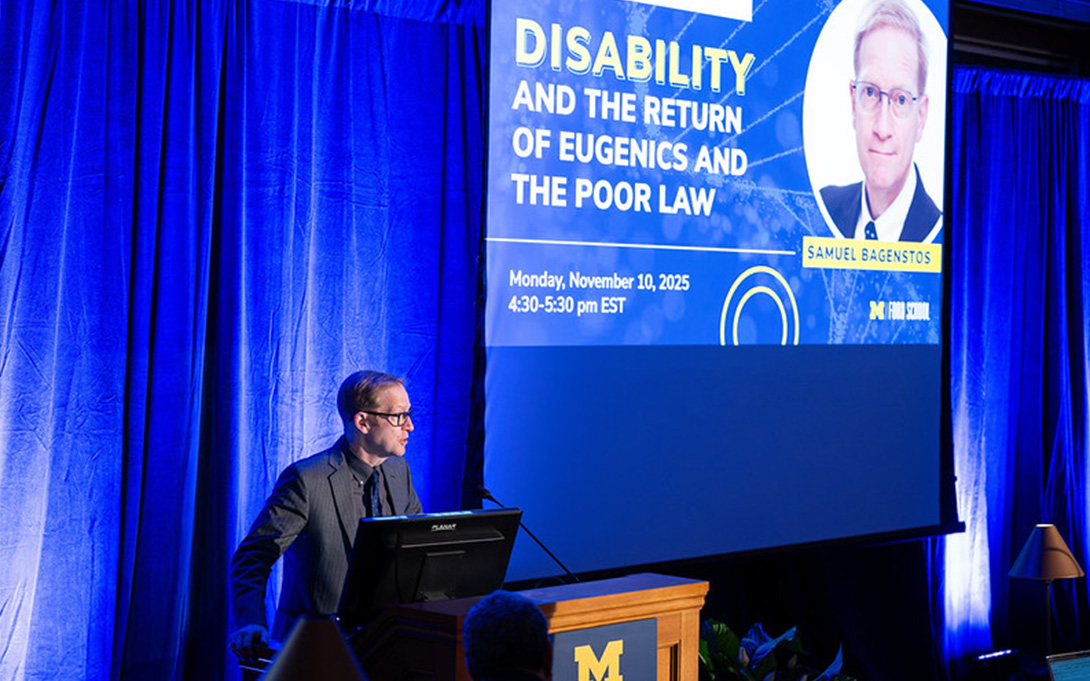
The Ford School's Samuel Bagenstos presented the Arlene Susan Kohn Professor of Social Policy Lecture lecture, which focused on the retrenchment of recognition and support for the disabled community in policies across healthcare and education. Bagenstos warned of a movement back toward the ideology that was promoted in the era of the English Poor Law.
Bagenstos argued that after a century of improvement and equality promoted in disability policy, citing the Affordable Care Act and Americans with Disabilities Act, the U.S. is facing the "return of eugenics." He explained that recent policies impose "significant threats to each of the pillars that have guaranteed individuals with disabilities equality, integration, and empowerment."
The Trump administration's anti-DEI efforts have resulted in the retraction of many disability rights protections. "The executive branch has attacked accessibility as a significant part of its attack on so-called illegal DEI programs. So disabled people are very much in the crosshairs of that approach," said Bagenstos. He argued that the anti-DEI and eugenics ideology being pushed by the current administration is infiltrating personal lives and attacking individuals' choices as part of their pursuit.
Attacking individuals' personal choices as a means to promote public health, rather than discussing community-focused initiatives, is a strategy adopted by the Trump administration to divert blame. "There's this idea of blame and fault, which is consistent with a poor law ideology… The idea that people are making choices that create disability in themselves. This resonates with the idea from the old Poor Laws that we shouldn't be too generous to poor people or people who claim to be sick or disabled for fear that they're faking it or for fear that… make them less productive," claimed Bagenstos.
Bagenstos suggested that the executive branch's anti-DEI policies could be likened to the philosophy of eugenics. "We have these very stigma advertising statements about disability coming from the highest levels, and this reflects a eugenic ideology, I would say, because the idea is that we should ideally eliminate disability by preventing it from happening in the first place or by hiding disabled people from view," explained Bagenstos. Eugenics against disability follows the same pattern that the administration has implemented across anti-DEI policies, erase, and prevent.
In this new era, Bagenstos declared the U.S. has been "moving away from what had been the trajectory in American healthcare policy of moving towards the realization of a right to healthcare." Instead, he claims, "Now we're seeing healthcare understood as an incentive, to be dangled in front of people to encourage them to work and be productive in society and to take away from them if they are not acting in a way that we deem to be sufficiently productive."
The change in healthcare policy under the Trump administration is having direct impacts on disabled communities. "This new poor law inflected means the states shouldn't work to assist people with disabilities because doing so is bailing out people who made bad choices. At the same time, it's undermining support for the collective public health measures on which we all rely to prevent sickness and suffering and to promote human flourishing in the first place." Focusing on placing blame for individual choices, rather than promoting community efforts poses a real danger to public health.
Bagenstos closed the conversation with a sentiment of hope and motivation to persevere in the fight against eugenics in the name of disability equality. "We need to fight as disability advocates but also as advocates of a flourishing democracy for a rebuilding of the public health
state. To recognize that health is about collective choice and to do what we can to share the effort to promote human flourishing for everyone. And that ultimately means we need to fight for
interdependence, but also for justice."
"I am convinced that that is a fight that can be won and that will be won."
