
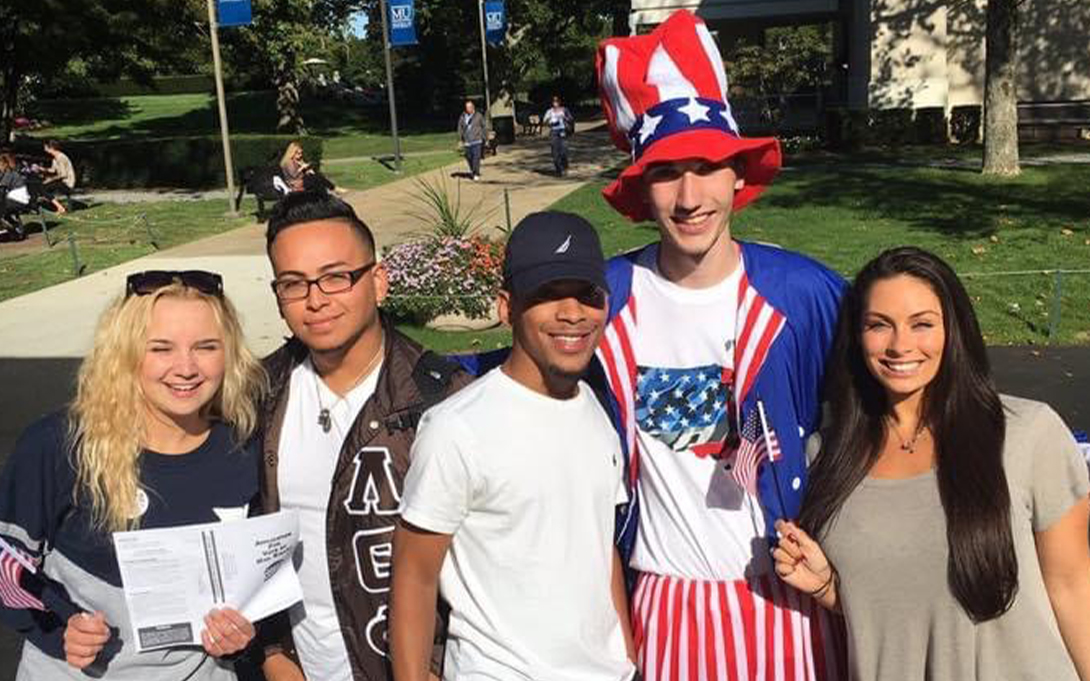
When I arrived at undergrad as a first-year student at Monmouth University, I had no idea that volunteering at a voter registration table would set the course for my career. I joined the Political Science Club with a fascination for politics and policy, but I had no clear idea of what I wanted to do with my life. One of their first activities that year was a voter registration table, and I signed up to volunteer. That first experience with voter registration opened my eyes to civic engagement as more than just a volunteer opportunity. The experience directed my passion and allowed it to flourish. The next year, as club president, I led the university's first campus-wide voter registration initiative, earning an award from the New Jersey Secretary of State for registering the most students to vote. For me, this experience was more than an award. I saw how our efforts enabled many students to take their first civic action and created pathways for them to develop their own civic identity.
While I discovered my passion for democracy and civic engagement as an undergraduate, I didn't yet know how to connect it to a career. That's when I came to the Ford School's Master of Public Policy program. One of the most valuable lessons I took from the Ford School was that policy opportunities exist far beyond traditional policy jobs. While there may not be many positions focused directly on democracy policy (believe me, I checked), I learned how you can take your policy passion and build your own path.
That lesson led me to the Campus Vote Project, where I served as Michigan Director and combined my experience in nonpartisan voter engagement with my passion for democracy and voting rights reform. While the position didn't explicitly include policy work, I created opportunities to apply my policy background. I had the privilege of serving on the Michigan Department of State Election Policy Working Group, ensuring young people's perspectives were represented in policy decisions. Through this experience, I advised lawmakers on issues related to the intersection of voter preregistration and automatic voter registration, ensuring the system was designed to maximize the number of young people automatically registered before their 18th birthday.

Over time, my interest in democracy deepened into a fascination with how it functions at the ballot box, both past and present. A few years ago, I stumbled upon a listing for a lever voting machine for sale at the MSU Surplus Store and instantly had to have it. Before then, I hadn't thought much about earlier generations of voting technology and was unaware of the robust history. That single discovery sparked a journey into the history of voting equipment and an appetite to learn more. Since then, I've collected three mechanical voting machines and more than a dozen ballot boxes, including several glass ballot boxes from the late 1800s.

For me, these artifacts are tangible reminders of how democracy has evolved and how every generation reimagines democracy. I bring those reminders to my work organizing the university's recognition of the 250th anniversary of the United States. As we approach the 250th anniversary, I am dedicated to helping students explore how they can turn knowledge of historical movements into their future civic aspirations.
From my experiences, my advice is simple: follow your curiosity, and don't be afraid to define your own path. Civic engagement takes countless forms, and we need all of your contributions towards the collective project of strengthening our democracy – one idea, one action, and sometimes, one lever voting machine at a time.
Landon Myers (MPP ‘21) is a ninth-generation Michigander, democracy advocate, and leader in local politics. Landon is the program manager for the University of Michigan's Initiative for Democracy and Civic Empowerment.
