
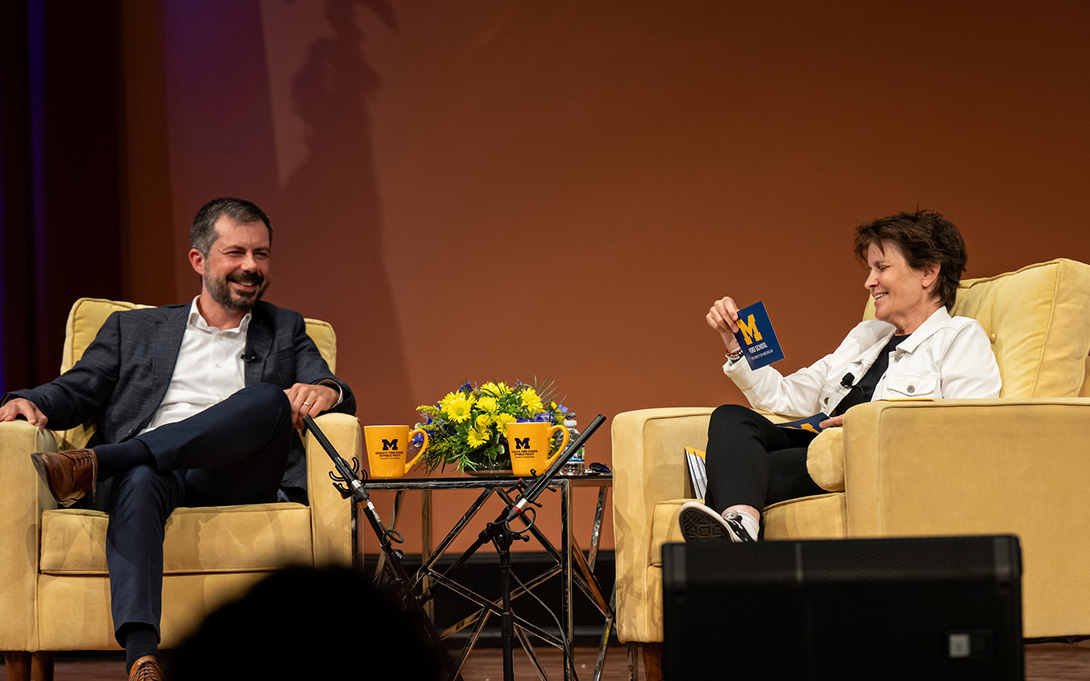
Kara Swisher, the award-winning journalist and current Ford School Towsley Foundation Policymaker in Residence, sat down for a conversation with Former Transportation Secretary Pete Buttigieg to discuss “The State of U.S. Democracy,” for her On with Kara Swisher podcast, touching on a variety of topics including freedom of speech, gerrymandering, the 2024 Presidential race, and the outlook of future politics and elections.
Acknowledging the increase in recent acts of political violence, Buttigieg and Swisher strongly condemned politically motivated attacks. They emphasized the importance of protecting the First Amendment and freedom of speech. Pete Buttigieg opened the conversation stating, “First and foremost, we still have to begin with the fact that a man was killed, that a family was robbed of a father. That should never have happened and that should never happen to anyone. That is the only sane place to begin. I will say that we did see a truly bipartisan response. Not a universal response by any means, but we saw leaders ranging from a conservative Republican like Spencer Cox, the governor of Utah, to Bernie Sanders on the left saying things that really rhymed with each other about why and how political violence is unacceptable, how terrifying it is that America is at this fork in the road.”
He went on to affirm that any form of political violence should be concerning to all Americans, no matter their politics. “Part of what makes political violence a crime not just against the target, but against the country, is that it deprives our whole country of the freedom for open, honest, safe, free political debate… A partisan response to something that should horrify us on a bipartisan basis is wrong, it’s bad and sadly it is unsurprising on the part of the president.” This developed into a conversation on President Trump’s response and the polarization we are seeing take over the country. “It turns out that they’re [Trump’s administration] against cancel culture selectively. Which you just can't be, in the same way that you can’t be against violence selectively. It’s either right or it’s wrong.”
The conversation moved on to big business and tech. Talking about big tech companies positively impacted by Trump’s administration, Buttigieg commented, “Maybe you think you're benefiting right now because the president's too busy going after the easiest pickings, like universities or law firms that employ people who were inconvenient to him or broadcasters. But you can't imagine that you're going to play his game and sooner or later he won't turn on you, too.” He stressed that no one is safe from targeting under Trump’s administration.
Swisher pressured Buttigieg on why he didn’t speak up to prevent President Biden’s second presidential campaign. Buttigieg insisted he didn’t have any say in Biden’s decision to run for a second term. Swisher persisted, asking what he saw from his position in the cabinet, to which he responded, “What my eyes told me was that the sitting president of the United States, the leader of my party, had made a decision that he was going to run, and that our country faced a choice between President Joe Biden or President Donald Trump. And it was not hard for me to know not just who I was going to vote for, but who I was going to do everything in my power to make sure won… and I continued just as enthusiastically backing the Harris campaign and then the Harris-Walz campaign as I did the Biden-Harris campaign, and anybody who was part of making sure that they and not Donald Trump won, anybody who tried to do that, I think should have their head held high because it was the right thing to do.”
Swisher then introduced a question from former West Virginia Senator Joe Manchin, who asked whether the Democrats would’ve had a better chance at winning the election had they held a mini-30-day primary after Biden’s resignation. “I think I felt that we were so under the gun that every day mattered so much and that she was prepared to not just come out running, but to take the organization that had been built over years and immediately carry it forward, that we just couldn't lose one day. I think with the benefit of hindsight, if we'd invested those 30 days, then had she been the nominee, she'd have done so after consolidating the party in a competition. And had she been unable to do that, then almost by definition, there would have been a stronger nominee.” He reiterated that his view is different now looking back. At the time and under pressure, Buttigieg argued he did what was best for the Democratic Party in that moment.
Concluding the discussion, Swisher probed Buttigieg on his current stance on running in the 2028 presidential race. Kara Swisher asked, “Are you going to run for president again in 2028?”
“Oh, I don't know,” Buttigieg replied. She pleaded, “Please don't be coy. Come on,” to which Buttigieg doubled down with “It's 2025.”
“That's not very long” Swisher asserted.
“Have you lived through the last nine months?” Buttigieg joked.
Swisher's podcast, On With Kara Swisher, and is now available on streaming platforms.