
What sustains democratic trust when political disagreements remain unresolved?
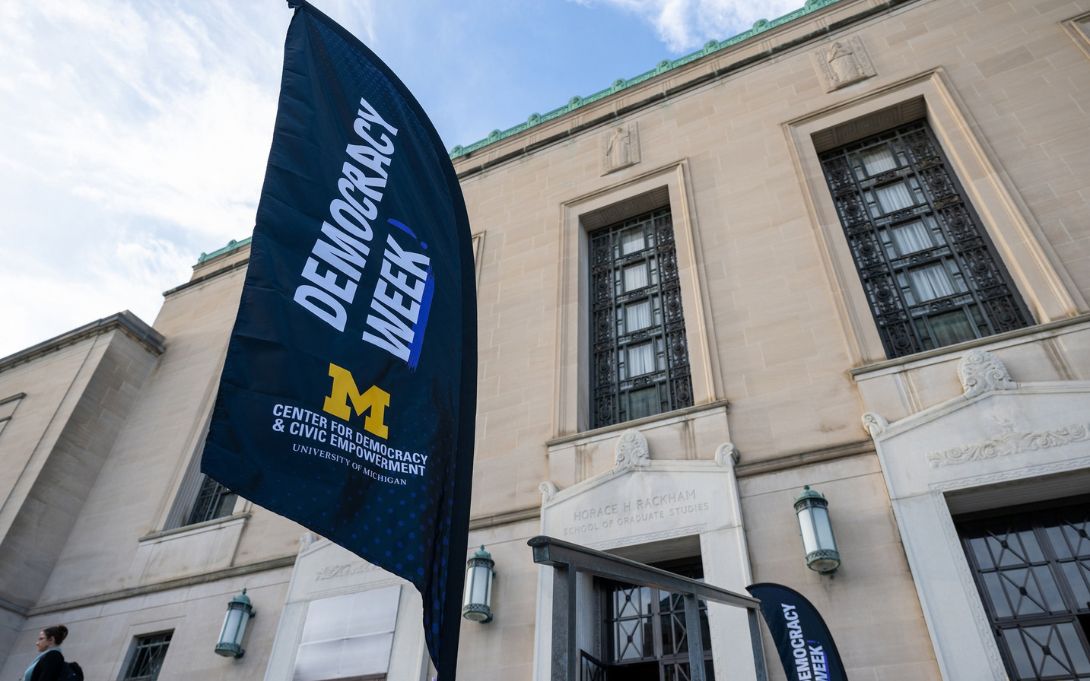
At two Ford School events during the University of Michigan's Democracy Week, held Sept. 14-18, current and former Democratic and Republican elected leaders pointed to local participation, civic education, careful listening, and relationships across ideological lines.
One event examined Michigan election administration and public confidence, while the other brought two sitting governors together to discuss political polarization. Across both conversations, speakers argued that constructive disagreement does not require abandoning principles. It requires curiosity, respect, and a shared commitment to democratic institutions.
Michigan elections: Local control, national scrutiny, and public trust
Four members of the Democracy Defense Foundation's Michigan leadership team—former Governors James J. Blanchard and John Engler, former U.S. Representative Michael D. Bishop, and former Lieutenant Governor John D. Cherry Jr.—participated in a bipartisan discussion of election security, public confidence, and democratic participation.

The panelists emphasized that Michigan elections are administered primarily by local clerks and thousands of community members. Familiarity with those election workers may help explain why voters often have greater confidence in elections conducted in their own communities than in elections elsewhere. The speakers also discussed safeguards such as bipartisan canvassing boards, transparent election procedures, and enforcement of election laws.
Beyond election administration, the conversation explored the civic habits that sustain democracy. Panelists called for stronger civics education, greater involvement in community organizations, more candidate debates, and careful engagement with news and social media. Although they expressed different views on election procedures and potential reforms, they shared a commitment to secure elections and democratic participation.

Moderator Rusty Hills framed the discussion by quoting a foundational principle articulated by President Gerald R. Ford upon being sworn in:
"Our Constitution works. Our great republic is a government of laws and not of men. Here, the people rule."
Bishop underscored the public's role in preserving that system:
"The most important, fundamental principle of our republic is allowing our citizens to be the people who run this country."

The panelists also emphasized education and civic participation as essential to sustaining trust. "Start teaching civics again in high school," Engler said.
Blanchard warned against complacency: "We take our democracy for granted. We take our system for granted."
Cherry described civic and community organizations as places where people develop the habits democracy requires: "We learn to perform in a democratic society by being engaged in organizations that conduct their own affairs democratically … You learn to compromise. You learn how to work with someone you don't agree with, and that goes a long way toward making the system viable."
How to disagree better: A forum with governors Spencer Cox and Michelle Lujan Grisham
At another Democracy Week event, Utah Governor Spencer Cox, a Republican, and New Mexico Governor Michelle Lujan Grisham, a Democrat, discussed political polarization and the practical work of maintaining relationships across disagreement. Presented by the Center for Democracy and Civic Empowerment and the Ford School, the forum focused on the idea that "disagreeing better" does not require people to abandon their principles. Instead, it requires listening, intellectual humility, and a willingness to understand how others reached their views.

Cox and Lujan Grisham put those practices into action while discussing issues including education, child care, immigration, artificial intelligence, and the balance of power within government. They described how governors exchange ideas across party lines, learn from successful policies in other states, and work together on issues that cross state boundaries.
Lujan Grisham explained why direct debate offers something that online exchanges often cannot:
"I learn something if I am debating an issue with you. I walk away with a deeper sense of understanding about why we disagree."
Cox argued that polarization is intensified when too much power and attention are concentrated at the national level:
"Congress was always intended to be the most powerful branch of government, on purpose. The executive branch has gotten far too powerful, and that's led to a lot of polarization that we're seeing."
He added that federalism was designed to allow states to serve as "laboratories of democracy," pursuing different policies while learning from one another.

Both governors encouraged participants to rebuild civic trust through human relationships by joining organizations that include people with different backgrounds, asking sincere questions, seeking context, and spending time together outside political settings.
They described how they regularly talk, seek each other's advice, and continue working together even when their approaches differ.
Lujan Grisham urged the audience to expect elected leaders to build similar relationships across party lines and to practice constructive dialogue in their own lives.
"If more elected leaders and more people required that we do this, I do think America can get back on track. And if more people will come to these events, and if you will take a minute to talk to the people that you disagree with and hear them out, I feel better about the work that we do every minute of every day."
Taken together, the events reflected the Ford School's commitment to nonpartisan, evidence-based, and inclusive public discourse through its Conversations Across Differences event series.
About Conversations Across Differences at the Ford School
Conversations across differences are essential to public policy education and democratic life. Ford School graduate and undergraduate students are training to be civic and national leaders. Listening carefully, evaluating evidence, understanding different perspectives, and remaining engaged during disagreement are skills needed to solve challenges in communities at home and across the world. The Ford School's Conversations Across Differences public event series and curricular and co-curricular programming aim to prepare students to develop critical skills to bridge divides.

