
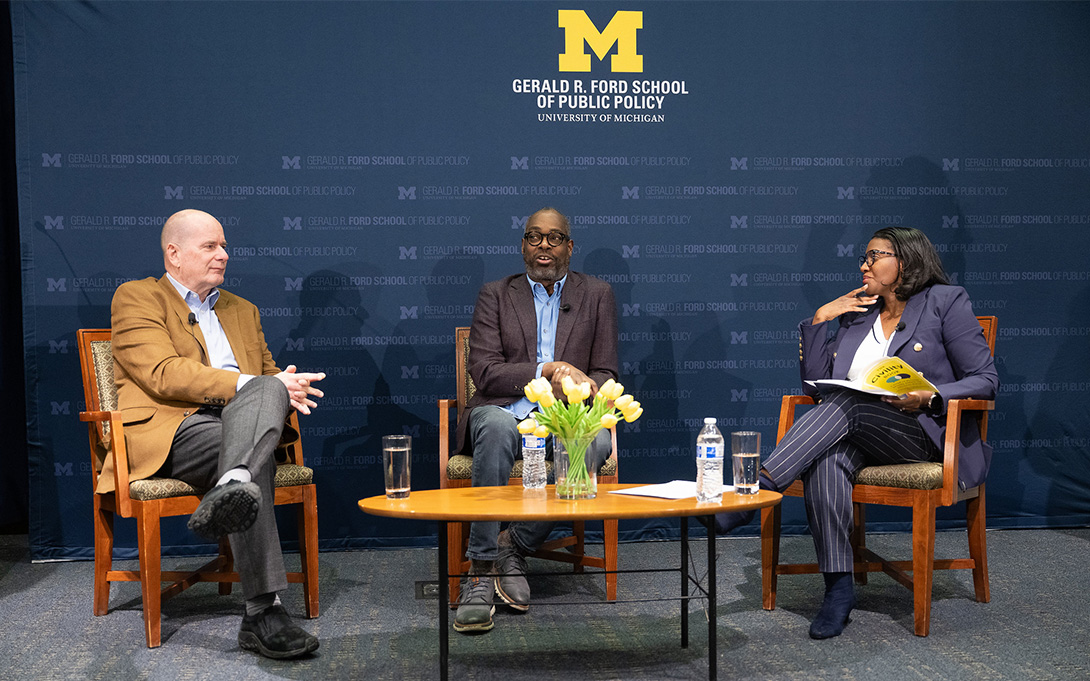
Showing respect, kindness, and courtesy towards others is the foundation for effective political dialogue, otherwise known as civility. The term civility is used by Detroit journalists Nolan Finley and Stephen Henderson to describe how they defend their opposing political beliefs while remaining friendly with each other. The two journalists spoke at the Ford School and explained that despite the public's perception of their heated political debates, their relationship is rooted in civility and friendship.
The event was co-sponsored by Talking Maize & Blue, Wallace House Center for Journalists, Access and Opportunity, and Life-Changing Education.
When discussing their commitment to their friendship, Finley argued that their relationship and respect for one another are deeper than politics. "Steve and I could come to complete agreement on everything, and the world wouldn't change tomorrow. But if we fell apart over these differences, our worlds would change, you know, it would be less rich," he stated. Finley also argued that their friendship works because they don't try to convert each other's political beliefs.
"What we've agreed to do is find value in our disagreement so that we can debate and talk. And all the while, we're learning from each other, we're testing our arguments. We're finding out things about each other we didn't know. And that takes a lot of the heat out of it when we approach it as sort of a learning exercise," Finley described the benefits of their political and friendly dialogue.
Henderson argued that the world could use a little more of the civility that he and Finley practice in their relationship. "What that word [civility] means is the things that we outline in this book, right? The ability to listen, the ability to open your mind to something that may not be the way that you see things. The ability to have an argument and then go have dinner with the person you had an argument with."
Agreeing with Henderson and acknowledging the current political climate, Finley raised concerns about increasing polarization. "Politics has become so all-consuming. The most important thing about us now is our politics. I mean, we've always had differences. Any two people are gonna have differences, but the one difference we don't seem to be able to tolerate now in another person is a political difference," said Finley.
Implying that civility on the individual level is just as important as civility in democratic systems, Henderson outlined the influence that individual interactions have on democracy. "There is no such thing as a democratic system or process that embraces incivility, right? Violence or disruption. The idea is that we should be able to share different ideas and different approaches and civilly come to an agreement about how we go forward together. I think that that's part of the bedrock of the democracy that we are still building here, right?" Henderson affirmed.
Finley and Henderson explained to the audience what civility means to them, how it appears in practice, and why it is so important in this era of politics. The pair asserted that civil discourse starts with individuals who will inspire positive change toward civility in our democratic systems and institutions.
