
So much of being a public servant is about listening."

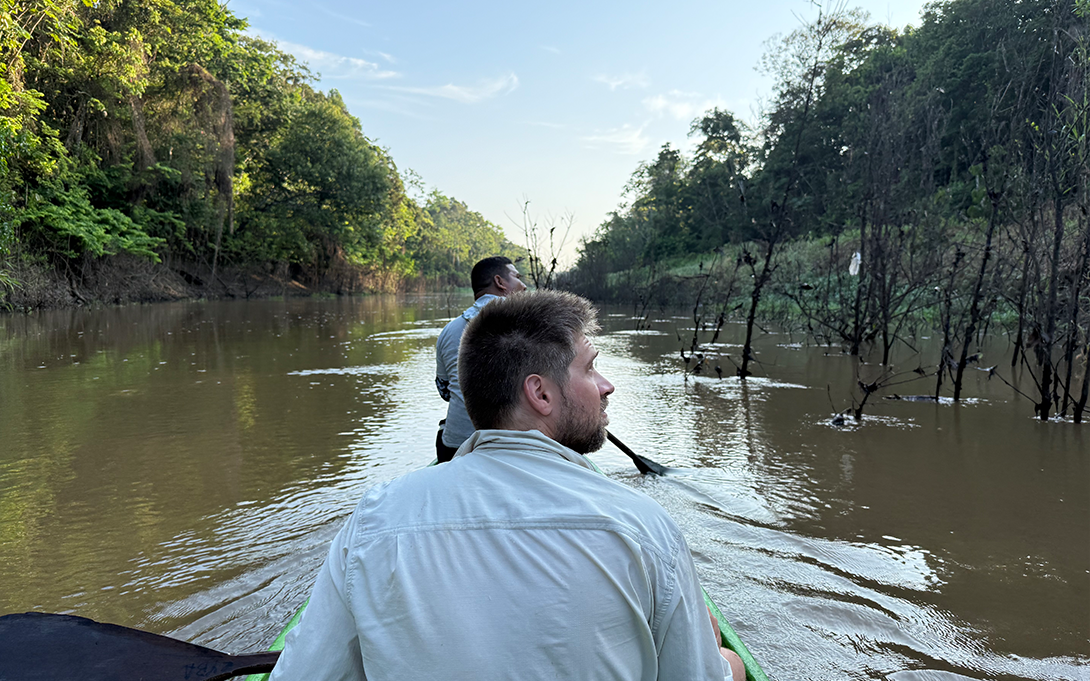
When it comes to protecting our planet, Ben Zukowski (BA ‘13) believes the key isn't just in science, but in listening to those living closest to the land. But first, he says, you have to know how to ask the right questions to get to a sustainable solution.
Where are the gaps in our knowledge? What data do we need to gather? When should we stop investing in quantitative data and hear directly from people who are affected on the ground? What perspectives or disciplines can help us solve the problem?"
After graduation, those questions guided Zukowski as he set off to gain practical conservation experience with the Andean Bear Foundation in Ecuador. As a field biologist, Zukowski initially focused on gathering data on how the indigenous Quechua people interacted with Andean bears and identifying potential solutions for the livestock depredation caused by the local bear population. But he quickly realized that having the numbers on bears alone wasn't enough to protect the region's wildlife. He needed input from the Quechua people, who would be responsible for long-term conservation efforts.
So he lived like a local (with two local families) and learned about the community's needs and belief systems. He also farmed alongside residents and taught English in the local schools.
"At the beginning, my Spanish was just okay, but the Foundation kept me on because I earned the trust of the community," he said. "It's incredibly important to build that trust when you're working across cultures."
Working closely with community members, government officials, and environmental activists, Zukowski's team launched education programs and published a case study examining how community practices shape perceptions of the Andean bear.
He brought those lessons back to the United States and now serves as senior project associate at the Udall Foundation, a federal agency dedicated to resolving tribal, environmental, public land, and natural resource-related conflicts. Zukowski leads collaborative efforts among federal, state, and tribal governments; local communities; and environmental groups in what he describes as a "perfect marriage" between his experiences working with community stakeholders and federal policymaking.
His current projects tackle U.S. environmental conflicts, such as finding consensus on how to repair California's Highway 101 as it crumbles into the Pacific Ocean, and supporting Native American tribes affected by offshore development, as well as strengthening Tribal sovereignty and the Federal Trust Responsibility in agencies nationwide.
He recently co-organized a Tribal Ocean Summit with the U.S. Department of the Interior, where tribes from Alaska to the Gulf Coast directly shaped and aired concerns about policies affecting their ancestral waters.
"The summit was a powerful experience," Zukowski recalled. "There are so many tribes across the country with entirely different languages, ecosystems, ways of living, and ways of knowing."
They came together to share what the ocean means to their communities. "Some spoke about fisheries and whaling, others of ancestral villages now underwater because of a changed coastline and impacted by offshore drilling. These places are more than land or water—they're sites of memory and meaning, where ancestors are still present, shaping how people see and interact with the world today. For many, the placement of a windmill is not just a technical issue, but about respect for sacred grounds and the voices of those whose stewardship stretches back millennia."
For Zukowski, public policy begins and ends with listening and building trust to honor community values and expertise.
So much of being a public servant is about listening. The data can tell us so much, but we need to listen to the people affected. What do the trees need, but also what do the people need? And how do we include them in our decision-making?
By Rebecca Cohen (MPP '09)
Related spring 2026 State & Hill stories
 Alumni Impact: Pathways for student success
  Alumni Impact: Families at the center of child welfare reform
  Alumni Impact: Collaborative development across Asia
 ← Read all stories in the spring 2026 edition State & Hill