
When Brighton city leaders set out to help residents better understand how public dollars are raised and spent, they faced a challenge familiar to many local governments. Their detailed 100-page financial report was not written for everyday use.
A team of University of Michigan public policy students took on that challenge through the Ford School Consulting Clinic, beginning with interviews with residents and business owners about what they wanted to know and where existing city documents fell short. By the time the team presented its findings to the Brighton City Council in May, it had developed recommendations for a new public-facing financial report template the city could update annually.
The presentation had the familiar markers of a professional consulting engagement: client research, stakeholder interviews, analysis, recommendations, and a final presentation. But through the Clinic, students provide that strategic support at no cost to public-sector partners.

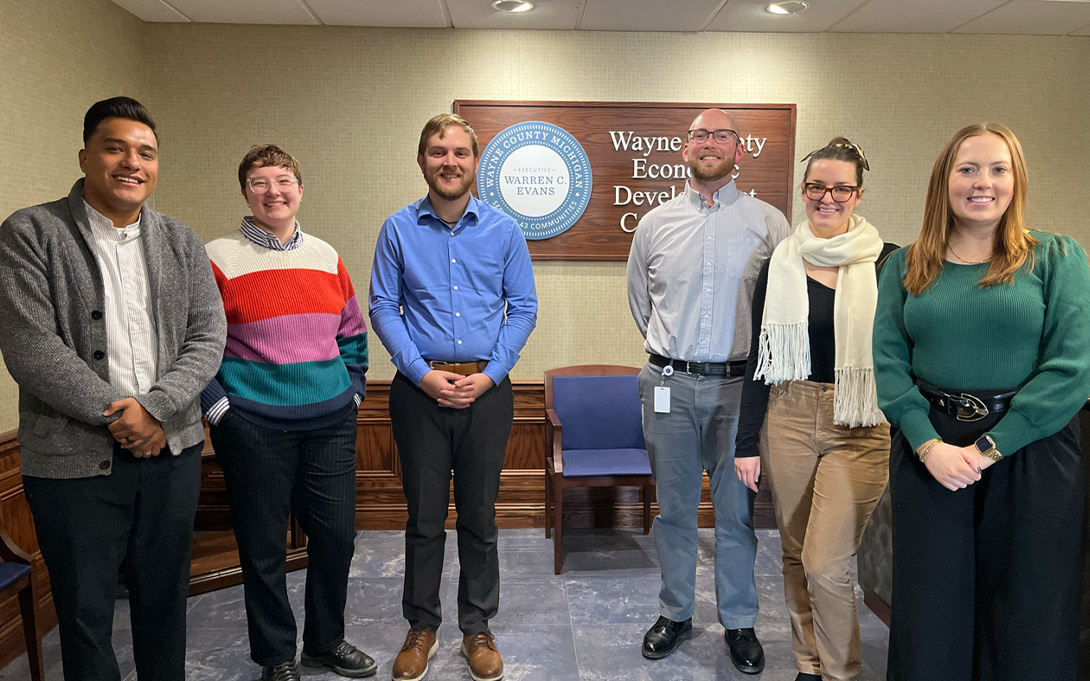
The Brighton team was one of three student groups in the Clinic's pilot year. Other teams worked with Wayne County to assess the economic impact of power outages on small businesses and with the Michigan Municipal League to explore policies that support homeownership.
For local leaders, that extra strategic capacity matters.
Local governments are on the front lines, and they are being stretched thin, with fewer tools, smaller teams, and growing responsibilities," said Dan Gilmartin, CEO of the Michigan Municipal League.
"Pro bono consulting from U-M can help bridge the gap, offering strategic support where it's needed most."
"It's a win-win," explained Professor Jeffrey Morenoff, who co-leads the Consulting Clinic.
"Our students gain professional, client-facing experiences that are difficult to replicate in the classroom.
Documenting the cost of power outages in Wayne County
Wayne County's Sustainability and Innovation Division knew power outages were disrupting businesses, but the full economic and operational impact was difficult to document. The Ford School team set out to measure those effects and understand how outages affected small business operations.
Christopher Martinez (MPP '27), who led the consulting team, said one of the most challenging parts of the project was estimating economic impact in a way that was credible and useful without overstating what the available data could prove.
"By maintaining strict analytical discipline, the project delivered a credible estimate that demonstrated the urgency of the issue while remaining realistic," he said.
The work included developing a survey, speaking directly with small business owners, and reviewing best practices.
The team found that many businesses do not formally document outage-related losses or submit claims for damages or lost revenue, especially when outages last only a few hours. Business owners also described limited proactive communication from their energy provider and the difficulty of planning around unpredictable disruptions.
"The impacts of outages extend far beyond temporary inconvenience; they affect workers, operations, planning, and overall economic stability for local businesses and communities," Martinez said.
None of the team members had previously worked in formal consulting roles, but they brought experience from other sectors and applied skills in project management, research, community engagement, and client communication.
Martinez said the experience showed him that effective consulting is not only about producing strong analysis. It also requires listening carefully to client needs, maintaining consistent communication, and making sure the work is useful to the partner.
Helping Michigan communities assess resident ownership models
Another student team worked with the Michigan Municipal League to examine how Michigan communities might expand affordable housing options and create more pathways to homeownership.
Led by Sarah Peterson (MPP/MBA '28), the team studied policies that can give tenants or residents a legally protected opportunity to organize and make an offer when the property where they live is put up for sale. The team focused in particular on manufactured home communities, where residents may own their homes but rent the land beneath them.

Peterson said that distinction is important. Manufactured homes are often discussed as affordable housing, but residents can still face instability when land is sold, rents rise, or a community changes ownership.
The team found that Opportunity to Purchase policies are not simply about helping residents buy property. They can also give residents more leverage and a stronger voice during moments of transition.
"The unique thing that these can do is they can offer the benefits of ownership to more types of people in more types of housing," Peterson said.
The students reviewed national examples, interviewed stakeholders, and analyzed three Michigan communities—Detroit, Ypsilanti, and Lake County—to understand how different local conditions might affect whether these policies could work. Their research showed that there is no one-size-fits-all approach, but successful resident ownership models depend on a broad ecosystem of support, including housing-focused nonprofits, community development financial institutions, resident or tenant associations, legal tools, and local government capacity.
The team's final deliverables included a guide designed to help municipalities assess their own readiness. The guide prompts local governments to consider the state of affordable housing in their communities, existing routes to ownership, the strength of local nonprofit and financing networks, and their capacity to support residents through a fast-moving purchase process.
For Peterson, the project confirmed her interest in consulting.
It's a really hopeful thing to get to work with local governments and public service employees who are making really tangible differences in their communities," she said.
Making Brighton's finances easier to understand
The Brighton project centered on creating a template for a Popular Annual Financial Report, or PAFR, a shorter, more accessible report that translates formal financial information for residents and business owners.
The city's Annual Comprehensive Financial Report contained detailed financial data, but the student team found that many residents and business owners were looking for more practical explanations about how the city's finances affect them.
"Relatively few asked about traditional measures of financial health," said Danielle Sockin (MPP/MBA '26), who led the consulting team. "Many wanted to better understand where the City's money comes from, what it gets spent on, what services are funded by their taxes, and how major projects are paid for."
The team was surprised by how often questions about property taxes and millages came up. Many residents were unclear about what portion of their tax bill goes to the city versus other entities, such as schools, the county, the library, or the fire authority. In short, stakeholders wanted to know what they were getting in return for paying taxes.
That feedback directly shaped the final template. The team added sections explaining where a property tax dollar goes and how different taxing entities interact. It also emphasized city services, infrastructure investments, and major projects, connecting financial information to visible community outcomes.
The project pushed students to think differently about policy communication. "The challenge was to preserve the accuracy of the financial report while making information understandable and useful for a general audience," explained Sockin.
Student growth and professional training
Across the three projects, students worked on different policy challenges facing Michigan communities. For Morenoff, the experience showed that professional training is about more than mastering technical material.
In each case, students had to turn complex information into something useful for a real client. That meant working with imperfect data, adjusting to client needs, managing team dynamics, and communicating findings to audiences outside the classroom. Morenoff said those are precisely the kinds of skills the Clinic was designed to develop.
In their presentations, the students commanded attention," Morenoff said. "They didn't shrink in that environment. You could see the transformation from being students to professionals, providing insights that were valuable for the client."
To prepare for those presentations, students participated in workshops on policy report writing, effective presentations, and answering questions in real time. Teams also gave midpoint presentations, received critiques, and met regularly with faculty supervisors as their projects evolved. That support helped teams navigate sensitive issues, including how to present findings carefully, acknowledge uncertainty, and ensure recommendations were useful to the client.
For several students, the experience also opened a window into consulting as a public-service career path. Morenoff said the level of student interest in the pilot showed that students are eager for more applied professional experiences.
"There is a craving for professional experiential learning opportunities," he said. "Our students have high levels of interest in local government and consulting jobs, and in gaining skills that will help them in those positions."
As the Clinic grows, Morenoff said, the Ford School hopes to continue focusing on local and state government projects that build on classroom skills while serving Michigan communities.
"We have a responsibility to be out there, to listen, and to be of service to communities," he said.
Students participating during the 2025-26 academic year include:
- Drew Bluethmann, MPP/MBA
- Christopher Healy, MPP/MBA
- Ben Hunnicutt, MPP
- Alice Kinney, MPP
- Kinsey Kutilek, MPP
- Christopher Martinez, MPP
- Isabella Martinez, MPP
- Lauren Parker, MPP
- Sarah Peterson, MPP
- Alimatou Sarr, MPP/MIRS
- Kyla Sherap, MPP/MBA
- Danielle Sockin, MPP/MBA
Related Fall 2026 State & Hill stories
 Samuel Owusu: The people behind the numbers
  Student "data detective" untangles India's rural wage-payment system
  A safety net that keeps its promise
 ← Read all stories in the fall 2026 edition State & Hill
