
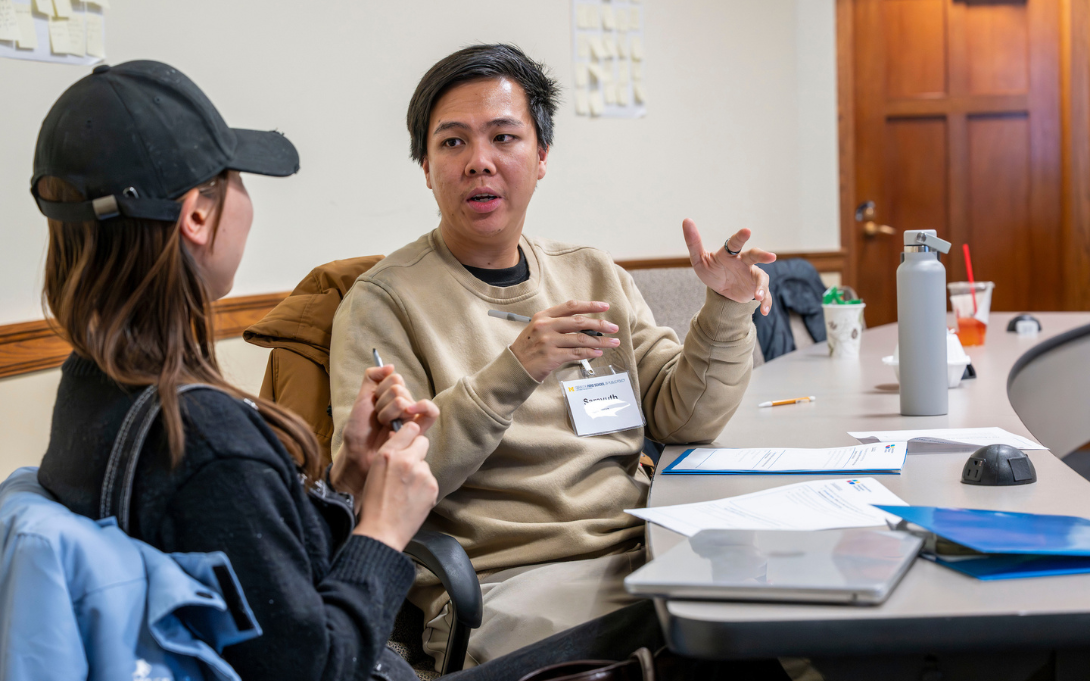
What does it take to have a real conversation about firearm safety—one that builds trust, not tension? That was the central question at a recent peer-led dinner, a program led by Ford School Bridge Builders that invites undergraduate and graduate students to practice using constructive dialogue to explore complex social and political issues.
Attending the dinner was Dr. Cynthia Ewell-Foster, director of the Community Engagement Core at the Institute for Firearm Injury Prevention (IFIP), who shared her experiences developing firearm injury prevention training and practices in rural communities in Michigan's Upper Peninsula.
Participants Lior Cooper (BA ‘26) and Isaac Davis (BA ‘26) reflect on what they learned.
Lior Cooper (BA ‘26)
Did you encounter any new or interesting perspectives on firearm injury prevention through dialogue and discussion at the Peer-Led Dinner with Dr. Cynthia Ewell Foster?
I did! Given that I didn't have much knowledge about gun violence going into this event, participating in this dialogue gave me a chance to consider perspectives I had never considered, given my background and positionality.
How do you feel this event prepared you to engage in similar dialogues–related to firearm injury prevention–in the future?
I feel very prepared to engage in similar dialogues, whether related to firearm injury prevention or not, because of my experience at this event. By taking part in this dialogue, I had the opportunity to absorb and analyze a policy conversation built upon the foundational assumption of mutual understanding rather than upon a zero-sum competitive foundation. Because of this experience, I now have the confidence to enter other policy conversations with a constructive mindset.
How will this conversation shape how you engage with this issue moving forward?
I realized just how many different ways one can engage with firearm injury prevention policy, given a multitude of factors. It sounds obvious in retrospect, but urban, suburban, and rural policies on firearm injury protection are much more distinct than I had previously assumed. Equipped with this knowledge, I can engage with firearm injury prevention debates in a more nuanced and multifaceted way, factoring in how geographic — as well as socioeconomic — differences across different communities shape which policy solutions to firearm injury prevention work best.
What do you feel that you gained from this experience?
I gained a better understanding of what the current zeitgeist on firearm injury prevention policy looks like. Additionally, I saw firsthand how my fellow students grapple with the strategies used in intentional dialogues within the context of policy conversations. I have previous experience in engaging in dialogue from previous extracurriculars, but despite being in my second year at the Ford School, this was my first real opportunity to take part in an experience that sat at the intersection of dialogue and public policy.
Isaac Davis (BA ‘26)
Did you encounter any new or interesting perspectives on firearm injury prevention through dialogue and discussion at the peer-led dinner with Dr. Cynthia Ewell Foster?
I encountered a lot of new perspectives from Dr. Foster and my fellow students that I had never considered before. Specifically, I found Dr. Foster's efforts in rural northern Michigan to be especially interesting. Her ability to not only see across political opinion, but also to effectively promote safe gun ownership through local engagement instead of a large focus on policy change, was something I had never considered seriously. I've been hesitant to focus on local initiatives when they weren't followed with a comprehensive state or federal policy, but I realized local results could be just as impressive and often longer-lasting.
How do you feel this event prepared you to engage in similar dialogues related to firearm injury prevention in the future?
It made me realize that I don't know as much about gun policy as I thought, and in the future, I should come into conversations more humbly, recognizing that there are perspectives just as important as my own.
How will this conversation shape how you engage with this issue moving forward?
One insight that I left with was that while approaching gun policy at the local level with local partners isn't the fastest way to make change, it is just as important in maintaining change.
What do you feel that you gained from this experience?
I feel like I gained a lot of insight into the professional and academic efforts that are currently being made to promote better gun ownership practices, including right here at U-M.