
Behind the scenes of the Ford School's policy simulation
How should you spend five entire months preparing for a dynamic event for one hundred students that is going to take place within an extremely short time window of two and a half days of activities, in which everything you set up has to come together in perfect harmony?
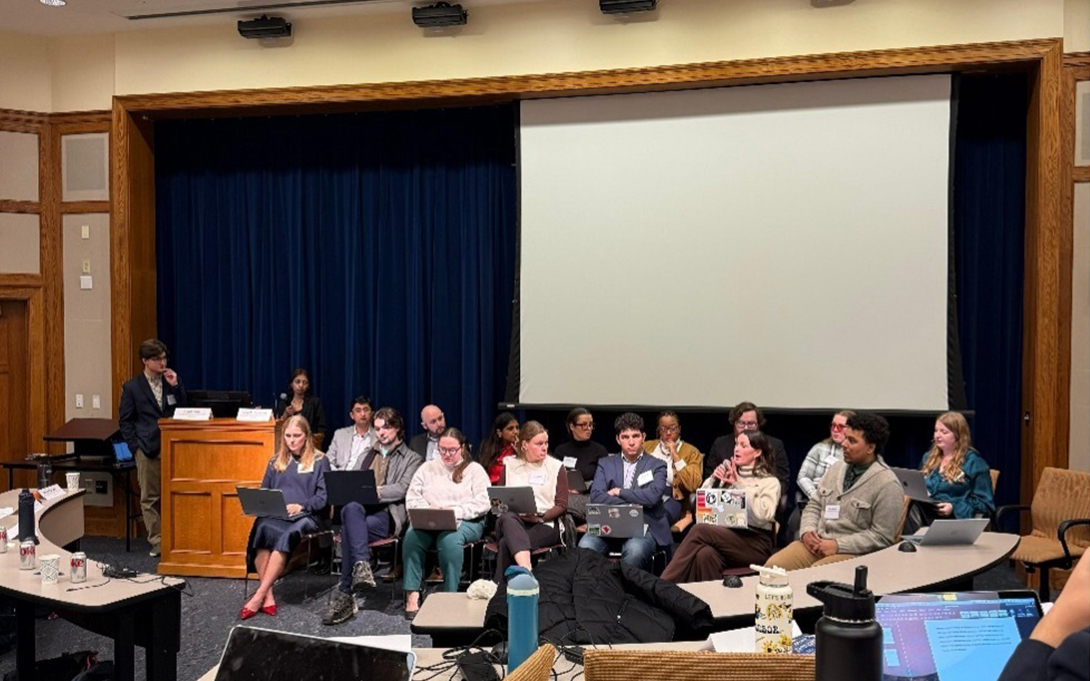
This past semester, I had the honor of working as a Graduate Student Instructor for the Integrated Policy Exercise, the IPE, at the Ford School of Public Policy, together with Professor Elizabeth Gerber and my colleague Lauren Parker. The IPE invites students to step out of their comfort zones and play the role of a real stakeholder, whether a politician, elected official, CEO, media member, or others, within a policymaking scenario. Rather than sitting and listening, students are expected to engage with each other, move around, find potential allies, and advance their respective agendas until the simulation is over.

The final results, whether that is the passage of a legislative bill, the creation of a new foreign affairs policy, or the delivery of a State of the Union speech, fully depend on what students make of the experience.
As a required course within the Master of Public Policy, the IPE has more than twenty years of history, firmly establishing itself as a tradition at the Ford School.
What to talk about?
For the 2026 IPE edition, our first task was selecting the topic and format of the simulation. What was an issue that had not yet been addressed, was under active discussion, and could capture their interest and engagement? After many rounds of consideration, we landed on the hazardous and solid waste management policy landscape in the state of Michigan.

"Waste?" you might ask. "Is this seriously the best option they could find?" While certainly not one of the most famous policy areas, it was my own background in environmental policy that led me to suggest it.
Waste is an often overlooked issue that is deeply embedded in our daily lives, involves multiple stakeholders, carries immense impacts on communities and the environment, and is not going away simply because we wish it would.
What we also discovered is that Michigan is currently a battleground for waste policy debates. The state has been receiving waste from other states in the United States and even from Canada due to its comparatively lower disposal costs and specific political dynamics. Adding to that, the state was set to receive nuclear waste from the Manhattan Project, which made us realize that bringing this issue to the center of the discussion would be particularly significant.
Running the backstage
After selecting the topic, it was time to start building the simulation itself. We spent countless hours working on aspects such as which stakeholders should be represented, what food we were going to serve, and all the small details involved in organizing an event. The real challenge, however, was ensuring that the logistical components were aligned with the academic value we aimed to create.

One clear illustration of this was the role of guest experts. We invited more than 27 real-life experts (including many Ford alumni!) to speak with students during the exercise. Deciding how to distribute them across the schedule, determining the appropriate time windows for their participation, and ensuring that their presence would advance rather than disrupt the simulation, all while accounting for their own tight schedules, proved to be extremely challenging.

Once all the background materials, schedules, room reservations, and guest invitations were finalized, we reached the final and longest stretch, the simulation itself. Running it from the inside felt like a constant juggling act between managing logistical aspects such as setting up food, preparing signs, and keeping the schedule updated, and engaging directly with participants by supporting students in their roles and welcoming guests to the building. As intense as it was, the experience became truly rewarding once students fully embraced their roles and brought the simulation to life.
Room for innovation
Although the IPE is already a long-standing tradition, we wanted to ensure that this edition introduced new elements. To begin with, we increased the importance of media roles in order to bring greater dynamism. In addition, we strengthened the use of the Viewpoint platform to enable smoother and more engaging channels for students to interact and perform their roles. Finally, we incorporated additional elements, including visual signs and geovisualizations, to make the experience even more immersive. I personally hope these and other changes continue to be considered in the future, so that the IPE remains one of the most important milestones for all MPP students, as it certainly was for me, both as a student and now as one of its organizers!
About the author
Pedro Eymael (MPP/MS '27) has experience working in land use change, sustainable agriculture, and climate finance, and aims to advance global efforts in these areas after he graduates.
Read more about this year's IPE.