
When people heard what I did before coming to the Ford School, the biggest question people asked was, "Why did you leave?" Though I grew up in Seattle, I had just spent five years living in New York working at a national news network. My answer was honest: though I believe journalism is important, I had strong opinions about what is and isn't working in our society. Rather than telling stories, I wanted to be part of the work to make our society better. I believed the Ford School and the School for Environment and Sustainability could teach me the skills needed to do so.
At the Ford School, I've stretched myself to my limits and grown so much as a scholar and person. Whether it's activities like the Leadership Crisis Challenge and the Michigan Journal of Public Affairs or quantitative classes covering material I hadn't thought about since undergrad, there are endless opportunities to try new things and get the support you need to succeed in them.

A lot of my learning and support has been centered on careers and professional development. During my summer internship, I received career coaching through the Ford School's Leadership Initiative, which gave me incredible insight into my strengths. Through this year's Aid & Development workshop series, I learned concrete skills around grant writing and project budgeting, and then practiced them by pitching a grant proposal to my peers and professors.
There's also been development of my theory of change and personal politics. Speakers like former Secretary of the Interior Deb Haaland, former Secretary of Transportation Pete Buttigieg, activist Angela Davis, and author Ta-Nehisi Coates bring new ideas and lived experience to campus. Class discussions on topics like ethics, AI, and participatory democracy are generative, thought-provoking, and best of all, fun. I've also learned so much from my peers, whose perspectives both ground and challenge me. As one friend said during our friendsgiving this year, "I'm grateful to have friends who are as excited about an upcoming public utilities commission hearing as I am." I also have friends in Public Health, Social Work, Law, Engineering, and Urban Planning, and when we go out, there's truly never a dull moment.

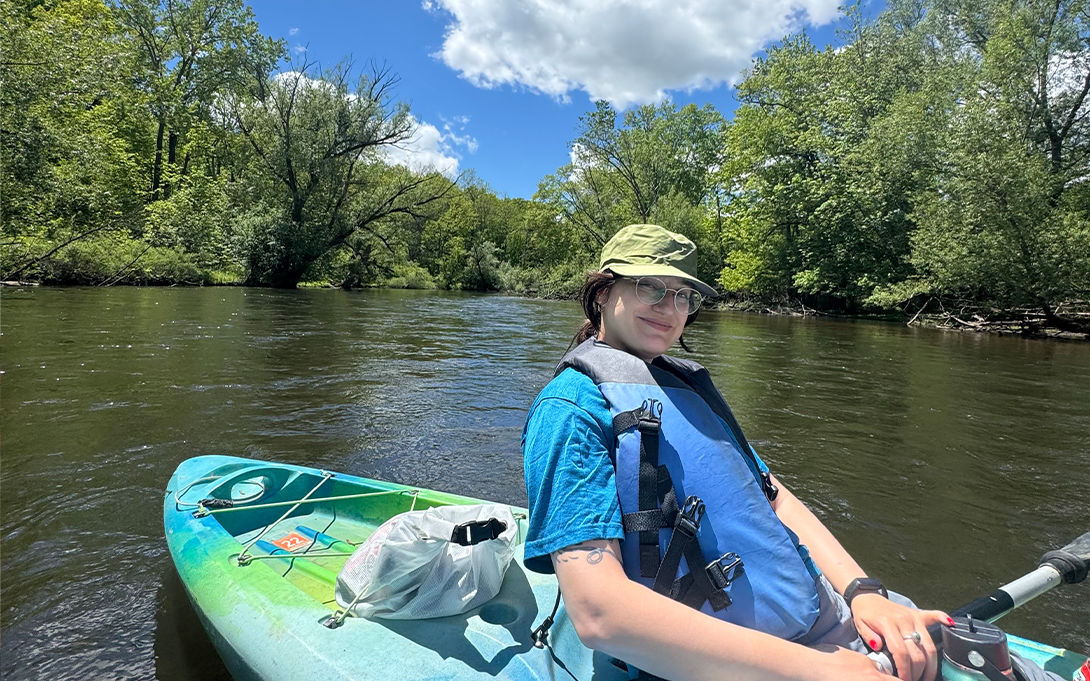
The area is rich with activities, too. I've learned to swim for exercise, danced at an ABBA bar night, and ice skated on the same rink as dozens of NHL players and Olympians. On any given day, Main Street may be shut down for a street festival or parade. When it's warmer, I mountain bike on SE Michigan's fantastic trails and kayak down the Huron River. Though Ford School class sizes are small, my world here at Michigan feels boundless.

Danielle Levy is a second-year dual-degree candidate at the Ford School (MPP) and the School for Environment and Sustainability (MS), and is a member of the Informal Sustainability Lab. She is interested in post-growth and wellbeing economies, urban sustainability, circular economy, and extra-market resource distribution. She is researching urban symbiosis, or the beneficial material and energy sharing between urban actors within cities. Her fieldwork in London looks at why urban symbiosis emerges and how it benefits urban citizens. Before returning to school, Danielle spent six years producing documentaries, news specials, and podcasts for CBS News. She graduated from Northwestern University with a Bachelor of Science in Journalism.