A refreshed Ford School course equips students with tools to analyze authoritarian practices and political structures worldwide
As authoritarian governance rises around the globe, Ford School students are digging into a timely question: How do systems of autocratic rule operate, and what does policy making look like under their constraints?
Graduate students are deepening their understanding in a newly revamped version of PubPol 510—one of the school's foundational courses. "I'm already learning about how to conceptualize authoritarian practices, and how to recognize them in a wide range of contexts," says first-year MPP student Sarah Peterson.
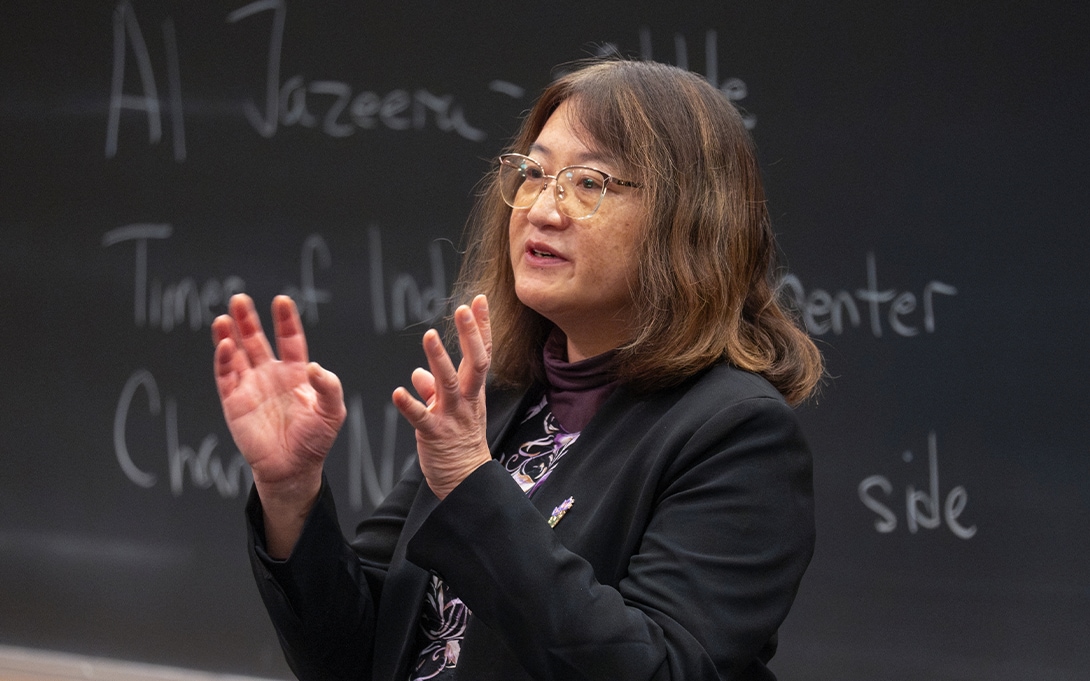
Since joining the Ford School in 1994, Ann Lin has taught "The Politics of Public Policy" in a variety of formats.
Other courses teach students how to develop and analyze public policy, but 510 focuses on the political processes and institutional structures that students need to understand to be successful decision makers."
Lin points out that 510 has evolved to reflect changes in both the Ford School and the wider political landscape. Sections organized around American politics, comparative politics, and foreign policy are standard, but faculty bring their own expertise and research interests to each version. "The course teaches enduring principles, but it also reflects current events," Lin notes.
In addition to Lin's course, this year, students could choose among:
American politics and the U.S. federal system (with emphasis on environmental policy), taught by Devin Judge-Lord;
Contemporary international security debates, led by Kamissa Camara; and
Foreign policy related to international security, taught by Megan Stewart.
Regardless of emphasis, the course equips students with essential skills—writing concise, persuasive memos and examining policy issues from multiple perspectives. A staple of the course is the policy roundtable, where students role play real-world stakeholders for and against a specific policy.
Ann Lin with students in PubPol 510. Photo credit: Charlotte Smith.
I am continually amazed at the creativity and initiative of our students. This semester, I have students examining an anti-fake news law in South Korea, book banning in the U.S., and Hungary's challenge to the EU's asylum system, among other issues."
"They've really dug into the issues to find appropriate leaders and organizations to represent," Lin says.
The course teaches students to identify when the rule of law, checks and balances, and government accountability are threatened—and to consider arguments for abandoning these safeguards in favor of decisive action in response to popular frustration, emergencies, or national security threats. It also encourages students to examine the conditions under which expertise, voice, political resistance, and even rebellion can undermine or reinforce autocratic rule.
"Policy professionals may not be able to change their governments, but they can choose to support and strengthen transparent and stable laws, voice and responsiveness, and accountable governance that works for the common good," Lin believes.
Student Norma Gay (MPP/MSW '27) notes that the course has helped her "develop a stronger analytical framework for identifying authoritarian practices, recognizing patterns across different country contexts, and critically examining the conditions that enable authoritarianism."
Students are eager to understand the political context of authoritarianism, Lin says. Two years ago, half her class was from outside the United States, including many with government service in Pakistan, Uzbekistan, and Kazakhstan. Their candor about their own work experiences allowed classmates to understand real-world tradeoffs. Lin says, "We're fortunate to have students who can teach each other—and their professors too."
Associate Professor of Public Policy; Director, Lieberthal-Rogel Center for Chinese Studies
Lin, a political scientist, studies how people experience policy implementation. Her current work examines racial and ethnic difference in the experience of the COVID-19 pandemic; bias reduction against Muslims; national security scapegoating of immigrant groups; conservatism among immigrants; and subnational labor migration policy.
Judge-Lord is a political scientist who studies interactions among interest groups, legislators, and bureaucracies. His current work focuses on how public pressure campaigns affect agency rulemaking, especially climate and environmental justice campaigns. His other research projects address legislator behavior and capacity, money in politics, lobbying, and private governance.
Dr. Kamissa Camara is a Professor of Practice in International Diplomacy at the University of Michigan. She is a scholar-practitioner with 20 years of experience in diplomacy, international affairs, democratic governance, and security across Africa. Before joining the University of Michigan, she held senior government positions in Mali and worked with international organizations in Washington, D.C., on democracy, governance, and elections.