
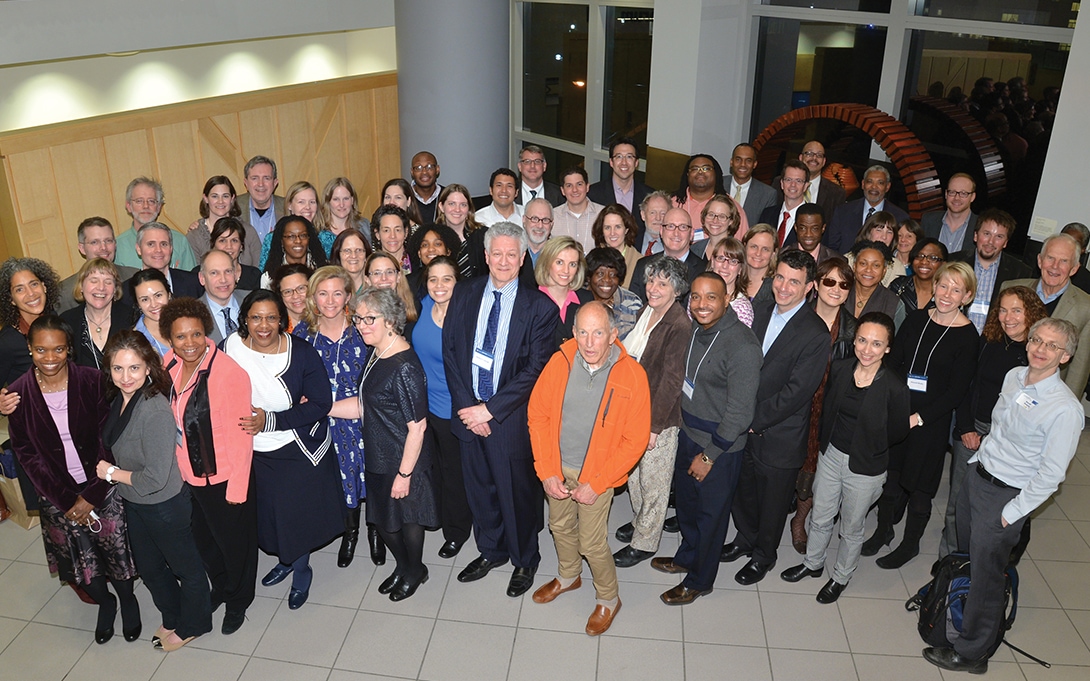
After decades as a renowned poverty scholar at U-M and president of the Russell Sage Foundation, Sheldon Danziger, the Henry J. Meyer Distinguished University Professor Emeritus of Public Policy, began his ‘third act’ last fall, taking the helm as president of the American Academy of Political and Social Science (AAPSS).
Founded in 1889, AAPSS is a nonprofit dedicated to promoting social science research to inform public policy—it publishes The Annals (a bimonthly journal), selects Fellows, and awards the Daniel Patrick Moynihan Prize honoring the late senator and recognizing social scientists, public officials, and civic leaders who carry the senator's legacy of advancing the public good.
Danziger is the 14th president in the Academy's history. In this role, he plans to emphasize the importance of social science research for addressing society's most pressing challenges.
At the Ford School, Danziger directed the National Poverty Center and founded the Research and Training Program on Poverty and Public Policy, a mentorship initiative supporting emerging scholars from groups underrepresented in the social sciences. "In the current environment, educating the next generation of policy researchers and practitioners is critically important," Danziger says.

"Unfortunately for the AAPSS and public policy faculty everywhere, policymakers don't seem interested in evidence-based public policies. Instead, they often neglect scientific evidence and cite disinformation—whether about climate change, the effects of vaccines, or the costs and benefits of Medicaid, or child tax credits," he says.
Quoting former Senator Daniel Moynihan, Danziger adds, "‘Everyone is entitled to their own opinions, but not their own facts.' Today, we seem to be in a world where everyone thinks they can make up the facts and make policy based on those."
As a policy researcher, Danziger has dedicated his career to studying how economic and policy changes shape trends in poverty and inequality.
"I came online in the 1970s as evidence-based public policies were becoming possible because computer capacity expanded," he says. "New methods were developed; new data sets became available. With each improvement in research methods, computer technology, and data, evidence-based public policy grew."
However, Danziger notes that in recent years, policymakers have ignored research. "Faculty are still conducting studies, and sometimes they influence public policy," he says. For example, the Biden Administration used evidence to increase income tax credits that reduced child poverty. But when Republicans took control of Congress after the 2022 midterm elections, those tax credits ended—and child poverty rose again. "That's evidence-based policy too," he explains, pointing to the measurable impact of the change.
Danziger sees AAPSS as a way to elevate the visibility of social science research. "I always thought academics were involved in a long game; I just didn't know how long that game had to be," he remarks.
In 2025, Ford School Dean Celeste Watkins-Hayes was named the AAPSS Sara McLanahan Fellow. In 2022, Earl Lewis, founding director of the U-M Center for Social Solutions, was recognized as the AAPSS Walter Lippmann Fellow. Danziger himself was named the John Kenneth Galbraith Fellow in 2010. Former Ford School Dean Rebecca Blank was honored as the Eleanor Roosevelt Fellow and won the 2015 Moynihan Prize.
By Sheri Hall
The Danziger effect
Over the years, Sheldon Danziger has influenced a generation of poverty scholars across disciplines. While co-leading U-M's National Poverty Center with Sandra Danziger, and as director of the Russell Sage Foundation, he championed and inspired hundreds of early-career scholars, including Ford School professors Pamela Herd, Ann Lin, Donald Moynihan, Natasha Pilkauskas, Kristin Seefeldt, Luke Shaefer, and Dean Celeste Watkins-Hayes.
The lasting effects of Sheldon's mentorship are reflected in the voices of his mentees:

"Sheldon's been a steadfast and compassionate source of support and counsel in every phase of my life, from dissertation writing to being a good father to advising the President. Together with Sandy, he built a community of researchers that continues to nurture one another while growing our knowledge base on how to improve the lives of low-income people in America."
Jordan Matsudaira (PhD '05)
Professor at American University, former deputy under secretary and chief economist at the U.S. Department of Education, and former chief economist of the Council of Economic Advisors

"Sheldon and Sandy have provided me with blueprints for what mentorship and leadership should look like within academia. When I find myself facing challenges—whether it's about running a study or an organization—I know that I have been trained by the best, and I can rely upon all the wisdom they've shared over the years. More important, though, is our friendship; they've created not just a community of scholars, but a real family of people who care about each other."
Kristin Seefeldt (MPP '96, PhD '10)
Director of U-M Poverty Solutions, assistant professor at U-M School of Social Work

"Sheldon has made fundamental contributions to our understanding of some of the most important issues facing this country today, and he has seeded and shaped a rich network of students, scholars, and friends. It is an honor to be a part of that network. He set a high standard for careful analysis, creative and original thinking, and clear writing, and made the time and the effort to invest in helping others meet those same high standards."
Maria Cancian (PhD '93)
Professor and former dean at the McCourt School of Public Policy, former senior advisor to the U.S. Secretary of Health and Human Services, and deputy assistant secretary for policy for the HHS Administration for Children and Families in the Obama administration

"Doing a postdoctoral fellowship under Sheldon's mentorship introduced me to engaged and rigorous policy research, gave me a lasting community of supportive and encouraging colleagues, and jump-started my career. Sheldon builds institutions that build people. And he does it with a big heart and incomparable swagger!"
Mary Pattillo
Harold Washington Professor of Sociology and Black Studies, Northwestern University
Related spring 2026 State & Hill stories
 Policy under autocracy
  Students build career-ready grant writing skills in Aid & Development Workshop series
  Wolverines put policy to work
 ← Read all stories in the spring 2026 edition State & Hill


