
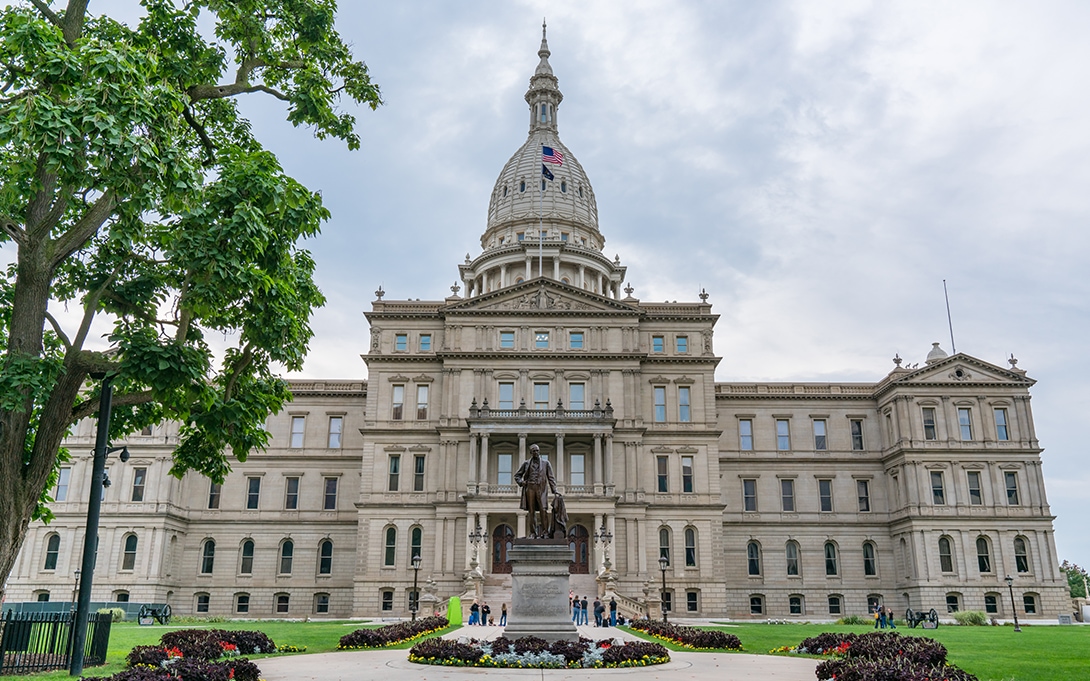
STPP’s post-graduate fellowship connects technical experts with Michigan lawmakers
Most people with advanced STEM degrees expect to work in laboratories, manufacturing facilities, or design studios. This year, the University of Michigan is on the hunt for scientists and technologists with doctoral degrees to advise the Michigan legislature.
Starting this summer, dedicated science and technology staff working for the state's nonpartisan Legislative Service Bureau (LSB) will advise lawmakers through the Michigan Science, Technology, and Public Policy (MiST) Fellowship program. MiST fellows will work on long-term projects and respond to urgent requests from legislators.
"We are looking for candidates who know how to learn technical topics quickly and make sense of them," says Mandy Gagel, the fellowship's project manager. "Michigan is surrounded by fresh water, so environmental science is important here. AI implementation and regulation, public health and biotech, climate, energy, and technology development are other really high-impact topics."
State lawmakers on both sides of the aisle say that the MiST program will help support better legislation in Michigan. And the idea of nonpartisan scientific advisors is gaining traction across the country. Twelve states have launched science and technology policy fellowship programs, and seven others, including Michigan, are working to establish such programs.
Ford School's Science, Technology, and Public Policy Program (STPP) will administer the MiST fellowship program, working in collaboration with the LSB and Michigan State University. An advisory council, including representatives from universities and organizations across the state, supports the program and will help to screen applicants.
"It is critically important for policymakers to rely on evidence-based analysis when making legislative decisions," says Merve Hickok, a member of the advisory council and president of the Center for AI & Digital Policy, an independent nonprofit research organization focused on ensuring that new technologies improve society.
At the state level, the partnership with research universities provides invaluable access to research and analysis—especially for rapidly evolving topics such as AI. ”
Merve Hickok, president, Center for AI & Digital Policy
The fellowship not only supports evidence-based policy, but also provides skill-building for the participating fellows, says Sheril Kirschenbaum, scientist and author at Michigan State University's Office of Research and Innovation. "I'm excited MiST will expand opportunities for young people to support evidence-based policy making in Michigan," she says.
Two fellows will be hired this year to serve one-year terms, with the option to renew for a second year. Moving forward, the program hopes to increase that number to four fellows.
By Sheri Hall
Related spring 2026 State & Hill stories
 CLOSUP turns 25
  This research is not partisan
  DMACS marks 10 years of listening to Detroiters for shared impact
 ← Read all stories in the spring 2026 edition State & Hill
