
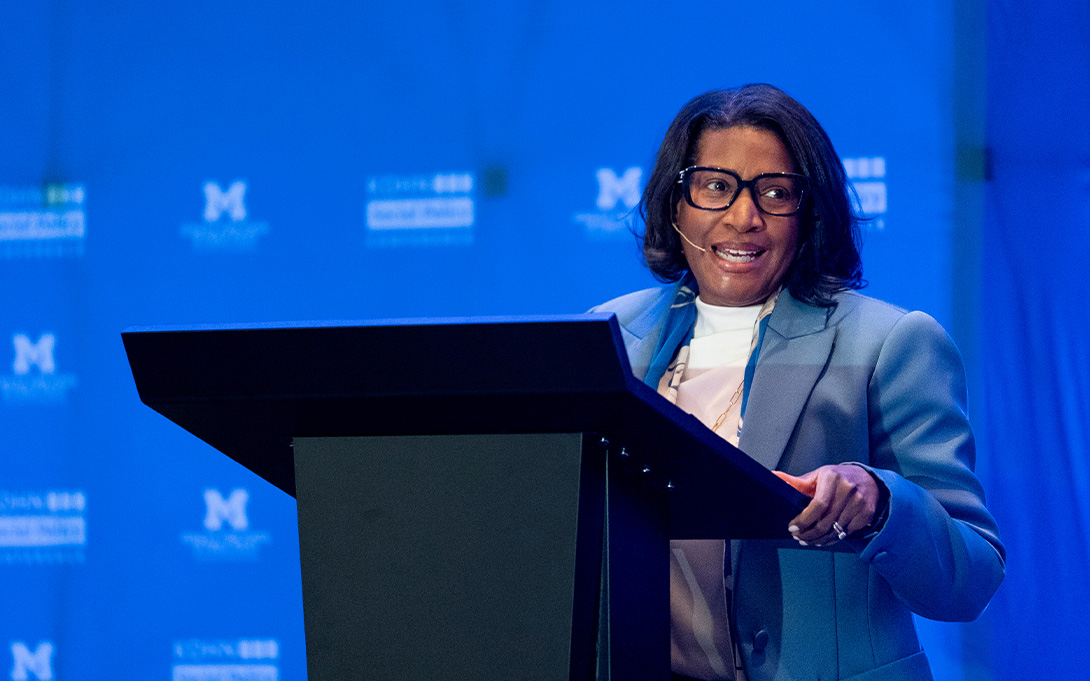
Dean Celeste Watkins-Hayes reflects on highlights from the Ford School's inaugural Kohn Social Policy Conference.
I grew up in the Metro Detroit area. Throughout much of my childhood, I visited my mother at her job as a home economics teacher at Catherine Ferguson Academy, a Detroit public school for pregnant and parenting teenage girls. I came to understand how education is connected to health, childcare, family support, and economic opportunity — and why effective public policy must be attentive to the complexity of people's lives.
I went on to have a scholarly career examining how people navigate public systems and how those systems can either expand opportunity or create additional barriers. Whether looking at women living with HIV or low-income families trying to make ends meet, my research demonstrates that policy design matters, but so does the way that policy is implemented and experienced.

Putting ideas into action
That understanding is what brought the Ford School to Detroit last Friday for the inaugural Kohn Social Policy Conference, convened around a deceptively simple question: What can a city do to promote human thriving?
The conference brought together scholars, policymakers, civic leaders, community partners, and Ford School students to consider that question through discussions of healthcare access, affordable housing, childhood poverty, and literacy. Each conversation addressed a distinct challenge, but the program reflected a larger reality: People do not experience public policy one system at a time.
Housing stability can shape a child's health and education continuity. Administrative burdens in public-benefit programs can disrupt access to care and deepen financial insecurity. Literacy can influence long-term opportunity, while family economic security affects nearly every dimension of well-being.
These connections are easy to describe. They are much harder to address.
Public institutions often divide complex challenges among separate agencies, funding streams, and areas of expertise. Universities can mirror that fragmentation through departments, disciplines, and research centers. Better policy requires us to connect knowledge across those boundaries and to bring academic expertise into direct conversation with the people responsible for designing, implementing, and navigating public systems.
That is where universities can make a distinctive contribution.
We can generate rigorous evidence, but evidence alone does not produce change. Research must be translated, tested against implementation realities, and informed by the knowledge of policymakers, practitioners, and communities. Universities are well positioned to create spaces where people can examine tradeoffs honestly, learn from one another, and identify practical paths forward.

Creating space for connections
The Kohn Social Policy Conference was designed to create that kind of exchange. Its purpose was not to suggest that a single day could resolve the complex challenges before us. Rather, it was to connect perspectives that are too often separated and ask what each can contribute to public problem-solving.
The featured conversation between Nicole Sherard-Freeman and Luke Shaefer was designed to reflect that purpose. Sherard-Freeman's leadership has connected philanthropy, public service, and economic opportunity across Detroit and southeast Michigan. Shaefer, a Ford School Kohn Professor currently serving as the city of Detroit's chief executive of health, human services, and poverty solutions, brings research and policy implementation into direct conversation. Their respective roles illustrate why strengthening public systems requires collaboration across sectors and with the communities those systems serve.
Meaningful engagement requires more than bringing university expertise into a community. It requires listening, building trust, and developing partnerships rooted in reciprocal learning. Communities should not be treated simply as settings for research, but as partners in shaping questions and identifying solutions.
Giving back to communities
This work reflects the broader promise of the Look to Michigan strategic vision: that the university's excellence should be measured not only by the knowledge we produce, but also by how effectively we put that knowledge into service for people and communities. At the Ford School, that means preparing students for lives of public purpose, conducting research that informs decisions, and creating opportunities for scholars and public leaders to learn from one another.
I am deeply grateful to Hal and Carol Kohn, whose generosity through the Kohn Charitable Trust established this conference as a biennial convening. Their investment gives the Ford School a lasting platform for examining emerging social policy challenges and strengthening relationships across research, policy, practice, and public service.
The conference concluded, but the work it represents continues. Our responsibility is to carry its questions and connections forward — to sustain the relationships formed, pursue the ideas raised, and help promising approaches move toward action.
A university cannot solve public challenges alone. But we can help bridge expertise and experience so that better solutions emerge. That is one important way we can help communities thrive.
