
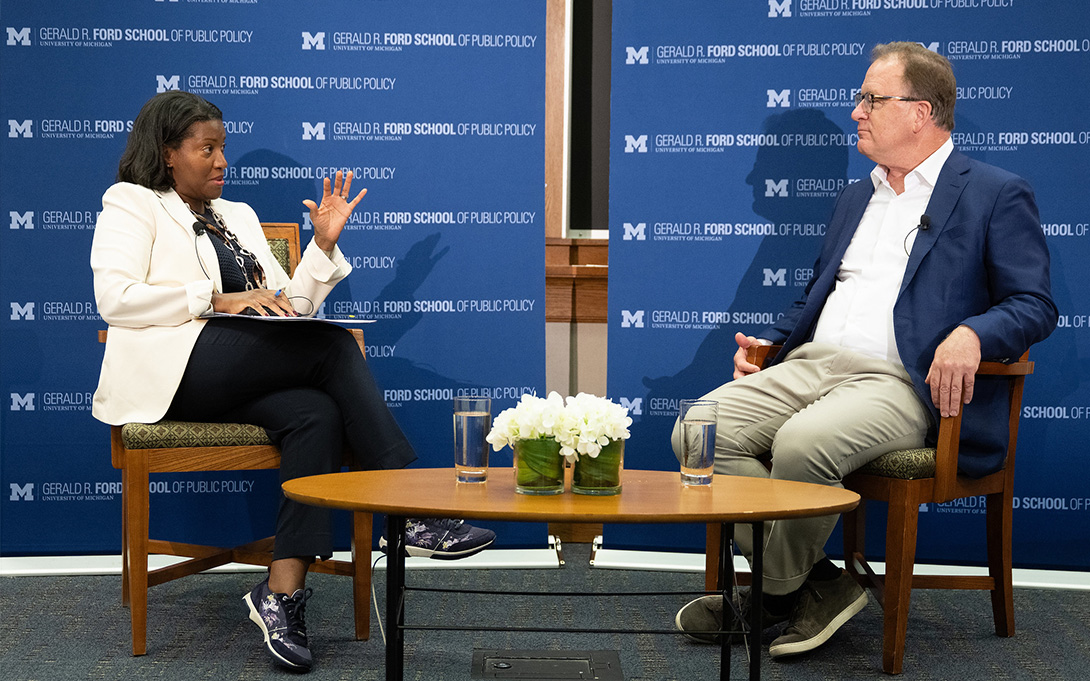
On a political spectrum that is becoming increasingly more divided, American Enterprise Institute president Robert Doar is optimistic that his center-right think tank is forging a path through the fray.
“I think we're dividing into three countries: extreme right, extreme left and the broad middle. 70% of Americans just want us to work on issues and solve problems for them. That's who we are. That's what we stand for,” he said at “Whither the Center-Right?” a recent conversation with Ford School Dean Celeste Watkins-Hayes.
Doar began the event with a few opening remarks, starting by sharing his own background. Doar’s upbringing in Brooklyn inspired him to launch a career focused on “advancing policies that would do a better job of helping people move up economically.”
AEI has a unique position in politics as a leading think tank, because it has preserved its independence. “We’re always non-partisan, we’re always civil, we’re always empirical, and we’re always supporting certain principles about free enterprise, limited government, a strong American role in the world…and we’re not on anybody’s team,” Doar said. He emphasized that there is certainly outside pressure to get think tanks like his to fall in line with a party agenda, but that calling shots as they see them, regardless of party lines, is how AEI continues its excellence.
AEI has five main priorities. First, AEI is committed to increasing viewpoint diversity and freedom of dialogue at universities. Second, AEI supports "fiscally prudent, pro-growth tax policy” and commitments to allies. Here, Doar championed AEI’s Critical Threats Projects, which have been a widely-used source for daily updates on conflict in Ukraine. Third, AEI is involved in celebrating the values of the nation’s founding and the principles of the Constitution. Fourth, AEI focuses on K-12 education, where they promote parents’ ability to choose educational paths for their children. Finally, AEI supports free trade and opposes harmful tariffs.
Doar said that certain elements of the rise of national populism resulted as a direct response to the traditional values held by organizations like AEI. AEI scholars have responded to those criticisms by reconsidering how they think about these topics. Doar gave four of them: immigration, Social Security reform, trade with China, and foreign wars.
Watkins-Hayes wondered if the tools AEI uses—evidence-based analysis and teasing out and appreciating nuance—are appropriate for the larger policy debate, which now focuses much more on dominating attention and a winner-take-all approach. Doar pushed back on the suggestion, expressing optimism that opposing policymakers are still working together behind closed doors on compromises. At the same time, he indicated a willingness to change with the times: “You do have to play in the game. I encourage my scholars to appear in all the venues,” such as engaging in live debates and social media conversations.
This continued to be an overarching theme in the conversation—what kind of policy tool is the right one for today? Watkins-Hayes characterized it as deciding between a scalpel and a sledgehammer. Doar noted that each tool has different strengths, but the sledgehammer is not as useful as people think, saying, “You can't always make your decision about what happens in public policy by [listening to] the loudest voice in the newspaper or on television . . . We do have a line I love to use, which is, ‘The best way to observe the Trump administration is with the sound off.’ Don't pay attention to what he says. Pay attention to what ultimately gets done.” To Doar, the scalpel—evidence-based reasoning, thorough dealmaking—is the tool that really does the work at AEI.
Watkins-Hayes elaborated on that idea, noting that many of the students she’s spoken to no longer feel that Washington is the most attractive option, and she asked Doar to make a case for his think tank. He conceded that the work is challenging, but noted that AEI is able to have a significant impact on getting things done. “We've been engaged in the discussions with the president over Ukraine, and it's been extremely frustrating. But some of our scholars would say that when he does the right thing, it's because he talked to some of us, and when he's done the wrong thing, it's because he ignored us.” He also shared that following Liberation Day, AEI scholars demonstrated that the math behind tariff calculations was done wrong. The White House didn’t officially acknowledge the mistake, but it was corrected.
The conversation also touched on the role of universities within the policymaking environment. Here, Watkins-Hayes and Doar found some areas where they respectfully disagreed. Doar expressed criticism of the elite educational institutions for being too slow to admit the areas where they have failed their students, and shared that he and AEI feel that the federal government is within its rights to hold universities accountable for their actions. Watkins-Hayes pushed back, saying that the nuance Doar described is not really there in the day-to-day of higher education. However, they seemed to agree that both higher ed and the federal government have work to do in making nuance in this debate more possible.
Watkins-Hayes closed her conversation by prompting Doar to identify what is wrong with Congress—that the sledgehammer always seems to be preferred to the scalpel. Doar observed, “Congress has lost its ability to reason together across party lines. Decisions are only being made by the majority and the speaker, and that's a real tragedy.” He stated that the only way to fix that is to get the parties back together and talking again, but how we do that is hard to know.
The event closed with several minutes of Doar responding to questions from a panel of three Ford School faculty: adjunct professor Rusty Hills, research associate professor Mara Ostfeld, and Hermann and Amalie Kohn Professor of Social Justice and Social Policy Luke Shaefer. The back-and-forth included discussion on Trumpism proliferating after 2028, the shrinking of the federal workforce, and the role of DEI in higher education.


