
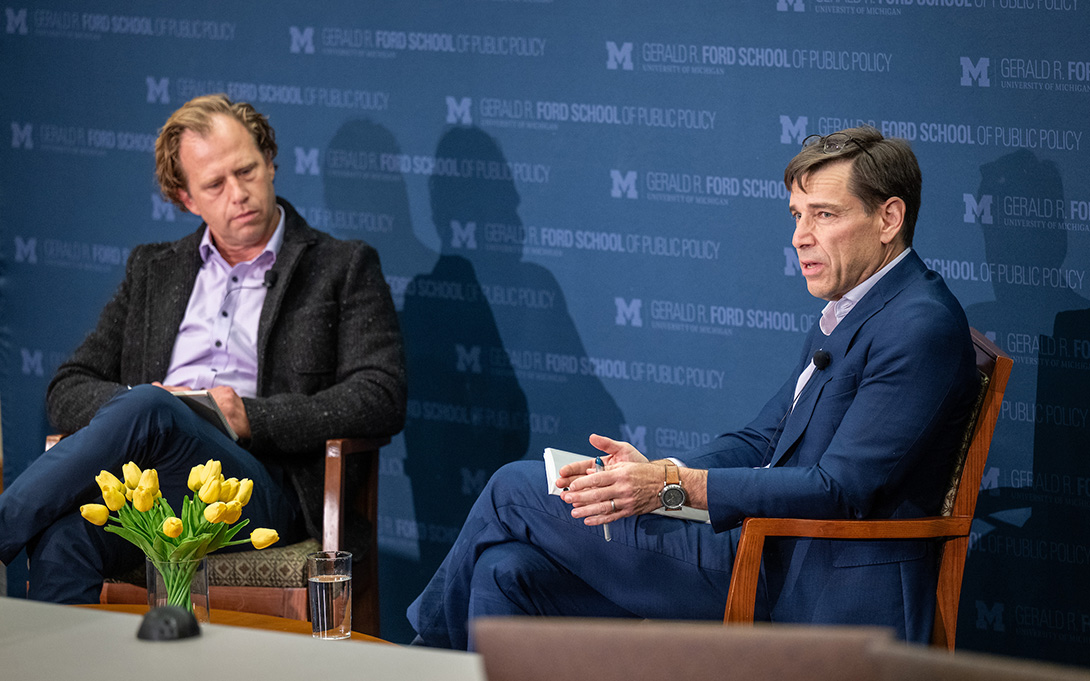
Transforming the government into a proactive, productive institution from its current reactive and constrained state is the goal of Ted Gayer's proposed abundance agenda. Gayer, President of the Niskanen Center, joined the Ford School's Justin Wolfers for a discussion on Abundance and the Future of American Institutions. He noted the need to be ahead of the curve in providing a well-resourced government, encouraged more across-the-aisle conversations to achieve the abundance agenda, and asserted that policies focused on abundance will bring economic prosperity.
You can see the entire discussion here.
Abundance is about "building and providing more of the goods and services that Americans need," Gayer said. An important aspect of the Niskanen Center's mission is refining and improving failing institutions, rather than tearing them down. "We want to improve liberal democratic institutions through the values of an open society. We do so roughly in three ways. One is we try to diagnose what ails our institutions. Two, we try to defend those institutions against those who want to tear them down. And three, we try to present an affirmative vision of what well-functioning governance looks like." He argued that it is essential to recognize why institutions are failing and what can be done to restore their functioning capacity, rather than letting them rot away.
Gayer's talk was a part of year-long activity around the Ford School's first-ever all-school read, Abundance, by Ezra Klein and Derek Thompson.
Beyond revising and critiquing institutions, Gayer asserted the need for proactive solutions. He claimed that it's crucial to notice where improvements are needed, but also to move forward and be proactive in establishing an "effective, capable government."
Gayer emphasized how abundance and a strong state capacity are necessary components of a prosperous economy: "A strong state is essential to sustaining a dynamic economy. The insight is that markets and government are not adversaries but complements… Abundance is about getting the government to stop doing the things that constrain supply. But it's also about a government that can make things happen. It's about having a more capable state that can deliver broad prosperity." When the government exhibits strong state capacity and can provide goods and services, market production increases, stimulating economic growth. "Almost everything associated with abundance on the supply side is productivity-enhancing," he said.
One matter Gayer talked passionately about was the need for more humanity in policy conversations. Showing concern that much of the policy debate has lost its people-forward focus, he commented on the increase of "despair and outrage" in political conversations. He asserted that, "Neither are good for your soul, nor are they a compelling strategy. Nor do I think they are politically persuasive." He said the abundance agenda denounces despair and outrage following, "A broader commitment to the principles of liberalism, principles of agency, of constructive engagement, of learning, and of hope and progress, they offer a way to channel our energy into repairing our institutions so they can improve Americans' lives… It reminds us that the answer to our challenges isn't to abandon our institutions, but to renew them, to make them work for the common good."
As part of bringing humanity into the policy-making process, he urged the audience to engage in conversation with individuals across the political spectrum on a personal level. "The way to really engage people with different views is to kind of just at a sheer level of humanity. They have a story to tell about whatever topic you're interested in. It's a little bit about their kids and their family and their background and where they came from and all the rest… That's my advice, is to wherever, whatever the noise is over there, there is a story underneath there, and there's a humanity underneath there." Gayer asserted that every political view and belief has a story behind it, and every story has a level of humanity that needs to be brought back into politics.
Encouraging more human-focused conversations, he tasked the students: "What I think universities were built to value, which is what we call an open society, which is a leaning in towards engagement, towards learning. This country needs more space for those kinds of conversations."
Click here to watch the discussion.
