
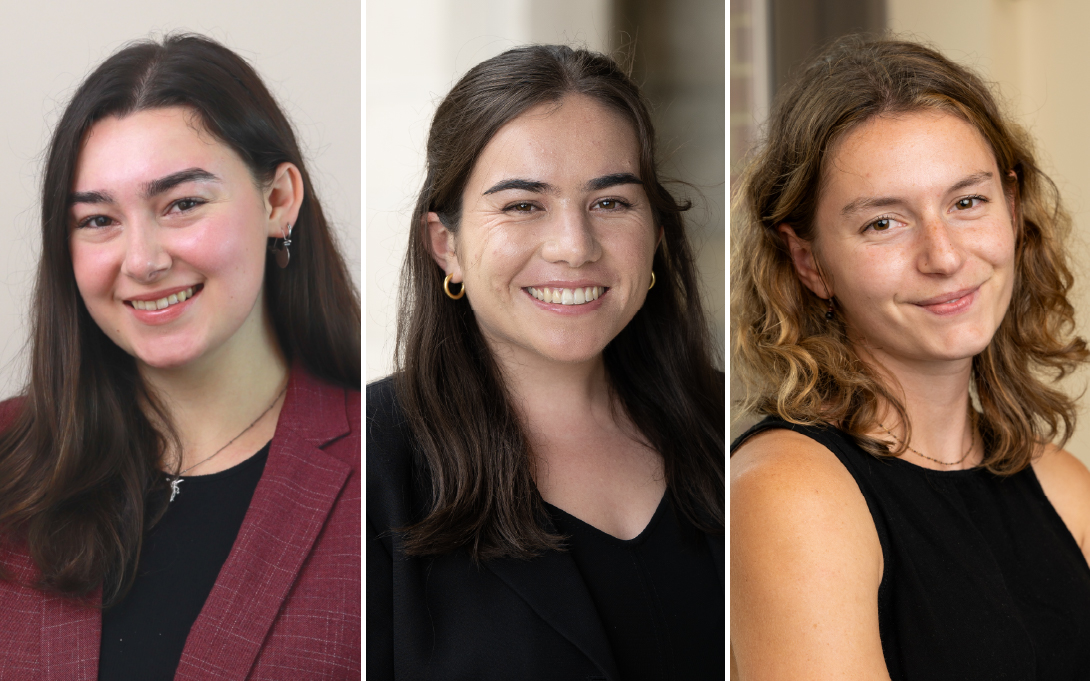
Over a snowy weekend in January, Anneke Craig (MPP ‘27), Madeleine Gibbons-Shapiro (MPP ‘27), and Emma Schwartz (MPP ‘27) traveled to Washington, D.C. for the annual U.S. Conference of the Mayors (USCM) as part of the David Bohnett Foundation Leadership and Public Service Fellowship. The Bohnett Foundation funds graduate students at the Ford School to serve in the Detroit mayor's office for a summer internship. As part of the fellowship, the Foundation invites fellows to the USCM, a semi-annual meeting of all mayors in the country, to build community with and learn from each other. Craig, Gibbons-Shapiro, and Schwartz recount their experience at the 2026 USCM.
Disaster Response Panel Reflection: Anneke Craig
I attended a session entitled Generosity and Leadership in Times of Crisis. The panelists discussed their experiences leading their communities in moments of profound crisis, and through the recovery process afterward. Mayor Ester Manheimer of Asheville, North Carolina, shared how the devastating impacts of Hurricane Helene changed her approach to public engagement.
In September 2024, Hurricane Helene left Asheville without power and with devastating damage to local roads, creating major obstacles for repair crews. Typical communications channels became inaccessible, forcing Mayor Manheimer to reconsider how best to update and reassure her constituents. With the help of her staff (who slept on the floors of the station each night just to keep it running), she delivered twice-daily radio broadcasts to the larger Asheville community. She also oversaw the collection of drone footage to help residents see the scope of the damage and watch the repairs in real time. These strategies helped her rebuild a sense of trust and teamwork with her constituents that was just as crucial to the community's recovery as road repair.
Some dismiss local government as an institution that lacks significant changemaking power, and argue that policymakers should prioritize state and federal leadership in times of crisis. I wholeheartedly disagree. Local government is the level of government at which we build and sustain community, giving local officials like Mayor Manheimer a unique perspective on issues that are otherwise so politically polarized that their human context is easily lost. In the wake of Helene, Mayor Manheimer brought those perspectives to the state government, serving as a founding member and co-chair of the Governor's Advisory Committee on Western North Carolina Recovery. The bipartisan group is dedicated to supporting communities affected by Helene and ensuring their long-term revitalization.
Panelists were asked to reflect on what happens once the initial urgency of a crisis has faded: How do you preserve the trust you build with constituents in emergencies? How do you ensure that the crisis is remembered, so that steps can be taken to prevent it from happening again? Mayor Manheimer said that celebrating milestones is key. Under her leadership, Asheville marked Helene's one-year anniversary with a series of remembrance events, including film screenings, performances, and a local day of service. If local governments can bring a unique human perspective to challenging policy issues, it can also help us share the joy to be found in overcoming them together.
Immigration Panel Reflection: Madeleine Gibbons-Shapiro
During the conference, Mayor Jacob Frey of Minneapolis, Minnesota, made a special appearance. Following a standing ovation as he entered the stage, Frey delivered a strong message to his fellow mayors: though they may have run for office with a desire to fix potholes for their towns, they are now faced with an imperative to stand up to the federal government and defend their constituents against ICE invasions and a pressing threat to democracy. Hearing Mayor Frey address the mayors as a united front—and witnessing the clear reverence and respect the group held for his leadership in a time of national crisis—gave me some relief from a swirl of terrifying headlines and reaffirmed the obligation local leaders have to fight for immigrant rights.
In the break-out session that followed Mayor Frey's speech, entitled How Cities are Responding to the Current Immigration Climate, mayors from small towns in Texas and New Jersey asked Mayor Keith Wilson of Portland, Oregon how to best balance protecting residents from ICE while avoiding retaliation for speaking out in defense of their communities. Mayor Adena Ishii of Berkeley, California gave an impassioned plea for all mayors to do all they could to support their constituents, comparing her family's experience in the Japanese internment camps to the Trump administration's treatment of immigrants today. The energy in the room rippled from fear to collective power, and I was particularly struck by the way mayors across different political parties, geographic regions, and city sizes came together to learn from each other and to create a unified response to the threats they faced. I found myself moved by the strength the mayors exuded as a group and felt invigorated to begin my career in local government with Mayor Mary Sheffield's administration in Detroit this summer.
Data Center Panel Reflection: Emma Schwartz
I squeezed into a crowded room of municipal staff, press, and other attendees for a panel on data centers in cities. The session's popularity was not surprising. For local municipalities, data centers are an economic opportunity but raise concerns about environmental, health, and cost burdens for communities. Having researched renewable energy development for my politics of public policy course last semester, I was curious about how mayors would frame the issue to address these costs and benefits.
As the panel began, it was clear that the mayors in the room had different approaches to handling data centers. Some mayors emphasized the economic potential of data centers as a revenue generator for city budgets, and discussed investment in closed-loop cooling systems that used less water. Others, citing environmental, cost, and health concerns, took a more cautious approach. Mayor Satya Rhodes-Conway of Madison, Wisconsin, shared the city's one-year moratorium on large-scale centers, intended to give city planners time to develop an informed regulatory framework. I was struck by the applause Mayor Abdullah Hammoud of Dearborn received after voicing concerns of his residents, corroborated by research, that data centers increase utility costs. Mayors were concerned about the consequences of developing data centers on farmland, and discussed opportunities for working with developers to repurpose brownfields as an alternative.
The panel was a strong reminder that local governments are on the frontlines of navigating complex issues that span multiple levels of government and involve competing stakeholder interests. In the mayors' comments, I noticed a tension between resident concerns, economic opportunity, and information deficits. While approaches differed, I was inspired to see how mayors used the panel as an opportunity to share resources and work together to navigate an uncertain policy landscape.
As an aspiring local government policymaker, I was heartened to witness cross-municipality collaboration and strong commitment from mayors to do right by their electorate on several pressing issues.
Anneke Craig (MPP ‘27) is a first year MPP student with interests in local government and social policy. At Ford, she hopes to pursue community-based policy research methodologies that elevate marginalized voices, expand local democratic decision-making, and help communities thrive.
Madeleine Gibbons-Shapiro (MPP ‘27) is a first-year MPP student with policy interests in social and health policy. She hopes to pursue a career in local government examining the intersections of healthcare quality, disability advocacy, and housing justice.
Emma Schwartz (MPP ‘27) is a first year MPP student. With a background in policy research and community engagement, she is interested in new ways to collect and interpret data to improve public systems for the people who use them. She plans to work in local government and is interested in housing, economic development, and justice system reform.